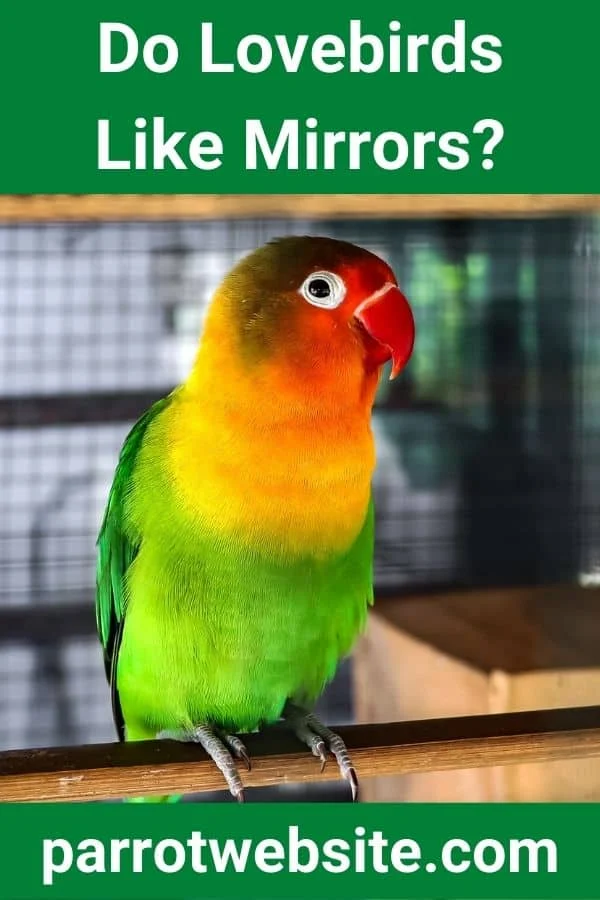
For many bird owners, the sight of a pet interacting with its own reflection—tilting its head, chirping at the glass, or performing a rhythmic dance—can seem like an endearing display of curiosity. However, for those who keep lovebirds, this seemingly innocent behavior often masks a deeper, more complex psychological struggle. As lovebird owners strive to provide enriching environments for their feathered companions, the question of whether to introduce a mirror into the cage has become a frequent topic of debate.
The consensus among avian behaviorists and experienced breeders is clear: while mirrors may seem like a source of entertainment, they are often a recipe for anxiety, frustration, and behavioral regression.
Main Facts: The Psychology of the Reflection
To understand why mirrors are problematic, one must first understand the social nature of the lovebird (Agapornis). Named for their strong, long-term pair bonds, these small parrots are inherently communal. In the wild, they are rarely seen alone, spending the majority of their lives in close proximity to a mate or a small flock.
When a lovebird encounters a high-definition, true-to-life mirror, it does not see a reflection; it sees an intruder or a potential mate. Because the bird cannot distinguish between its own image and another living creature, it begins to treat the reflection as a real individual.
The primary issues arising from this misperception include:
- The "Unrequited Bond": The lovebird attempts to interact with the reflection—grooming it, feeding it, or courting it. When the reflection fails to respond, the bird becomes confused.
- Resource Guarding: The bird may attempt to "defend" its territory against the intruder, leading to territorial aggression and unnecessary stress.
- Psychological Fixation: Over time, the bird may develop an obsessive-compulsive attachment to the mirror, ignoring its actual human owners or its avian partner in favor of the silent, unresponsive reflection.
A Chronology of Avian Enrichment Trends
The inclusion of mirrors in bird cages was not always viewed with such skepticism. Historically, the practice originated in the mid-20th century as a "quick fix" for owners of single, solitary parrots.
- The 1960s–1980s: During this era, the pet industry heavily promoted mirrors as a cure for loneliness. The logic was simple: if a parrot was solitary, a mirror would provide the visual illusion of a companion, theoretically alleviating the boredom of cage life.
- The 1990s–2000s: As the field of avian veterinary medicine expanded, researchers began to document the downsides of this practice. Veterinarians started reporting cases of "mirror-induced hormonal frustration" and chronic stress in small psittacines.
- Present Day: Modern aviculture emphasizes "environmental enrichment" that focuses on cognitive challenge rather than visual illusions. The current standard of care discourages mirrors in favor of puzzle toys, foraging opportunities, and authentic social interaction.
Supporting Data: The Science of Self-Recognition
One of the most persistent questions in the debate is whether lovebirds are "self-aware." In the scientific community, the "Mirror Test" (or Gallup test) is the gold standard for testing self-awareness in animals.
The Mirror Test and Avian Intelligence
While some species, such as magpies and certain larger parrots like the African Grey, have shown signs of recognizing their own reflections, there is currently no peer-reviewed, empirical evidence that suggests lovebirds possess this level of cognitive sophistication.
Because lovebirds do not pass the self-recognition test, they are unable to conceptualize that the movement in the glass is a reflection of their own body. Consequently, every movement made by the bird is interpreted as a mirrored action by a "rival" or a "partner." This leads to a loop of constant social signaling that never results in a resolution, leaving the bird in a state of permanent arousal and physiological stress.
Official Perspectives: The Veterinary Stance
While there is a lack of large-scale, peer-reviewed clinical studies on the specific impact of mirrors on lovebirds, the veterinary community has reached a strong consensus based on observational evidence.
The Problem of Hormonal Overdrive
Avian veterinarians often warn that mirrors act as "hormonal triggers." By stimulating the bird into a constant state of courting or defense, the mirror keeps the bird’s reproductive system in an active state. For a pet bird, chronic hormonal stimulation can lead to:
- Egg Binding: In females, the stress of constant breeding behavior can lead to reproductive complications.
- Feather Plucking: A common sign of frustration and displaced energy, often seen in birds that are denied a true social connection.
- Aggression: The bird may redirect its frustration toward its human handlers, becoming nippy or defensive.
Dr. Elena Vance, an avian specialist, notes: "When we treat a bird for self-mutilation or severe anxiety, one of the first questions we ask the owner is whether there is a mirror in the cage. Removing the mirror is often the first step toward a noticeable improvement in the bird’s temperament."
Implications: Building a Better Environment
If mirrors are off the table, how can an owner effectively occupy a high-energy lovebird? The goal of enrichment should be to stimulate the bird’s natural behaviors—foraging, chewing, climbing, and problem-solving—without inducing psychological distress.
Recommended Alternatives for Mental Stimulation
- Foraging Toys: These mimic the natural search for food. By hiding treats inside cardboard tubes or puzzle boxes, you force the bird to use its intelligence to earn its meal.
- Tactile Destruction: Lovebirds possess powerful beaks meant for chewing wood and stripping bark. Providing soft, bird-safe wood blocks or "shredding" toys made from dye-free paper allows them to fulfill this biological urge.
- Physical Challenges: Swings, boings (flexible ropes), and ladders encourage movement. A bird that is physically active is generally a bird that is less prone to neurotic behaviors.
- Auditory Stimulation: Bells or toys that produce a chime when manipulated provide "feedback" that is satisfying to the bird without causing the social confusion associated with mirrors.
The Role of Distorted Reflections
Some owners argue that "distorted" or "fun-house" mirrors are safer. While these are less likely to be mistaken for a real bird, they still offer little in the way of actual cognitive development. If you choose to experiment with a distorted surface, it must be done under strict supervision. If the bird displays signs of head-bobbing, regurgitation (an attempt to feed the reflection), or obsessive pacing, the item should be removed immediately.
Conclusion: The Path Forward
The lovebird is a bird defined by its social capacity. It is a creature that thrives on the nuances of body language, vocalization, and physical contact with a member of its own species. A mirror, regardless of its design, is a static, sterile object that cannot provide these essential inputs.
The implication for owners is simple: rather than looking for a technological or artificial shortcut to keep your bird occupied, invest that energy into genuine interaction. Whether it is training your bird to perform simple tricks, spending time in the same room while you work, or—ideally—providing your lovebird with a bonded companion, the most effective "toy" you can offer is your presence.
By moving away from mirrors, you are not just removing a potential stressor; you are creating the space for your lovebird to develop a healthier, more balanced, and ultimately more rewarding life in your home. The next time you find yourself at the pet store aisle, walk past the reflective surfaces. Your bird’s mental health is worth far more than the temporary distraction of a glass-bound illusion.