In the competitive world of professional dog grooming, few styles are as iconic—or as challenging to perfect—as the classic Bichon Frise silhouette. Renowned for their cheerful dispositions and cloud-like coats, Bichons require a specialized approach that balances breed standards with modern, manageable aesthetics.
Blake Hernandez, a celebrated industry leader and 2020 Barkleigh Honors Seminar Speaker of the Year, argues that the "short and sassy" Bichon modification is the ultimate crowd-pleaser. Whether you are working with a purebred show dog or a curly-coated mixed breed, this versatile style prioritizes a rounded, adorable facial structure paired with a body trim that is practical for everyday life. In this comprehensive guide, we explore the methodology behind achieving this professional finish.
The Philosophy of the Modern Groom
The "short and sassy" trim is more than just a style; it is a solution for the modern pet owner. As clients increasingly seek styles that minimize daily maintenance without sacrificing the quintessential "fluffy" look, groomers must adapt.
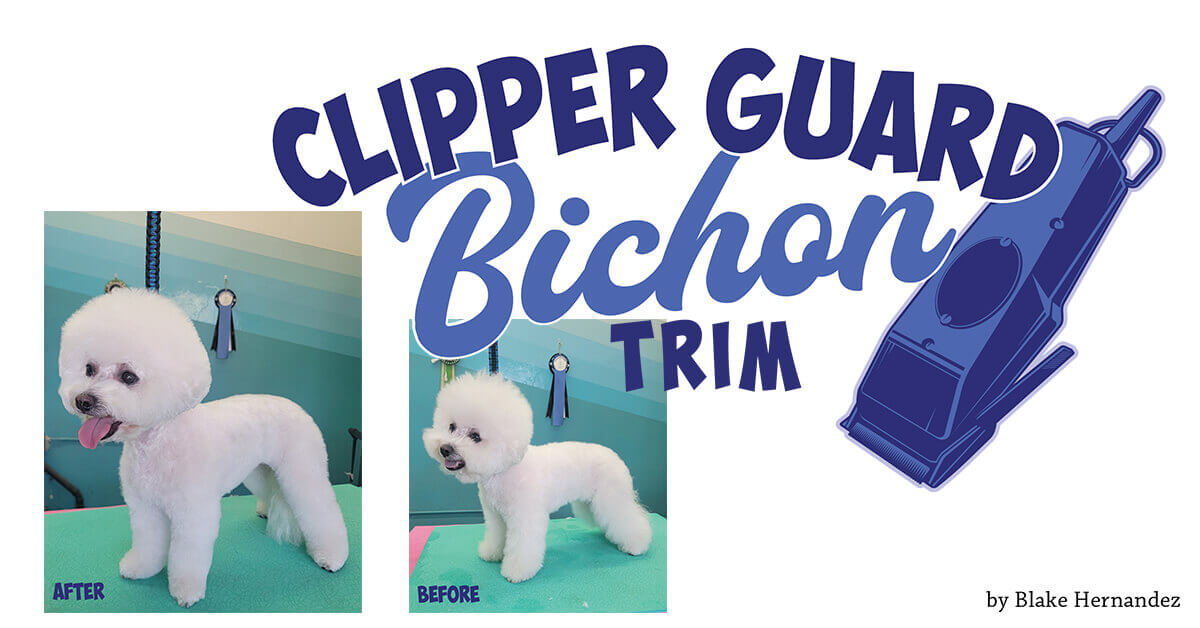
"Before I had any high-end Bichons to practice on, I had tons of curly mixed breeds," Hernandez notes. "I would practice and practice on all sorts of mixes, as long as I could make them fluffy. This trim works beautifully on mixed breeds, providing a polished look that remains manageable."
The primary goal of this style is to create a seamless transition from the body to the head, ensuring the dog appears balanced from every angle. By utilizing specific guard comb lengths and precise scissoring techniques, a groomer can turn an unruly coat into a sophisticated, rounded masterpiece.
A Step-by-Step Chronology of the Trim
Achieving the perfect look requires a methodical approach. Hernandez outlines the process into fourteen distinct steps, moving from the top line down to the final facial detailing.

Phase 1: Establishing the Body Line
The process begins at the top line. To achieve a consistent look, start where the shoulder blades meet and clip to the desired length. For clients who maintain a six-to-eight-week grooming cycle, Hernandez recommends a 1/2" guard comb over a #30 blade. This provides enough length to maintain the signature fluff while preventing matting.
Once the top line is set, carry that same length around the ribs and underneath the brisket. This creates a uniform body foundation.
Phase 2: Refining the Neck and Rear
To create an elegant neck, switch to a #5F blade in reverse. Starting at the dog’s Adam’s apple, move upward toward the throat latch. This technique clears the area and provides a crisp line that will later serve as the anchor for the head shape.

Moving to the rear, the goal is to accentuate the dog’s natural angulation. Use a shorter blade (typically 1/4") and clip from the pin bone down to the area behind the knee. This creates a "tucking" effect that makes the rear legs appear more defined. To balance this, leave the legs longer. Hernandez utilizes a 1" guard comb around the rear and front legs, providing a soft, rounded aesthetic that contrasts with the shorter body.
Phase 3: Finishing the Feet and Tail
Feet should be kept rounded and tight. Use shears to scissor around the pads, shaping a tight bevel that prevents the dog from tracking in dirt while maintaining the rounded "Bichon foot" look. For the tail, hold it over the back and trim away any stray hairs that draw the eye away from the center of the dog, ensuring a clean, focused silhouette.
Phase 4: Sculpting the Face
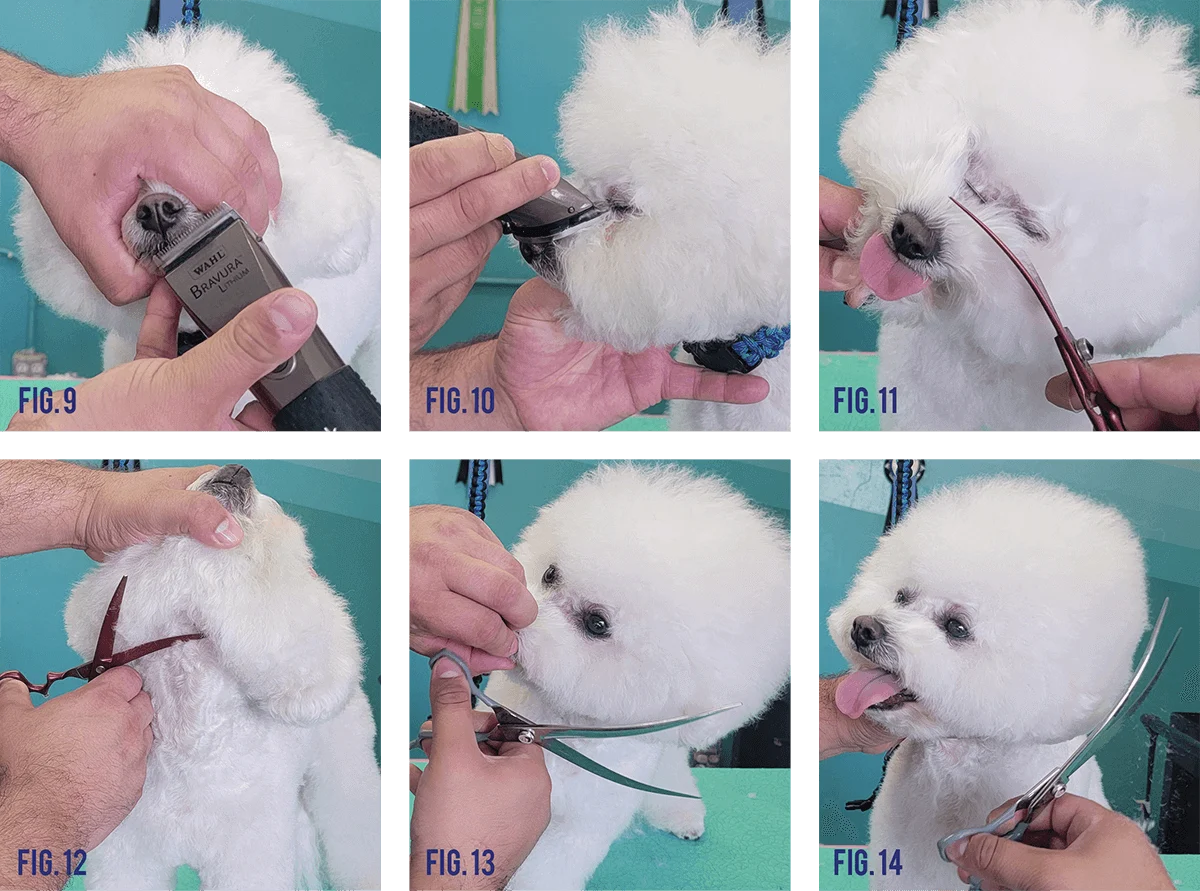
The face is where the "sassy" element truly comes to life. Begin by shaving the top lip and carefully removing one or two lines of hair on the bottom lip, just beneath the nose. This cleans up the muzzle area and prepares it for a symmetrical shape.

Next, use a #10 blade to clip the stop. This small detail is crucial, as it exposes the eyes and makes them "pop." Comb the remaining facial hair forward toward the eyes and trim at a 45-degree angle. This creates the "visor" effect characteristic of the breed. Finally, use curved scissors to separate the head from the body at the throat latch, then shape a tight lip and round out toward the ears. At eye level, turn the scissors upward to create a perfect circle, repeating the process on both sides to ensure total symmetry.
Supporting Data and Technical Specifications
For professional groomers, the choice of equipment is paramount. The following technical breakdown summarizes the tools used in this specific modification:
| Area | Tool/Method | Goal |
|---|---|---|
| Top Line | 1/2" Guard Comb (#30 blade) | Manageable length/Smooth finish |
| Throat Latch | #5F Blade (Reverse) | Define head/neck junction |
| Rear Angulation | 1/4" Blade | Define hindquarters |
| Legs | 1" Guard Comb | Balance and fluff |
| Stop | #10 Blade | Facial expression/Eye visibility |
These specifications are tailored for dogs on a six-to-eight-week maintenance schedule. Deviating from these lengths may require more frequent maintenance or result in a coat that is prone to tangling.

Professional Insights: An Official Perspective
Blake Hernandez, who manages a successful salon in San Diego, CA, is widely regarded as an expert in his field. Beyond his technical prowess, he is known for his infectious energy and commitment to education. As a co-creator of Groomsource and a featured professional in the Netflix documentary series DOGS, Hernandez advocates for a "people-first" approach to grooming.
"My philosophy is that grooming should be approachable," Hernandez explains. "When we make these styles accessible to the average pet owner, we increase the likelihood that they will maintain the dog’s health between visits."
His work is frequently cited by industry professionals who struggle with the "Bichon head," often the most difficult aspect of the groom. By emphasizing the use of curved scissors and consistent, circular motions, Hernandez has helped demystify the art of the round head, turning a complex task into a repeatable system.

Implications for the Grooming Industry
The trend toward "manageable fluff" has significant implications for the professional grooming industry. As dog ownership continues to rise, the demand for high-quality, practical grooming services is at an all-time high.
- Client Retention: By providing a "six-to-eight-week" style that looks just as good at week seven as it does at week two, groomers build trust and loyalty with their clients.
- Standardization of Education: Techniques like those presented by Hernandez allow salons to standardize their output. When every stylist in a shop follows the same methodology, the salon builds a reputation for consistent quality.
- Versatility: The ability to apply "Bichon" techniques to mixed breeds—often referred to as "Doodles" or "poo-mixes"—widens the groomer’s market share. Understanding how to manage curly, inconsistent textures is a critical skill for any modern stylist.
Final Considerations
The "short and sassy" Bichon trim is a testament to the fact that style does not have to come at the expense of function. By mastering these fourteen steps, groomers can provide their clients with a look that is both aesthetically pleasing and structurally sound.
Whether you are a seasoned professional looking to refine your technique or an aspiring groomer seeking to understand the fundamentals of head-shaping, the principles shared by Blake Hernandez offer a roadmap to excellence. In an industry defined by its attention to detail, these small, calculated adjustments are exactly what set a master groomer apart from the rest.