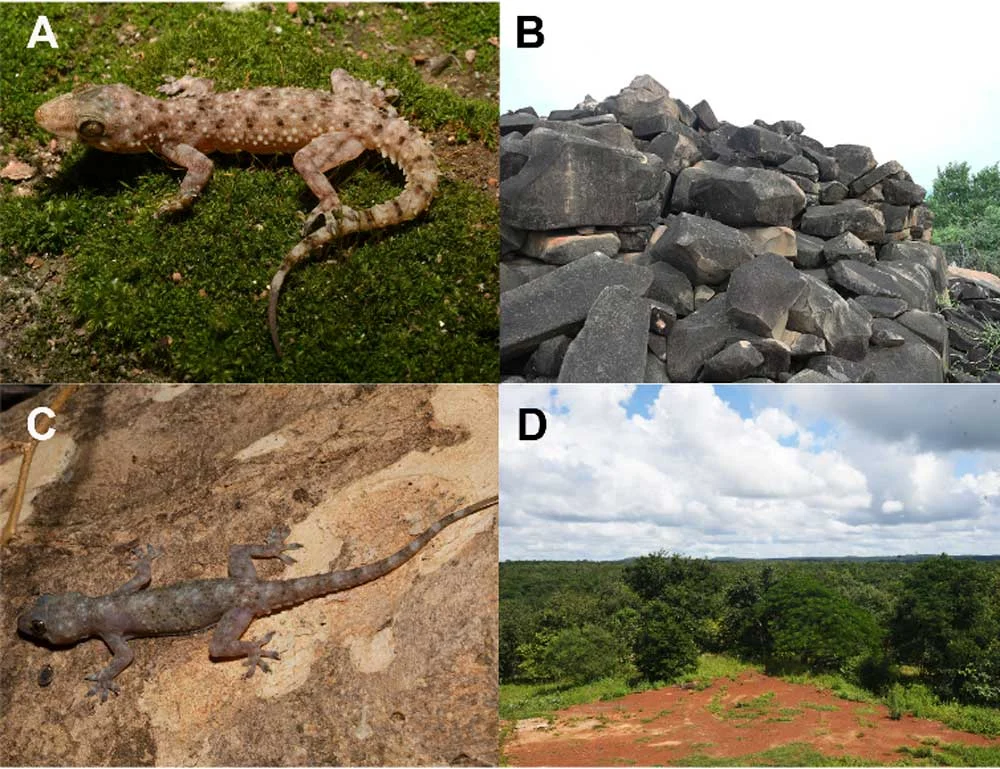
HYDERABAD, INDIA — In a significant contribution to South Asian herpetology, a collaborative team of researchers has formally discovered and described two new species of geckos belonging to the genus Hemidactylus from the Nalgonda and Warangal districts of Telangana State, India.
The newly identified reptiles—named Hemidactylus cairnicola and Hemidactylus koyaorum—add to the growing catalog of endemic vertebrate biodiversity documented within the Central Plateau of the Deccan Peninsula. Both species have been assigned to the well-known Hemidactylus brookii species group and specifically positioned within the murrayi clade.
The comprehensive taxonomic findings were published in the European Journal of Taxonomy, highlighting not only the rich biological heritage of the region but also the vital role that rigorous molecular and morphological analyses play in uncovering cryptic diversity in heavily altered landscapes.
Main Facts
The discovery of Hemidactylus cairnicola and Hemidactylus koyaorum underscores the complex biogeography of the Indian subcontinent. The research team behind the discovery comprises Bharath Bhupathi, Sumidh Ray, B. Laxmi Narayana, Amirtha Balan, Deepa Jaiswal, and Pratyush P. Mohapatra, representing a multidisciplinary cohort from prominent institutions including the Zoological Survey of India (ZSI), Fakir Mohan University, Nehru Zoological Park, and the Wildlife Institute of India.
Key highlights of the discovery include:
- Taxonomic Placement: Both species belong to the family Gekkonidae, specifically the Hemidactylus brookii group and the murrayi clade.
- Geographic Distribution: H. cairnicola is currently known from its type locality in the Nalgonda District, while H. koyaorum is endemic to the Warangal District of Telangana.
- Genetic Divergence: Mitochondrial ND2 gene sequencing confirmed substantial genetic separation, with H. koyaorum showing an uncorrected sequence divergence of 7.0% to 13.5% from its closest relative, H. treutleri. The two new species are separated by a genetic divergence of 9.5% to 10.0%.
- Ecological Niches: Both geckos inhabit unique microhabitats characterized by rocky outcrops, scrub forests, and proximity to rural human settlements, demonstrating adaptability to semi-disturbed environments.
Chronology of the Discovery
The journey toward formally describing these two cryptic reptiles spans years of field surveys, morphological examinations, and laboratory-based molecular sequencing. While the formal announcement was made with the publication in the European Journal of Taxonomy, the timeline of discovery reflects standard, rigorous protocols in modern systematic zoology.
Phase 1: Field Surveys and Initial Collection
Field expeditions conducted across various districts of Telangana by researchers from the Freshwater Biology Regional Centre of the Zoological Survey of India in Hyderabad aimed to map the herpetofaunal diversity of the Deccan Plateau. During surveys in the rocky scrub forests of Nalgonda and Warangal, researchers encountered specimens of Hemidactylus that visually resembled the Hemidactylus brookii complex but displayed subtle, inconsistent morphological traits. Recognizing the potential for cryptic speciation—where distinct species look nearly identical—the team preserved voucher specimens and tissue samples for detailed laboratory analysis.
Phase 2: Morphological Examination
Back in the laboratory, detailed scale counts, body measurements, and structural comparisons were performed. Hemidactylus cairnicola was distinguished by its medium size (reaching 49 mm in snout-to-vent length), stout body, and specific arrangements of dorsal tubercles and femoral pores. Morphological data were cross-referenced against historical type specimens and existing literature regarding the Hemidactylus brookii group.
Phase 3: Molecular Phylogenetics
To confirm species boundaries that morphology alone could not entirely resolve, the researchers turned to molecular genetics. Mitochondrial ND2 gene sequencing was executed to calculate genetic distances between the new specimens and closely related taxa, notably Hemidactylus treutleri. The resulting phylogenetic trees and genetic distance matrices provided undeniable proof that the populations from Nalgonda and Warangal represented distinct evolutionary lineages.
Phase 4: Formal Description and Publication
Following international codes of zoological nomenclature, the researchers drafted formal taxonomic descriptions, designated type specimens, and coined scientific names reflecting the ecology and geography of the animals. The manuscript was submitted to the European Journal of Taxonomy, undergoing peer review before its final publication.
Supporting Data and Morphological Characteristics
The scientific descriptions of Hemidactylus cairnicola and Hemidactylus koyaorum rely on precise quantitative and qualitative metrics. Below is a detailed breakdown of their morphological traits, ecological behaviors, and genetic profiles.
Hemidactylus cairnicola
- Size and Build: A medium-sized gecko with a snout-to-vent length (SVL) reaching approximately 49 mm. It features a relatively stout, slightly depressed body paired with a large head that is distinctly wider than the neck.
- Scalation: The dorsal scalation is characterized by granular scales intermixed with enlarged, strongly keeled, conical tubercles arranged in 13 to 15 longitudinal rows extending from the occiput to the base of the tail. The belly features approximately 31 to 32 scale rows across its width and 137 to 145 longitudinal ventral scales. Males possess seven or eight femoral pores on each side.
- Coloration and Camouflage: Its light-brown to gray coloration shifts dynamically depending on the background substrate, offering exceptional camouflage against exposed rock surfaces. The head displays several dark spots alongside paired preocular and postocular streaks, while irregular dark markings stretch across the body and tail. The ventral side remains lighter and unpatterned.
- Ecology and Habitat: Primarily nocturnal, H. cairnicola spends daylight hours sheltering in rock crevices, emerging after dusk to forage for insects. Interestingly, individuals have been observed basking or resting on exposed rocks during cooler winter days and rainy periods. It shares its habitat with rural and tribal settlements, including traditional Lambada communities, and co-exists with a variety of other reptiles such as skinks, agamid lizards, and the Indian sand boa (Eryx johnii). The species gets its specific epithet from its frequent association with black rock cairns (cairnicola meaning "cairn-dweller").
Hemidactylus koyaorum
- Endemism and Relationships: Endemic to the Deccan Peninsula biogeographic zone, H. koyaorum is currently recorded exclusively from its type locality in Warangal District. Phylogenetic analysis places it within the murrayi clade of the H. brookii group, identifying H. treutleri as its closest relative.
- Genetic Divergence: Mitochondrial ND2 sequence data confirmed a stark genetic boundary. H. koyaorum exhibits an uncorrected sequence divergence of 7.0% to 13.5% when compared to H. treutleri. Furthermore, genetic comparisons between the two newly described species (H. cairnicola and H. koyaorum) reveal a robust sequence divergence of 9.5% to 10.0%, cementing their status as separate, valid species.
Official Responses and Institutional Collaboration
The discovery highlights the collaborative nature of contemporary Indian wildlife research, drawing expertise from regional conservation centers, national museums, and premier wildlife institutes.
The research consortium bridges multiple institutions:
- Freshwater Biology Regional Centre, Zoological Survey of India (Hyderabad, Telangana): Spearheaded field efforts and regional collection logistics.
- P.G. Department of Zoology, Fakir Mohan University (Balasore, Odisha): Contributed academic and analytical frameworks.
- Zoological Survey of India, FPS Building, Indian Museum Campus (Kolkata, West Bengal): Provided overarching taxonomic guidance and historical specimen comparison.
- Nehru Zoological Park (Bahadurpura, Hyderabad, Telangana): Facilitated regional wildlife insights and conservation perspectives.
- Wildlife Institute of India (Chandrabani, Dehradun, Uttarakhand): Provided advanced molecular phylogenetics and analytical support.
While formal political reactions are typically reserved for broader environmental policy changes, the publication has drawn praise from academic circles and forestry departments. Herpetologists emphasize that identifying baseline biodiversity is the crucial first step toward effective wildlife management. Without knowing what species exist within a specific scrub forest or agricultural matrix, crafting targeted conservation legislation remains nearly impossible.
Implications for Conservation and Biodiversity Research
The identification of Hemidactylus cairnicola and Hemidactylus koyaorum carries profound implications for conservation biology, biogeography, and the understanding of micro-endemic reptiles in peninsular India.
Unmasking Cryptic Diversity
For decades, many small brown geckos across the Indian subcontinent were routinely misidentified and lumped under broad species complexes like Hemidactylus brookii. This taxonomic oversimplification masked true biodiversity. The integration of mitochondrial DNA sequencing with classical morphology has repeatedly demonstrated that what was once thought to be a single widespread species is often a complex of multiple, distinct, localized endemic species. This realization shifts conservation priorities: animals previously assumed to be common and widespread may actually be narrow-range endemics vulnerable to localized habitat loss.
Anthropogenic Pressures on Scrub Forests
Both new gecko species inhabit rocky outcrops, scrub forests, and agricultural peripheries in Telangana—landscapes that are frequently undervalued in conservation policy compared to dense tropical rainforests or protected tiger reserves. These rocky scrub ecosystems face mounting pressures from stone-quarrying, urbanization, agricultural expansion, and infrastructure development. Because H. cairnicola and H. koyaorum are restricted to specific type localities in Nalgonda and Warangal, any localized degradation of rock cairns and scrub vegetation poses an immediate threat to their survival.
Future Research Directions
The authors of the study stress that further herpetological explorations across the Deccan Plateau are urgently needed. It is highly probable that additional cryptic species remain undiscovered within the undulating terrain of central and southern India. Conservation authorities are now urged to incorporate these micro-endemic reptiles into regional wildlife management plans, ensuring that unprotected rocky outcrops receive due consideration in environmental impact assessments.
By illuminating the hidden reptile life of Telangana, the discovery of Hemidactylus cairnicola and Hemidactylus koyaorum serves as a powerful reminder of the rich, complex natural heritage still waiting to be uncovered in India’s overlooked landscapes.