Main Facts
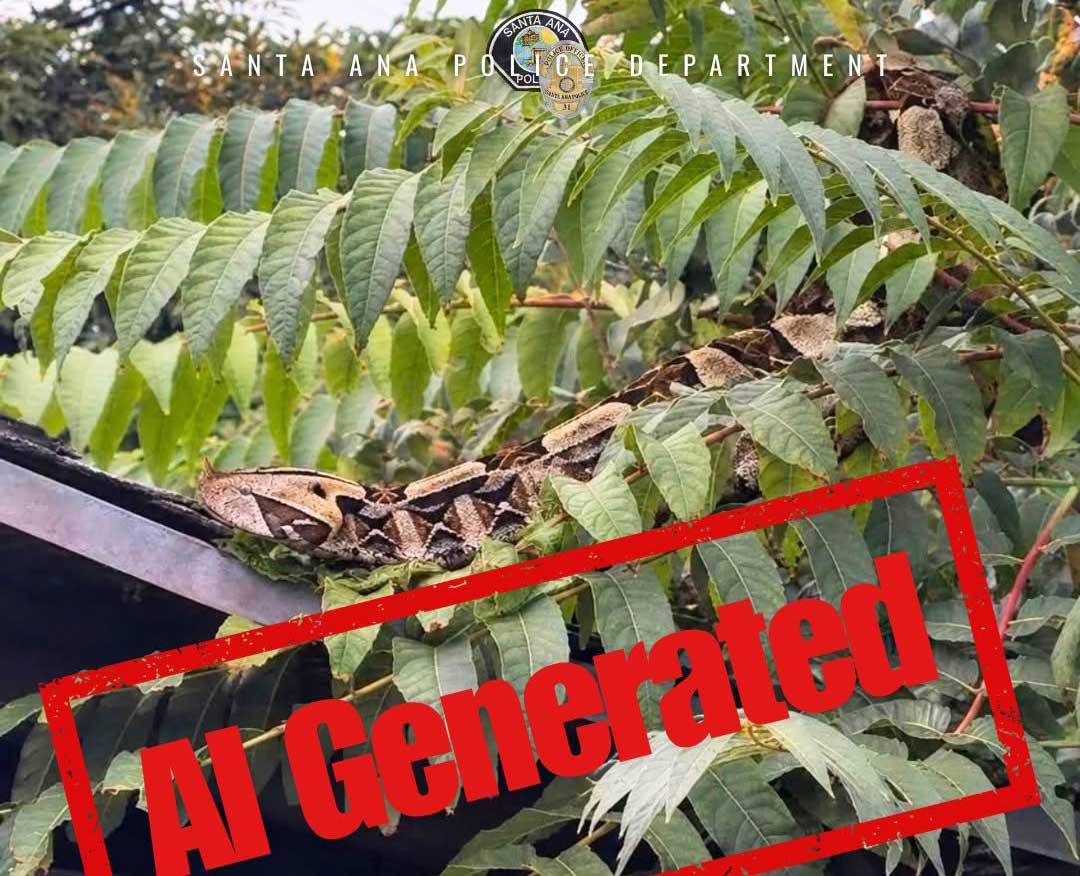
In an era where artificial intelligence can instantly generate hyper-realistic imagery, the line between digital fiction and public safety reality is increasingly blurred. On September 29, what began as a viral social media panic over a purportedly venomous, exotic snake slithering through a Southern California neighborhood culminated in a criminal investigation. A resident of Santa Ana, California, allegedly fabricated an emergency by circulating an AI-generated image of a Bitis gabonica—commonly known as the Gaboon viper—coiled inside a local tree.
The incident mobilized the Santa Ana Police Department (SAPD) and specialized herpetologists, consuming valuable municipal resources and sparking widespread anxiety among local residents. While internet sleuths quickly pointed out anatomical and behavioral discrepancies in the viral photograph, law enforcement was obligated to treat the threat as credible until proven otherwise.
The perpetrator, identified by news outlets as Joel Ciprian, ultimately confessed to authorities that the image was entirely computer-generated and that the emergency report was false. Now, Ciprian faces potential criminal prosecution by the Orange County District Attorney’s Office. Law enforcement is recommending misdemeanor charges for making a false report of an emergency, an offense that carries a maximum penalty of up to one year in county jail.
This bizarre episode serves as a cautionary tale about the intersection of generative AI, social media panic, and the very real legal consequences of crying wolf in the digital age. It also highlights the critical importance of public awareness regarding exotic wildlife biology, as basic knowledge of the species in question ultimately helped unmask the hoax.
Chronology of Events
The timeline of the Santa Ana Gaboon viper hoax unfolded rapidly over the course of several days, transforming a digital prank into a multi-agency public safety response.
Phase 1: The Initial Report and Emergency Activation
The saga began on September 29, when emergency dispatchers received a call reporting a dangerous, highly venomous African snake perched in a tree within a residential neighborhood in Santa Ana, California. The caller, later identified as Joel Ciprian, reportedly dialed 911 to report the sighting, accompanying his claims with a striking visual of a massive, heavily patterned viper resting amidst foliage.
Given the proximity of residential homes, domestic pets, and children, the Santa Ana Police Department treated the call with the utmost urgency. Venomous snake sightings, particularly involving exotic and potentially lethal species not native to the United States, are treated as high-risk public safety hazards. Police protocols immediately required an on-the-ground assessment to protect the community.
Phase 2: The On-Site Investigation and Expert Consultation
Recognizing the specialized nature of the threat, the SAPD coordinated an exhaustive field search. Law enforcement did not merely rely on visual checks; they brought in expert herpetologists—professional zoologists and reptile handlers—to scour the neighborhood.
These specialists conducted a meticulous search of the trees, brush, and surrounding properties indicated in the report. However, despite a thorough examination of the area, the experts found zero physical evidence, tracks, or sightings of a snake matching the description or proportions of the animal in the image.
Phase 3: Digital Scrutiny and the Confession
While local authorities were boots-on-the-ground searching for a phantom reptile, online communities were already performing their own digital forensics. Internet sleuths and reptile enthusiasts on social media platforms quickly dissected the image. Commenters pointed out lighting inconsistencies, unnatural scaling patterns, and—most crucially—the biological implausibility of the snake’s placement in a tree.
Faced with mounting skepticism online and the inability of law enforcement to locate any physical animal, police investigators re-engaged with the reporting party. Under questioning, Ciprian admitted the truth: the image was entirely AI-generated, and the emergency report was a complete fabrication.
Phase 4: Legal Fallout and Case Preparation
Following the admission, the Santa Ana Police Department shifted its focus from wildlife containment to accountability. Recognizing the waste of emergency services and public funds, the SAPD began compiling an airtight case file to submit to the Orange County District Attorney’s Office, setting the stage for formal criminal charges.
Supporting Data and Resource Impact
While the hoax ultimately proved to be a digital fabrication, the logistical footprint of the response was entirely real. Public safety agencies operate under strict mandates to protect citizens from verifiable and potential threats, meaning every emergency call must be evaluated with gravity.
Allocation of Municipal Resources
According to statements released by the Santa Ana Police Department and local media reports, the false report triggered a cascade of resource expenditures:
- Officer Deployment: Multiple patrol units were dispatched to secure the perimeter, interview residents, and manage potential crowd control.
- Specialized Personnel: The SAPD incurred costs and utilized emergency scheduling to retain professional herpetologists. These experts were pulled away from other conservation, educational, or private consulting duties to conduct a physical sweep of a neighborhood.
- Emergency Dispatch Systems: 911 dispatchers diverted time and communication channels to manage the incoming reports, which could have delayed responses to genuine, life-threatening medical or criminal emergencies in the city.
Legal Penalties and Sentencing Frameworks
Under California penal statutes, making a false report of an emergency is treated severely because of the inherent dangers associated with diverting first responders.
- Potential Charges: The SAPD recommended a charge of making a false report of an emergency.
- Classification: In California, such offenses can be prosecuted as misdemeanors.
- Maximum Sentences: A conviction on this misdemeanor charge carries a penalty of up to one year in county jail, alongside potential fines, restitution for emergency response costs, and probation.
Legal analysts note that as AI manipulation tools become more accessible, prosecutors are increasingly looking to make examples out of individuals who use synthetic media to disrupt public infrastructure or emergency services.
Official Responses and Expert Insights
The incident drew sharp commentary from both law enforcement agencies and the scientific community, emphasizing the unique challenges that artificial intelligence poses to modern society.
Law Enforcement Statements
The Santa Ana Police Department expressed frustration over the reckless nature of the stunt. In statements to outlets such as the Los Angeles Times and CBS News, department representatives underscored that public safety resources are finite. When individuals manufacture crises for attention, internet clout, or amusement, they directly compromise the safety of the community they manipulate.
Law enforcement officials reiterated that AI-generated hoaxes are no longer harmless pranks when they cross the threshold into official emergency reporting. The swift transition from a viral internet post to a recommended criminal filing sends a clear message that synthetic media used to trigger emergency responses will be met with the full force of the law.
Herpetological and Biological Realities
The wildlife community played an instrumental role in exposing the hoax, long before the official police confession. Professional herpetologists and experienced reptile keepers pointed out fundamental flaws in the viral image that should have tipped off authorities earlier—had the biology of the species been widely understood.
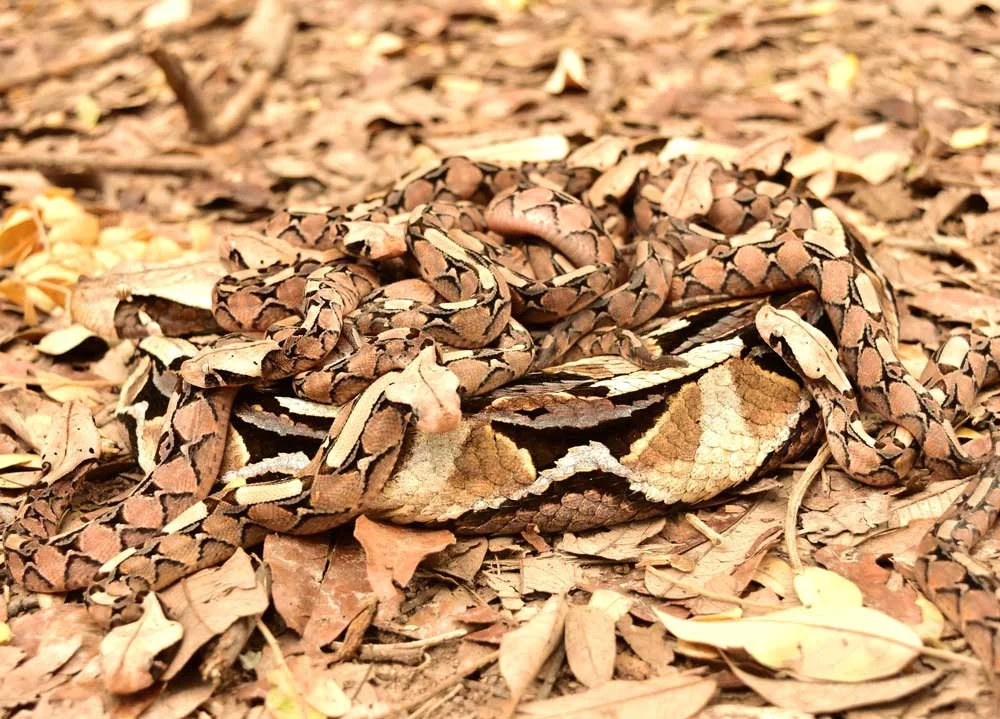
The Gaboon viper (Bitis gabonica), native to the rainforests and savannas of sub-Saharan Africa, possesses several distinct physical and behavioral traits:
- Terrestrial Nature: Unlike arboreal snakes (such as green tree pythons or certain vine snakes), Gaboon vipers are strictly terrestrial. They are exceptionally heavy-bodied, stout snakes designed for life on the forest floor, where they rely on their extraordinary disruptive coloration to camouflage themselves in leaf litter.
- Locomotion Limitations: Because of their massive girth and heavy musculature, Gaboon vipers are exceptionally poor climbers. Finding a massive adult Gaboon viper elevated comfortably in the branches of a tree is biologically counterintuitive.
- Size and Mass: Adults typically grow to lengths of four to five feet and represent the heaviest vipers in the world, with documented specimens weighing up to 20 pounds. An animal of that mass would require significant structural support from a branch—a detail the AI generator failed to realistically render.
Furthermore, the species is globally renowned for two biological extremes: they possess the longest fangs of any venomous snake (often exceeding two inches) and inject a potent cocktail of hemotoxic and cytotoxic venom designed to immobilize mammalian prey such as rodents, small mammals, and birds.
Implications for the Future
The Santa Ana Gaboon viper incident is far more than a quirky local news story; it is a preview of the complex socio-legal landscape defining the mid-2020s. As generative AI models become indistinguishable from reality, several profound implications emerge for emergency services, digital literacy, and the law.
The Erosion of Public Trust and the "Boy Who Cried Wolf" Dilemma
When sensationalized AI content mimics genuine hazards, it risks fatiguing public safety systems. If citizens, journalists, and first responders become conditioned to view extraordinary animal sightings, natural disasters, or public safety alerts as potential "deepfakes," a genuine emergency could be tragically dismissed. The psychological toll of sorting fact from fiction in real-time threatens to erode the baseline of trust necessary for community safety.
The Evolution of Digital Forensics in Law Enforcement
Police departments and municipal agencies are increasingly forced to adapt to the digital age. Officers can no longer rely solely on photographic evidence presented by complainants or found on social media. Training protocols must evolve to include rapid digital verification, collaboration with tech-savvy investigators, and a deeper understanding of AI generation artifacts—such as incorrect lighting, distorted anatomical structures, and impossible physical physics.
Stricter Legal Frameworks for Synthetic Disruption
As lawmakers grapple with the societal fallout of deepfakes, revenge porn, and AI-generated disinformation, cases like Joel Ciprian’s provide test cases for municipal prosecution. While existing laws regarding false reporting and waste of public resources can be retrofitted to address AI hoaxes, legal experts anticipate that states will begin drafting legislation specifically penalizing the deployment of synthetic media in emergency contexts.
Ultimately, the phantom Gaboon viper of Santa Ana serves as a stark reminder that while artificial intelligence can generate any image imaginable, it cannot alter the physical laws of nature—nor can it shield creators from the very real, very legal consequences of deception.