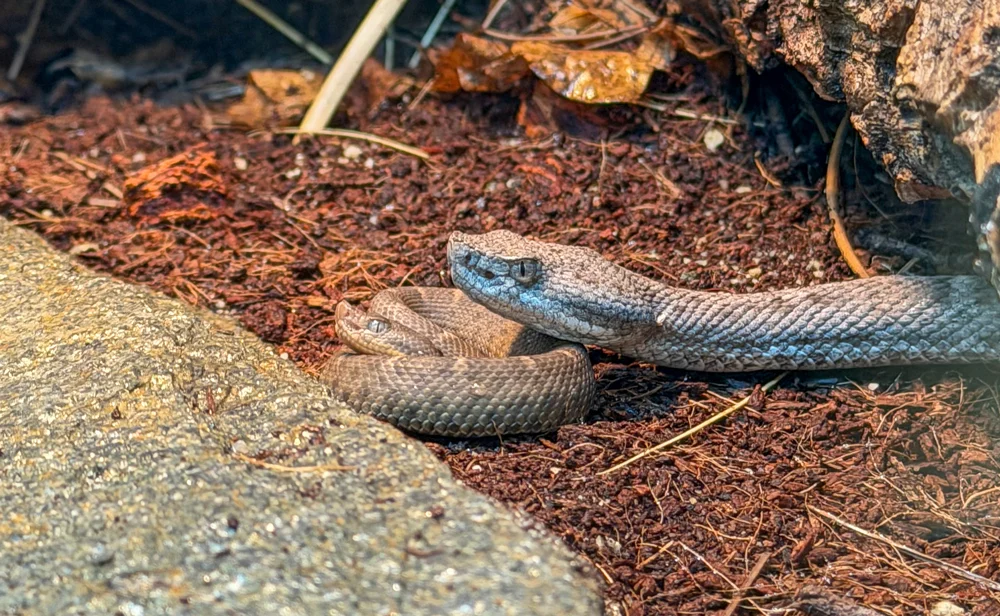
NEW SOUTH WALES, AUSTRALIA — In the shadowy, temperature-controlled enclosures of the Australian Reptile Park, a quiet giant resides. Her name is Shazza, and she is nothing short of a biological anomaly.
Measuring a staggering 110 centimeters (nearly 3.6 feet) in total length and tipping the scales at 1.55 kilograms, Shazza has officially been recognized by the Australian Reptile Park and the Australian Museum Herpetology Department as the largest living common death adder (Acanthophis cerastinus) ever recorded.
While her name might evoke the casual warmth of a backyard barbecue, her physical proportions are a nightmare scenario for anyone with even a mild aversion to serpents. Roughly double the size of an average adult of her species, Shazza is redefining what scientists thought possible for the growth limits of Australian elapids. Yet, despite her formidable and somewhat frightening stature, this gargantuan reptile is quietly pulling off a heroic double shift: serving as a star attraction while simultaneously fueling a life-saving milking program that protects humans across the continent.
Main Facts: The Anatomy of a Titan
To understand just how exceptional Shazza is, one must look at the baseline biology of the common death adder. Typically, adult male death adders reach a modest average length of around 42 centimeters, while females max out at a slightly larger, though still compact, 55 centimeters.
Shazza completely shatters these metrics. According to official measurements taken by her caretakers:
- Total Length: 110 cm (approx. 3.6 feet)
- Snout-to-Vent Length: 95 cm
- Total Weight: 1.55 kg (up from 1.41 kg in 2023)
- Age: Approximately 15 years old
Unlike true vipers—which death adders superficially resemble with their broad, triangular heads, thick bodies, and short, tapered tails—Shazza and her kin belong to the family Elapidae. This places her evolutionary lineage closer to cobras, mambas, and taipans than to European or American vipers.
Death adders are ambush predators of the highest order. They possess highly potent neurotoxic venom that disrupts nerve signaling, rapidly leading to paralysis and potential respiratory failure in their prey. In the wild, they use a specialized hunting technique known as caudal luring, wriggling their worm-like tail tips against leaf litter to trick curious lizards, frogs, birds, and small mammals into striking distance.
Shazza, however, doesn’t need to lure small lizards anymore; she is sustained by a specialized husbandry diet at the park, allowing her to maintain a robust, heavy-bodied physique that leaves seasoned herpetologists awestruck.
Chronology: Nine Years of Quiet Growth Behind the Glass
Shazza’s journey to record-breaking fame was not an overnight phenomenon; it has been nearly a decade in the making, unfolding right under the noses of park visitors.
- Circa 2011: Shazza hatches, likely beginning life with the standard, rapid growth spurt typical of young elapids—a phase where the animal expends significant energy reaching reproductive maturity.
- Circa 2015: At roughly six years of age, Shazza arrives at the Australian Reptile Park. Even then, her proportions hint at something unusual. Park Manager Billy Collett notes her unusually robust frame upon arrival, suspecting she has the genetic potential to break the one-meter threshold.
- 2015–2022: Shazza integrates smoothly into the park’s elite venom milking program. While other death adders come and go, Shazza continues to feed well, shed cleanly, and—most importantly—keep growing long past the age when normal death adders plateau.
- 2023: A routine health and measurement check logs Shazza at 102 centimeters in total length and 1.41 kilograms in weight. The scientific community begins to whisper that she may be the largest living specimen on record.
- Late 2025 / Early 2026: Collaborative assessments by the Australian Reptile Park and the Australian Museum Herpetology Department formally record her dimensions at 110 cm and 1.55 kg, cementing her status as a living legend in Australian herpetology.
Supporting Data: By the Numbers
To put Shazza’s biological metrics into perspective, scientists rely on comparative historical data and physiological output metrics:
| Metric | Average Female Death Adder | Shazza (Current Measurements) | Historical Record (Preserved Specimen) |
|---|---|---|---|
| Total Length | ~55 cm | 110 cm | 117 cm |
| Snout-to-Vent | ~45–48 cm | 95 cm | 101 cm |
| Weight | Varies (~300–600g) | 1.55 kg | Not recorded (preserved) |
| Venom Yield | ~100–130 mg | 270 mg (Single milking) | N/A |
As detailed in the table, Shazza’s venom output is staggering. During a routine extraction for the park’s venom program, Shazza regularly yields 270 milligrams of pure, highly potent neurotoxic venom in a single milking. This is more than double the output of an average common death adder.
Her growth trajectory also presents an intriguing biological puzzle. Dane Trembath, Collection Manager of Herpetology at the Australian Museum Research Institute, points out that while most snakes experience rapid growth during youth followed by a sharp deceleration, Shazza has defied the typical aging curve. While her growth rate is now slowing down as she approaches mid-life at 15 years old, her incremental expansion leaves open the tantalizing possibility that she could eventually threaten the all-time historical record: a preserved specimen housed in the Australian Museum collection that measured 117 cm in total length (with a snout-to-vent length of 101 cm) at the time of its death.
Official Responses: Fear and Revered Respect
The scientific and animal husbandry communities have reacted to Shazza’s official measurement with a mixture of sheer awe and cautious healthy respect. Handling any venomous snake requires absolute focus, but dealing with a living prehistoric-sized specimen raises the occupational hazard to new heights.
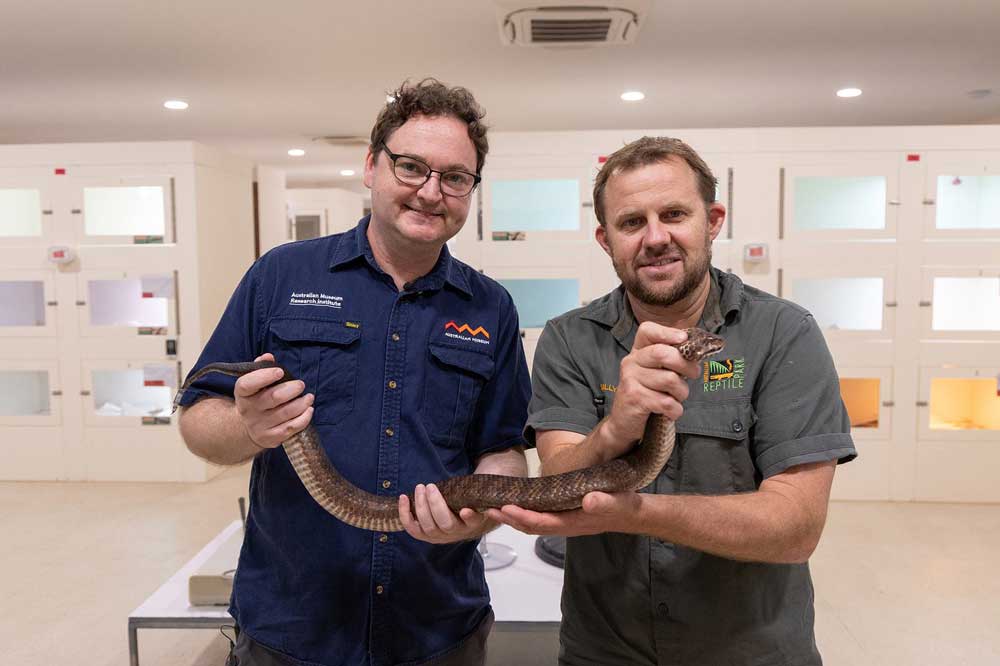
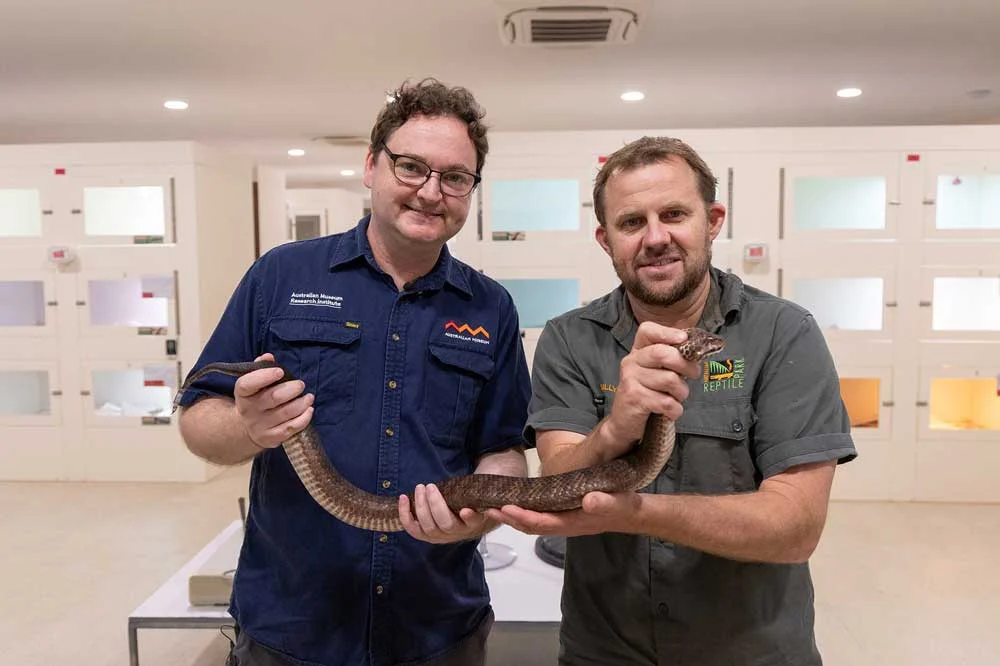
"The moment I first laid eyes on her… I knew she was just a monster and her potential to get over a meter was definitely there," said Park Manager Billy Collett in an official media statement. Collett, who has spent his life working alongside some of Australia’s most dangerous fauna, does not hide his apprehension when it comes to the park’s resident giant.
"I don’t want to get bitten by any snakes, but I cannot get bitten by her," Collett admitted. "She’s so big, her venom yields are so big, it’s frightening."
This sentiment is echoed by the scientific establishment in Sydney. Dane Trembath of the Australian Museum Research Institute expressed genuine surprise at the snake’s ongoing development.
"She’s a big death adder, way bigger than I thought she would be," Trembath noted. "I’d say she’s almost double the size of a normal death adder. Most snakes have this initial growth spurt when they are born… she’s way beyond that so her growth will now slow down. As she slowly grows, she may actually surpass the biggest death adder ever recorded, but we don’t know how long that is going to take."
Implications: Saving Lives on a Massive Scale
While Shazza’s massive size makes her a viral sensation and a fascinating subject for academic study, her existence carries a profoundly practical, life-saving purpose.
Australia is home to some of the most venomous terrestrial snakes on Earth, and for decades, the Australian Reptile Park has played a critical role in the country’s healthcare infrastructure. The park is the sole supplier of raw venom used to manufacture antivenom for funnel-web spiders, tiger snakes, brown snakes, taipans, and, of course, death adders.
Every drop of venom extracted from these captive serpents is sent to commercial pharmaceutical laboratories (such as CSL Seqirus) to produce the life-saving antivenom administered in hospitals across the nation when someone is unfortunate enough to suffer an elapid bite. Because death adders rely on a sit-and-wait ambush strategy—often hiding flush against leaf litter or sandy soils where unsuspecting bushwalkers might tread—human-snake encounters, while relatively rare, do occur.
This is where Shazza’s oversized biology translates directly into human survival.
"Her venom yields are literally twice the size of the average Common Death Adder," Billy Collett emphasized, "so there’s no doubt she’s saving more human lives with the venom she’s producing."
By delivering 270 milligrams of high-grade neurotoxin per milking session, Shazza single-handedly supercharges the park’s production quotas. Every extraction cycle contributes a massive volume of raw material to the national antivenom stockpile, ensuring that Australian hospitals remain well-equipped to reverse the paralyzing effects of death adder envenomation.
A Living Legend of the Australian Bush
At approximately 15 years of age, Shazza is well into her prime. Snakes in managed care can often live for two decades or more, meaning her reign as the undisputed queen of the death adders is far from over.
Whether she ultimately stretches out another few centimeters to claim the absolute all-time historical crown from her museum-preserved predecessor remains to be seen. But for now, the gentle giants of the Australian Reptile Park—and the scientists who monitor her every shed and scale—are content to watch in wonder.
Shazza stands as a testament to the wild, untamed extremes of Australian wildlife: a creature capable of inspiring deep, primal fear, yet ironically serving as a vital guardian angel for countless humans across the continent.