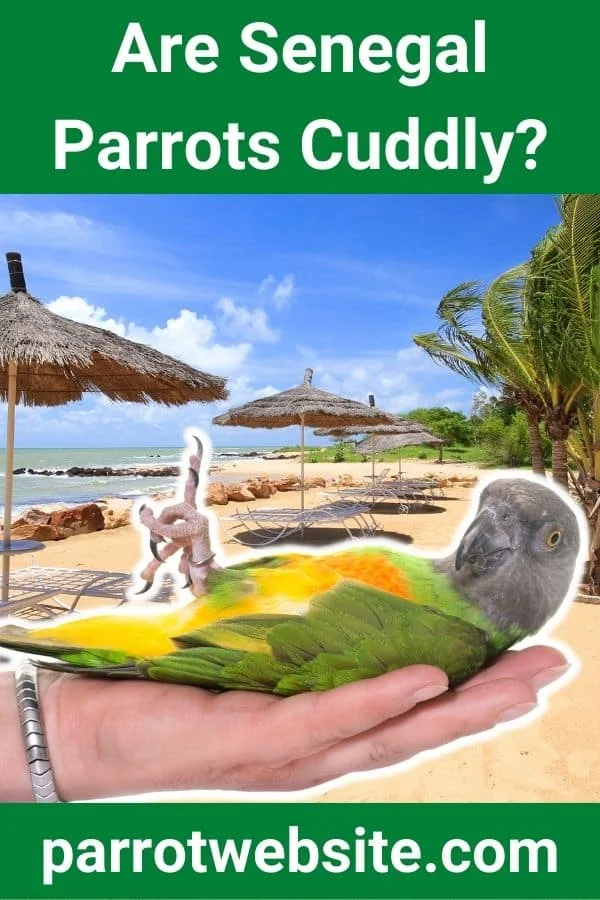
When a friend of mine recently brought a Senegal parrot into his home, he spent weeks debating whether he was truly ready for the commitment. Like many prospective parrot owners, he envisioned a companion that would offer companionship, laughter, and—perhaps most importantly—a sense of mutual affection. For the first few weeks, everything seemed perfect: the bird was remarkably quiet, picked up on training cues quickly, and appeared to be settling into its new environment with ease.
However, a lingering concern soon began to cloud the experience. My friend noticed a distinct lack of physical affection from his new companion. He began to wonder if he had failed in his husbandry or if something was fundamentally wrong with the bird. This led to a broader investigation into the nature of the Senegal parrot (Poicephalus senegalus): Are they truly "cuddly" birds, or is the expectation of a lap-parrot setting owners up for disappointment?
Main Facts: Understanding the Senegal Temperament
To understand the Senegal parrot, one must first appreciate its inherent nature. These birds are native to West Africa and are known for their sturdy, compact builds and intelligent, often mischievous personalities.
The primary fact to establish is that Senegal parrots are, generally speaking, highly social and capable of forming deep, lifelong bonds with their human guardians. However, the definition of "cuddly" is subjective. Unlike a dog or a cat, which may seek out sustained physical contact, a Senegal parrot’s affection is often expressed through proximity, vocalization, and subtle physical interactions.
If a Senegal parrot is well-raised and properly socialized from a young age, it is typically an affectionate and playful companion. Conversely, birds that are wild-caught or suffer from poor early socialization often struggle to establish trust. It is vital for potential owners to recognize that individual personality plays a massive role in a bird’s willingness to engage in physical intimacy. Just as humans have varying levels of comfort with physical touch, so too do individual parrots.
Chronology of the Bonding Process
The journey to a bonded relationship with a parrot is not instantaneous; it is a chronological progression that begins long before the bird arrives at your home.
1. The Pre-Arrival Phase (The Breeder’s Role)
The foundation of a bird’s temperament is laid during its first few months of life. A reputable breeder plays a critical role in the socialization process, exposing the fledgling to various human stimuli, household sounds, and gentle handling. This early period determines whether the bird will view humans as safe, benevolent entities or as threats.
2. The Transition Phase (Bringing the Bird Home)
The first few weeks are a critical period of observation. The bird is assessing its new environment for safety. During this time, the owner must remain patient. Forcing interaction during this phase can permanently damage the trust-building process.
3. The Development Phase (Active Bonding)
Once the bird feels secure, the phase of active engagement begins. This is where consistent, positive reinforcement training comes into play. By rewarding desired behaviors—such as stepping onto a hand or remaining calm during handling—the owner begins to build a "language" of mutual respect.
4. The Long-Term Maintenance Phase
Bonding is not a finite project; it is a lifelong maintenance task. A parrot’s emotional needs evolve as it reaches sexual maturity, and an owner must be prepared to adjust their interaction style to accommodate these developmental shifts.
Supporting Data: The Nuances of Affection
When we ask if a Senegal parrot is "cuddly," we must look at how these birds manifest love. They rarely want to be "cuddled" in the human sense of being held tightly. Instead, they demonstrate affection through "beak-rubbing" against their owner’s cheek, perching on a shoulder, or simply choosing to stay within the same room as their human.
One of the most profound indicators of affection is vocalization. Senegal parrots are not typically known for loud, piercing screams like some larger macaws, but they are expressive. A bird that greets its owner with soft, rapid chirps or whistles upon their arrival home is expressing a high degree of social attachment. These vocal signals are, in many ways, the parrot’s equivalent of a verbal "I love you."
However, data from avian behaviorists suggests that the "cuddly" factor is highly dependent on environmental stimulation. A bird that is kept in a cage for the majority of the day without intellectual enrichment will often develop "stiff" or standoffish behaviors. They become bored, depressed, or frustrated, which manifests as a rejection of physical affection.
Official Perspectives: The Role of Behavioral Health
Expert avian veterinarians and behavioral consultants emphasize that "aggression" in Senegal parrots is often a symptom of unmet needs rather than a character flaw. While it is natural for these birds to be slightly "nippy"—using their beaks to explore their environment or to exert boundaries—constant aggression is a red flag.
Professional Observations on Aggression:
- The "Boundary" Bite: Parrots often bite when their physical or emotional boundaries are pushed. If a bird is handled when it wants space, it will use its beak to communicate its discomfort.
- The Lack of Enrichment: If a Senegal is not provided with foraging toys, social interaction, and mental stimulation, it may develop behavioral pathologies, including feather plucking or extreme irritability.
- Sexual Maturity: During the breeding season, even the most affectionate Senegal parrot may become hormonally charged, resulting in territorial or aggressive behavior. This is a natural, biological phenomenon that requires owners to adjust their interaction techniques, not to punish the bird.
Veterinary professionals advise that if a bird is displaying consistent, unexplained aggression, a physical examination is necessary to rule out underlying health issues, such as pain or nutritional deficiencies.
Implications for the Modern Parrot Owner
Owning a Senegal parrot carries significant responsibilities that extend beyond simple feeding and cleaning. The implications for the owner are clear: you are entering a long-term psychological partnership.
Creating an Environment for Connection
To foster a truly affectionate bond, consider the following strategies:
- Vocal Engagement: Parrots are linguistic sponges. Even if they do not learn to speak clearly, they thrive on the rhythm of human speech. Talking, reading aloud, or playing music can provide the sensory stimulation they crave.
- Respecting Personal Space: To get a bird to be "cuddly," you must first prove that you respect its autonomy. If you learn to read your bird’s body language—such as a slight head tilt or a specific feather posture—you will know when it is in the mood for affection and when it is not.
- Consistency in Routine: Senegal parrots are creatures of habit. A predictable schedule helps them feel secure, which in turn lowers their stress levels and makes them more receptive to bonding.
The Myth of the "Easy" Pet
The most dangerous implication for a potential owner is the belief that a parrot is an "easy" pet. Senegal parrots are complex, intelligent, and emotionally demanding. The decision to bring one into your life should be predicated on an understanding that your time will be required daily for the next 20 to 30 years.
Conclusion
Are Senegal parrots cuddly? The answer is a nuanced "yes," provided the owner is willing to do the heavy lifting. They are capable of forming deep, affectionate bonds that can be incredibly rewarding. However, this is not a passive process. It requires a commitment to proper rearing, constant socialization, and a deep respect for the individual personality of the bird.
If you find that your Senegal is not as cuddly as you had hoped, do not view it as a failure. Instead, look at the situation as an opportunity to change your approach. Perhaps the bird needs more time, perhaps it requires more stimulation, or perhaps its way of showing affection is simply different from what you expected. By focusing on building trust rather than demanding physical contact, you may find that the bond you develop is far more profound than any simple "cuddle" could ever be.
Owning a Senegal parrot is an invitation into a different kind of consciousness. If you approach that invitation with patience, education, and respect, you will find a companion that is as loyal as it is complex.