Main Facts
In a significant addition to Asian herpetology, a team of researchers has officially described a brand-new species of frog belonging to the genus Brachytarsophrys. Commonly referred to as the short-legged toad, the newly identified amphibian has been scientifically designated as Brachytarsophrys jinxiuensis. The landmark discovery was made deep within the lush, biodiverse landscapes of the Guangxi Zhuang Autonomous Region in southern China.
This discovery expands the known diversity of the Brachytarsophrys genus to 12 species globally, all of which are native to Asia, with a heavy concentration in China. Notably, B. jinxiuensis is the third species of its genus to be documented within Guangxi, cementing the region’s status as a critical hotspot for amphibian evolution and endemism.
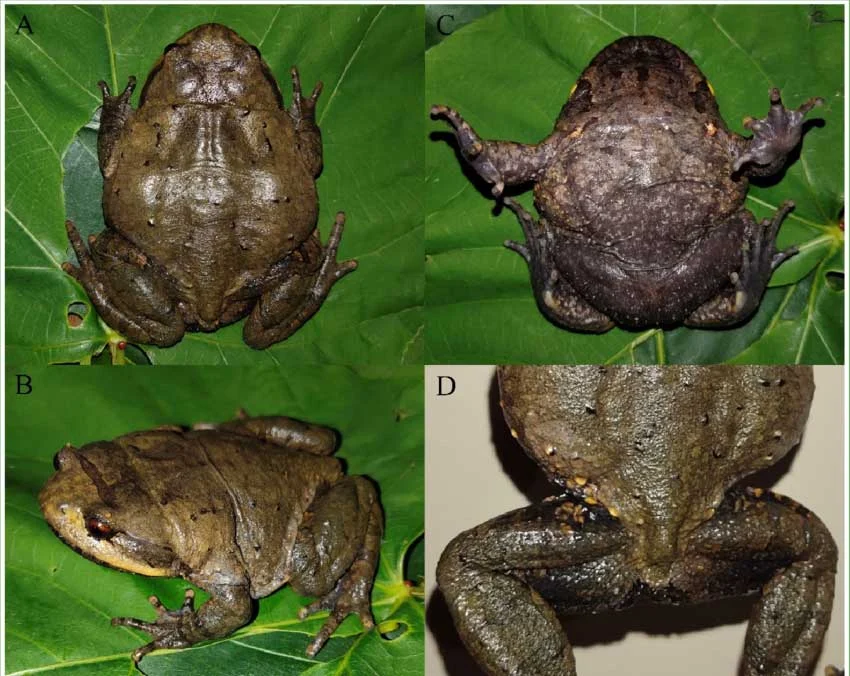
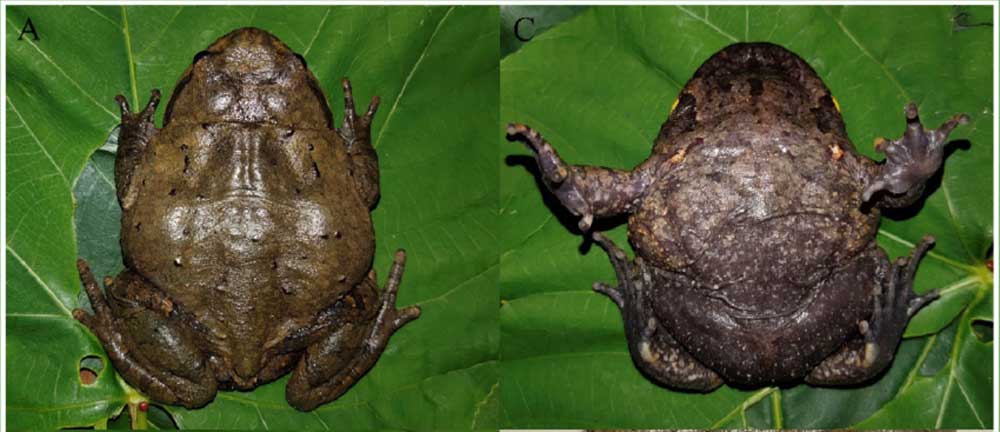
Morphologically, Brachytarsophrys jinxiuensis is distinguished from its close relatives by a unique combination of physical traits. It features a relatively small body size compared to other members of the genus, paired with smooth dorsal skin dotted with several distinct, large tubercles scattered across the back and the crotch region. Furthermore, the species boasts a notably long snout complemented by comparatively small eyes.
Coloration and anatomical markers further set the new toad apart. B. jinxiuensis displays striking short, orange-colored pectoral glands and mesmerizing blood-red irises that transition into a reddish-brown hue on the lower portion of the eye. Additionally, adult males exhibit a specialized nuptial pad on their first finger—a common breeding adaptation among certain anurans.
Genetic analyses substantiate the morphological findings, revealing a 4.2% to 15.7% genetic divergence, alongside a 3.3% to 15.2% variation in the mitochondrial COI and cytochrome b (cyt b) genes when compared to its closest phylogenetic congeners. The species epithet, jinxiuensis, pays direct homage to Jinxiu County within Guangxi, the localized geographic area where the holotype specimen (cataloged as KIZ2019035) was first encountered and collected.
Chronology
The journey leading to the formal description of Brachytarsophrys jinxiuensis spans years of meticulous field expeditions, laboratory genetic sequencing, and taxonomic verification. While the formal scientific paper describing the creature was finalized and shared publicly in mid-2026, the groundwork for the discovery began much earlier.
- 2019 (The Discovery): Herpetologists operating in the mountainous terrain of the Guangxi Zhuang Autonomous Region collected the holotype specimen (KIZ2019035) during field surveys. Initial field observations immediately suggested that the specimen deviated significantly from known species of Brachytarsophrys, prompting a deeper, multi-disciplinary investigation.
- 2020–2025 (Laboratory Analysis & Comparison): Over the course of several years, a research team—featuring prominent scientists including Shuo Liu, Mian Hou, and Dingqi Rao—conducted rigorous morphological comparisons. They analyzed skeletal structures, skin textures, color patterns in life, and glandular placements. Concurrently, DNA was extracted to sequence mitochondrial genes (COI and cyt b) to determine precise genetic divergence markers.
- 2026 (Formal Publication): The comprehensive research was compiled into a formal academic paper titled "A new species of the genus Brachytarsophrys Tian & Hu, 1983 (Anura: Megophryidae) from Guangxi, China." The study was published and made accessible to the scientific community via academic repositories such as ResearchGate, officially introducing Brachytarsophrys jinxiuensis to the global scientific record.
Supporting Data
Taxonomic classifications within the family Megophryidae—and specifically the genus Brachytarsophrys—rely heavily on an integrative taxonomy approach, combining traditional morphology with modern molecular genetics.
Taxonomic Hierarchy
- Kingdom: Animalia
- Phylum: Chordata
- Class: Amphibia
- Order: Anura (Frogs and Toads)
- Family: Megophryidae
- Genus: Brachytarsophrys
- Species: Brachytarsophrys jinxiuensis
Key Diagnostic Metrics
- Genus Diversity: Brachytarsophrys jinxiuensis represents the 12th recognized species within the Brachytarsophrys genus.
- Regional Distribution: It is the 3柏rd species of the genus documented specifically within the Guangxi Zhuang Autonomous Region, while the remaining 10 species are distributed across other parts of China and neighboring Southeast Asian countries.
- Genetic Divergence:
- Overall genetic divergence: 4.2% – 15.7%
- COI and cytochrome b (cyt b) gene divergence: 3.3% – 15.2%
- Holotype Identification: Specimen cataloged as KIZ2019035.
- Key Visual Characteristics: Small body size, smooth dorsal skin with prominent large tubercles on the dorsum and crotch, elongated snout, small eyes, short orange pectoral glands, blood-red to reddish-brown irises, and nuptial pads on the first finger of adult males.
Official Responses and Scientific Significance
The description of Brachytarsophrys jinxiuensis has drawn positive attention from the international herpetological community, underscoring the vital importance of continued biodiversity surveys in southern China.
Researchers involved in the discovery—including Shuo Liu, Mian Hou, and Dingqi Rao—emphasize that finding new amphibian species in well-studied countries like China demonstrates that local ecosystems still harbor hidden biodiversity. Because frogs and toads are notoriously sensitive to environmental shifts, pinpointing their exact ranges and species boundaries is crucial for baseline ecological data.
Independent conservation biologists have lauded the integration of genetic sequencing with classic morphology in the published research paper. By establishing clear genetic benchmarks (such as the 4.2–15.7% divergence range), the authors have provided future researchers with a foolproof framework to identify B. jinxiuensis in the wild without relying solely on subjective visual traits.
Furthermore, the discovery highlights the unique evolutionary pressures present in the karstic and mountainous terrain of Guangxi. The region’s microclimates and isolated forest patches have long acted as evolutionary cradles, allowing distinct lineages of amphibians and reptiles to diverge over millennia.
Implications
The formal introduction of Brachytarsophrys jinxiuensis carries several critical implications for wildlife conservation, ecological research, and regional environmental policy in China.
1. Conservation Status and Habitat Protection
Amphibians globally face unprecedented threats, including habitat fragmentation, climate change, chytrid fungus infections, and pollution. Because B. jinxiuensis is currently known from a restricted locality in Jinxiu County, its localized endemic nature makes it inherently vulnerable. Conservationists argue that immediate steps must be taken to assess the exact population size, geographic distribution range, and specific ecological requirements of the short-legged toad to determine if it warrants a threatened status on the IUCN Red List.
2. Heightened Focus on Regional Biodiversity Hotspots
The discovery reinforces the ecological significance of the Guangxi Zhuang Autonomous Region. As the home of three distinct Brachytarsophrys species—along with other recent finds, such as new odorous frog species—Guangxi continues to prove that its subtropical forests are irreplaceable reservoirs of genetic wealth. This will likely spur government agencies and non-governmental organizations to allocate more resources toward protected area management and ecological corridors in the region.
3. Advancements in Integrative Taxonomy
The methodology utilized to describe Brachytarsophrys jinxiuensis—seamlessly blending field observation, detailed macro-photography of live specimens (such as documenting the distinct blood-red irises and orange pectoral glands), and robust mitochondrial DNA sequencing—serves as a blueprint for future taxonomic revisions. As cryptic species continue to baffle scientists, adopting this multi-pronged approach ensures that future amphibian discoveries are robust, defensible, and accurately placed within the tree of life.
Ultimately, the short-legged toad serves as a small yet powerful reminder of the vast, undiscovered wonders still waiting in the mist-shrouded forests of southern China.