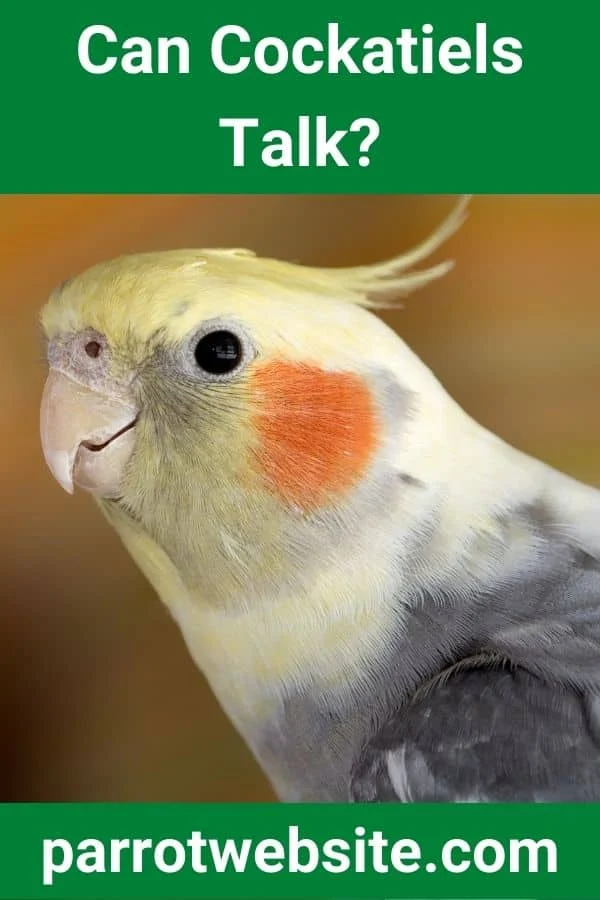
For many first-time bird owners, the allure of bringing a parrot into the home is often tied to the dream of a feathered companion that can hold a conversation. However, a common point of confusion arises when new owners find their cockatiels—one of the most popular companion birds globally—remained stoically silent, preferring whistles and chirps over human speech.
While the cockatiel (Nymphicus hollandicus) is an incredibly affectionate, intelligent, and rewarding pet, its relationship with human language is nuanced. Understanding why these birds speak—or choose not to—requires a deep dive into avian behavior, biological constraints, and the reality of pet ownership.
Main Facts: The Vocal Capacity of the Cockatiel
To address the elephant in the room: Can cockatiels talk? The short answer is yes. Like virtually all members of the parrot family (Psittaciformes), cockatiels possess the physiological apparatus—a syrinx, the avian vocal organ—necessary to mimic complex sounds, including human speech.
However, the capacity to perform a task is distinct from the inclination to perform it. While African Greys or Amazon parrots are renowned for their ability to memorize hundreds of words and mimic complex sentence structures, the cockatiel’s repertoire is significantly more modest. A "chatty" cockatiel might master a handful of words or short phrases, but they are far more likely to focus their vocal energy on melodic whistling, trilling, and chirping.
It is a common misconception that a lack of speech indicates a lack of intelligence. On the contrary, cockatiels are highly social and communicative creatures. They simply choose to prioritize their natural, species-specific vocalizations over the mimicry of human language. For a potential owner, managing expectations is the most important step in the bonding process.
Chronology: The Developmental Timeline of Vocalization
The vocal development of a cockatiel is a gradual process that relies heavily on early environmental exposure and the individual bird’s personality. While there is no "fixed" date for when a bird might start talking, researchers and breeders have observed distinct developmental phases.
The Foundation (0–8 Months)
During the first eight months of life, a cockatiel is primarily an observer. While they may not be reproducing human speech, they are "soaking up" their environment. Owners who wish to encourage speech are advised to start early. Speaking clearly, using consistent phrases, and maintaining an upbeat, engaging tone during these months helps acclimate the bird to the cadence of human communication. Even if the bird shows no interest in repeating words, this period is vital for building trust and social bonds.
The Emergence (8–12 Months)
Between the eight-to-ten-month mark, many cockatiels hit a developmental milestone where their cognitive capacity for mimicry begins to mature. This is the window where an owner is most likely to hear the first, often garbled, attempt at a word. It is a period of experimentation; the bird may combine human sounds with their natural whistles.
The Plateau (12–24 Months)
If a cockatiel has not begun mimicking human speech by the time it reaches its second birthday, the statistical probability of it ever becoming a "talker" drops significantly. By this age, the bird’s behavioral patterns are largely set. If it has chosen to express itself through songs and whistles—which is the norm—it is unlikely to pivot to speech later in life.
Supporting Data: Why Do Some Birds Talk and Others Don’t?
To understand the disparity in vocalization, we must look at the evolutionary pressures that shape avian behavior.
Mimicry as a Social Strategy
In the wild, many parrot species use mimicry as a social lubricant. Parrots that learn the "dialect" of their flock are more likely to be accepted, find mates, and avoid conflict. In a domestic setting, some parrots view their human family as their "flock" and attempt to mimic speech as a way of integrating into that social unit.
Cockatiels, however, seem to operate differently. They are highly adept at forming deep emotional bonds with humans through physical affection, grooming, and non-verbal cues. Because they feel fully integrated into the "flock" without needing to replicate human speech, they may feel no evolutionary or social pressure to learn our language.
The Role of Gender
In the world of cockatiels, there is a widely observed (though not absolute) trend regarding gender and vocalization. Male cockatiels are generally considered the more prolific vocalists. In the wild, males use elaborate songs and whistles to attract mates and defend territory. This biological drive to produce complex sounds often translates into a higher aptitude for mimicry in captivity. Females, while equally capable of bonding, are historically quieter and less prone to mimicry, often preferring simple "contact calls" to communicate their needs.
Official Perspectives: The Expert View on Training
Avian behaviorists emphasize that training a cockatiel to talk should never be treated as a performance requirement, but rather as an optional social game.
"The most effective training method," notes one avian specialist, "is positive reinforcement." When a bird mimics a sound—or even makes a noise that sounds remotely like a word—immediate positive reinforcement is essential. This can take the form of a favorite treat, a specific clicker sound, or enthusiastic verbal praise. The goal is to create a Pavlovian association: The sound I just made led to a reward; therefore, I should repeat that sound.
Key Training Principles:
- Consistency is King: Use the same phrase for the same action. If you want the bird to say "Hello," use that word exclusively when entering the room.
- Short and Sweet: Cockatiels have shorter attention spans for complex phrases. Stick to one- or two-syllable words.
- The "Audience" Effect: Speak to your bird as if they are a participant in your day. Narrate your actions.
- Remove Pressure: If the bird perceives that you are frustrated by their silence, they may associate talking with negative energy and become less likely to attempt it.
Implications: The Reality of Ownership
For those considering adding a cockatiel to their household, the implications of their vocal habits are clear: Do not acquire a cockatiel if your primary goal is to have a talking pet.
Redefining Success
If you define a "successful" pet as one that mimics human speech, you risk being disappointed. If, however, you define success as building a relationship with an intelligent, emotionally complex, and physically affectionate creature, the cockatiel is arguably one of the best choices in the avian world.
The "Quiet" Advantage
There is also a practical implication to the cockatiel’s vocal habits: they are relatively quiet compared to larger parrots like Macaws or Cockatoos. Their whistles and chirps, while repetitive, are rarely ear-splitting. For apartment dwellers or those who prefer a more subdued home environment, the cockatiel’s preference for song over speech is actually a significant advantage.
Managing the "Wait-and-See" Phase
If your bird is young, provide a stimulating environment with plenty of social interaction. Play music, talk to them during dinner, and offer them toys that stimulate their natural curiosity. If they begin to talk, consider it a delightful bonus. If they do not, appreciate the unique whistles and "contact calls" they develop—these are the ways your specific bird has chosen to say, "I am here, and I am part of your flock."
Conclusion: Embracing the Individual
Ultimately, the question of whether a cockatiel can talk is secondary to the question of who the cockatiel is as an individual. These birds are not programmable machines that output language; they are sentient beings with their own preferences for expression.
Whether your cockatiel learns to greet you with a crisp "Hello" or simply whistles a happy tune every time you walk through the door, the bond remains the same. The beauty of avian companionship lies not in the words we exchange, but in the trust we build. As you navigate the journey of pet ownership, remember that the most profound communication between a human and a bird is often found in the silence between the chirps—a silent understanding that you are, indeed, each other’s chosen flock.