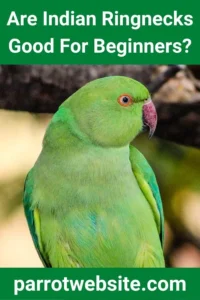
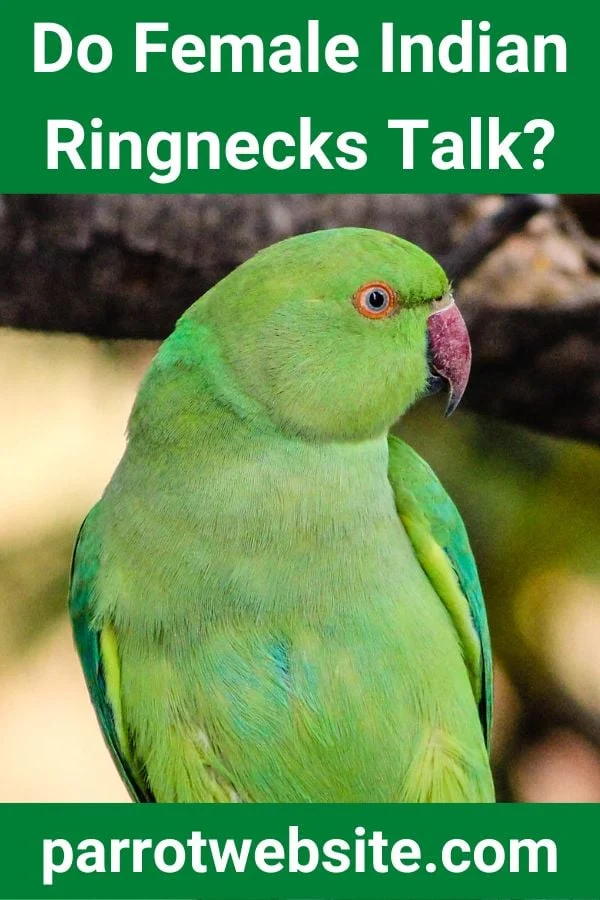
For many prospective bird owners, the primary appeal of the Indian Ringneck parrot (Psittacula krameri) lies in their striking emerald plumage and their reputation for being highly intelligent, interactive companions. Yet, nestled among the questions regarding diet, cage size, and temperament is one recurring inquiry that often dictates a potential owner’s final decision: "Can they talk?" While the male of the species is frequently touted for his loquacious nature, a lingering misconception persists regarding the vocal potential of the females.
The reality is that female Indian Ringnecks are not just capable of speech; they are, in many instances, remarkably adept linguists. Understanding the nuance of their vocalization, the biological drivers behind their chatter, and the best practices for training is essential for any owner looking to cultivate a communicative relationship with their avian companion.
Main Facts: Debunking the Gender Myth
The fundamental scientific consensus is that both male and female Indian Ringnecks possess the identical neurological hardware required to mimic human speech. Unlike some species where sexual dimorphism dictates a stark contrast in vocal capability, the Indian Ringneck exhibits a more subtle difference in inclination rather than capacity.
Female Indian Ringnecks are, by nature, chatty, inquisitive, and highly social creatures. They possess the ability to master an expansive vocabulary of words and complex phrases. While individual personality plays a massive role—some females may be naturally reserved while others are social butterflies—the species as a whole is classified among the top tier of "talking" parrots. The notion that females are "quiet" is a misnomer; they are simply less driven by the evolutionary pressures that compel the male to demonstrate his vocal prowess.
Chronology of Development: From Chirp to Sentence
The journey of a parrot’s speech development is a fascinating timeline that requires patience and consistent interaction from the owner.
The Early Stages (0–8 Months)
During the first several months of life, your young Indian Ringneck will spend most of her time observing. She will be listening to the cadence of your voice, the ambient sounds of the household—from the microwave beep to the jingle of keys—and the vocalizations of other birds. While she may not produce recognizable human words during this phase, she is building her auditory library.
The Initial Breakthrough (8–12 Months)
Most female Indian Ringnecks begin to experiment with mimicking speech around the eight-month mark. This is a critical period. Owners often report that the first sounds are garbled or "mumbled." It is important not to discourage this, as it is the bird’s way of practicing vocal cord control and inflection. By the one-year milestone, most females will have begun to articulate their first clear words.
The Refinement Phase (1–3 Years)
Between the first and third year of life, the parrot’s vocabulary will expand rapidly. This is the period where they shift from simple mimicry to contextual usage. A well-socialized female will begin to associate specific phrases with specific actions or times of day—such as saying "Hello" when you enter the room or "Goodbye" when you pick up your keys. By age three, their speech patterns are usually solidified, though they will continue to learn new phrases throughout their long lives.
Supporting Data: The Biological Basis for Chatter
Why do males often outperform females in the "talking" department? To answer this, we must look at the evolutionary biology of the Psittacula krameri.
Territoriality and Mate Attraction
In the wild, the male Indian Ringneck’s vocal ability serves a distinct evolutionary purpose. Males are responsible for establishing and defending territory. Their ability to produce a loud, clear, and complex song is a direct signal of their vitality to potential mates. A male with a larger vocabulary and a more robust voice is perceived as "higher quality" by females.
Conversely, the female does not have the same evolutionary pressure to "perform." Her role in the wild is focused on nest selection and chick rearing. Because she does not need to attract a mate through song, she is naturally less inclined to utilize vocal mimicry as a primary tool for survival or status. However, this does not mean she lacks the skill; it simply means she lacks the instinctive drive to broadcast it as frequently as the male.
Environmental Influence
Data suggests that the "talkativeness" of a female Indian Ringneck is highly correlated with the amount of engagement she receives. Because they are social flock animals, they mimic what they hear to integrate themselves into their "human flock." If an owner speaks to their female Ringneck with clarity, frequency, and enthusiasm, the bird will almost invariably mirror that behavior.
Training Strategies: Cultivating the Communicator
Training a female Indian Ringneck is less about "drilling" and more about creating a positive, communicative environment.
Positive Reinforcement
The most effective training tool is the use of a clicker combined with high-value treats. When the bird vocalizes a sound that resembles your target word, click immediately and offer a reward. This Pavlovian connection reinforces the behavior, encouraging the bird to repeat the sound to earn the treat.
The Importance of Context
Parrots are more likely to learn words that have a functional purpose in their daily lives. Phrases like "Good morning," "Night-night," or "Want a treat?" are learned faster than abstract words because they are tied to specific, predictable daily routines.
Avoiding Complacency
Many owners make the mistake of stopping training once the bird says its first word. This is a critical error. The "teenage" years of a parrot (1–2 years old) are when their brain is most plastic. Continuing to introduce new vocabulary, playing audio recordings of clear speech, and engaging in "conversations" with your bird will ensure she reaches her full potential as a talker.
Implications for Owners: What If She Doesn’t Talk?
Despite the best efforts, some birds simply remain "quiet." If you find yourself in this situation, it is important to analyze the context of your bird’s silence.
Distinguishing Between Temperament and Health
If your female Ringneck is physically active, eating well, and producing non-human sounds (whistling, clicking, chirping), then her lack of speech is likely just a matter of individual personality. Some birds are observers; they are content to watch the world without feeling the need to vocalize in human tongue.
However, if your bird has suddenly stopped making any sound at all, this is a significant red flag. A sudden change in vocal habits is often the first symptom of a health issue, such as an upper respiratory infection or psychological distress. In such cases, a consultation with an avian veterinarian is mandatory.
Setting Expectations
For the prospective owner, the decision should not rest solely on the bird’s ability to talk. Indian Ringnecks are complex, long-lived, and highly demanding pets. Whether or not your specific female becomes a chatterbox, she will form a deep, emotional bond with you if treated with respect and provided with a stimulating environment. If a "talking" bird is your only requirement for a pet, consider that a parrot is a living, thinking creature, not a programmable recording device.
Conclusion
The female Indian Ringneck is a brilliant, capable, and often chatty bird that frequently defies the "male-only" stereotype of avian speech. While they may not have the same instinctive, territorial drive to vocalize as the males, their cognitive capacity for language is equal.
With consistent, positive, and patient training, most female Indian Ringnecks will develop a vocabulary that brings joy and entertainment to their owners for many years. When selecting your companion, look for signs of intelligence and engagement rather than just gender. By fostering a environment of trust and communication, you are not just training a bird to talk—you are building a lifelong relationship with an intelligent, sentient partner who will, in her own way, find the words to tell you she is happy to be part of your flock.