COLORADO SPRINGS, Colo. — In the shadow of the Rocky Mountains, where modern metropolitan growth meets ancient geological secrets, paleontologists have unspooled a remarkable new chapter in the history of North American reptiles. Researchers working in the fossil-rich badlands of Colorado’s Denver Basin have announced the discovery of a brand-new species of extinct alligator that shatters previous timelines for the group.
Named Mandrasuchus milleri, this newly described prehistoric predator lived during the Early Paleocene epoch, shortly after the cataclysmic asteroid impact that wiped out the non-avian dinosaurs some 66 million years ago. Identified from remarkably well-preserved fossil remains unearthed in the Lower Paleocene Denver Formation of Corral Bluffs, M. milleri has officially been crowned the oldest known alligatorine—and a vital Rosetta Stone for understanding how life recovered and diversified in the wake of Earth’s fifth mass extinction.
The discovery, detailed in a recent study published in the Journal of Vertebrate Paleontology, was led by a collaborative team of researchers including E. J. Lessner, S. M. Sherman, H. Petermann, E. Panigot, F. Duffy, and T. R. Lyson. Their findings not only introduce a fascinating new beast to the prehistoric menagerie of North America but also shed light on an elusive branch of the crocodilian family tree.
Main Facts: Unveiling Mandrasuchus milleri
At first glance, Mandrasuchus milleri would have looked somewhat familiar to anyone acquainted with modern crocodilians, yet its specialized anatomy reveals an ecological niche distinct from today’s American alligator (Alligator mississippiensis).
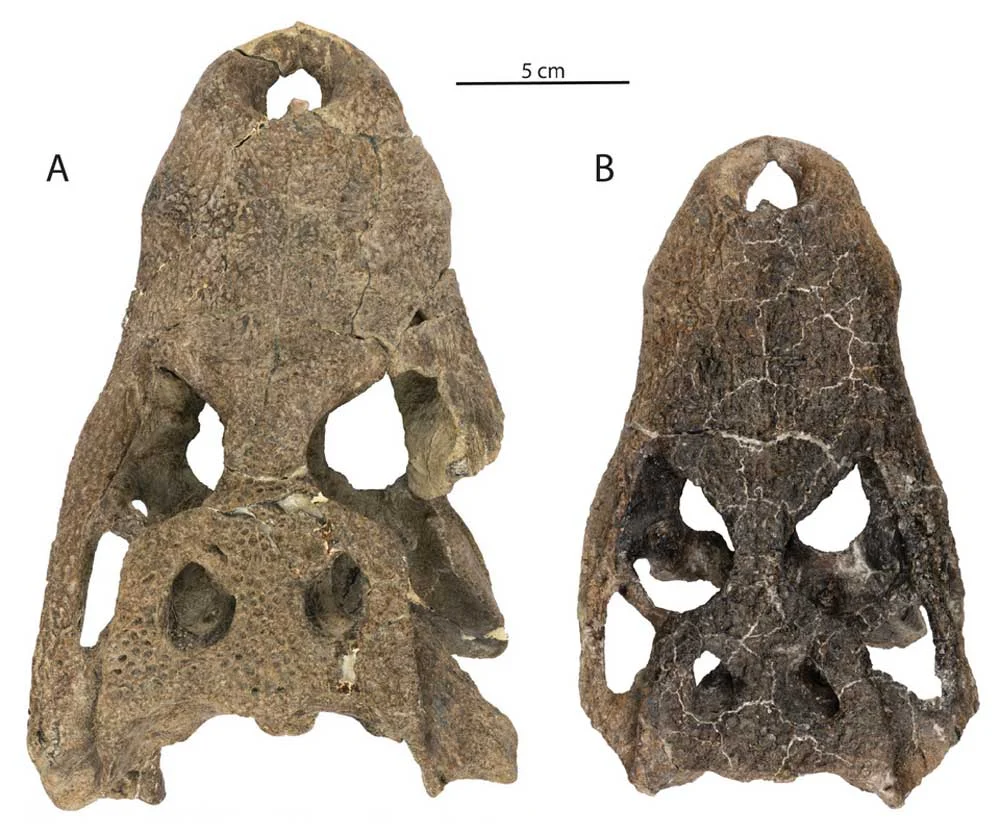
Reaching an estimated length of approximately 2 meters (about 6.5 feet) from snout to tail-tip, M. milleri was a medium-sized predator. However, it is the creature’s facial and dental architecture that has most excited the scientific community. The species was formally identified and differentiated from its contemporaries by two primary anatomical features: a distinctively blunted rostrum (snout) and globular caudal dentition—meaning its rear teeth were rounded, bulbous, and built for crushing rather than piercing.
A Generalist Diet of Tough Prey
The combination of a blunt snout and rounded posterior teeth points directly toward the animal’s dietary preferences. Paleontologists categorize M. milleri as a "macro generalist." While it was undoubtedly capable of taking down larger vertebrate prey that ventured too close to the water’s edge, its powerful, crushing back teeth suggest it specialized in a menu of heavily armored or hard-shelled organisms.
In the freshwater ecosystems of Paleocene Colorado, this likely meant a steady diet of freshwater mollusks, crustaceans, and potentially even early freshwater turtles. Where other predators might have struggled to break through tough shells, M. milleri possessed the biological hardware to crunch through them with ease.
The Burrowing Behavior Hypothesis
Adding to the intrigue of M. milleri is how it interacted with its physical environment. The research team posits that these ancient reptiles may have engaged in burrowing behavior—a trait seen in some modern crocodilians facing extreme environmental stressors, but rarely documented with such physical circumstantial evidence in the fossil record.
Fossils recovered from Corral Bluffs are occasionally encased in unique, phosphate-rich rock nodules known as concretions. These structures can form around organic remains, acting as a geological time capsule that preserves delicate bones in exquisite detail. Scientists believe these mineral formations were catalyzed by decaying soft tissues and intense bacterial activity. Crucially, the researchers theorize that these very same concretion-forming processes might trace back to the physical burrows excavated and inhabited by M. milleri itself, providing a rare glimpse into the subterranean shelters of a Paleocene reptile.
Chronology: Life After the Dinosaur Extinction
To understand the true significance of Mandrasuchus milleri, one must look backward through the geological clock to the dawn of the Cenozoic Era—specifically, the Danian stage of the Early Paleocene epoch.
The K-Pg Boundary and Ecological Recovery
Roughly 66 million years ago, the Cretaceous-Paleogene (K-Pg) extinction event wiped out approximately 75% of all plant and animal species on Earth, most notably the non-avian dinosaurs. While the catastrophe devastated global ecosystems, it also opened up vast ecological vacuums.
For decades, paleontologists have intensely studied how surviving lineages—particularly mammals, birds, and reptiles—rebounded from this global trauma. The Corral Bluffs site in the Denver Basin has emerged as one of the premier fossil localities in the world for tracking this exact post-extinction recovery, capturing the rapid evolution and radiation of life during the first million years of the Paleocene.
The Timeline of Discovery
- The Excavation: Over several years of meticulous fieldwork in the Denver Basin’s Corral Bluffs, researchers unearthed the fragmented yet diagnostic fossil remains that would eventually define the new species.
- Laboratory Analysis: Paleontologists spent countless hours cleaning the specimens, extracting them from their stubborn phosphate-rich nodules, and conducting comparative anatomical studies against known Mesozoic and Cenozoic crocodilians.
- Phylogenetic Placement: Through rigorous cladistic analysis, the team determined that the animal did not neatly fit into existing evolutionary boxes. Instead, it represented an ancient, previously unrecorded branch of alligatorines.
- Formal Description (2026): The research was officially submitted and published under the title "New alligatorid, Mandrasuchus milleri, from the Early Paleocene (Danian) of the Denver Basin supports earliest Paleocene North American alligatorid radiation" in the Journal of Vertebrate Paleontology.
Supporting Data: Filling the Phylogenetic Gaps
In evolutionary biology, classification relies on constructing family trees, or phylogenies, based on shared anatomical traits and genetic data (when available). For extinct lineages, scientists must rely entirely on morphology—the shape and structure of bones.
According to the research team, Mandrasuchus milleri represents a new representative of what they term an “unresolved portion of the crocodylian phylogeny.” This phrase describes a branch on the evolutionary tree where relationships remain murky because transitional fossils have historically been missing or too poorly preserved to tell a definitive story.
Anatomy as a Map
By analyzing the specific cranial proportions, jaw mechanics, and dental morphology of M. milleri, the authors were able to anchor the species firmly as the earliest confirmed alligatorine (members of the alligator family, Alligatoridae, which includes modern alligators and caimans).
| Feature of Mandrasuchus milleri | Anatomical Trait | Ecological Implication |
|---|---|---|
| Size | ~2 meters in length | Mid-tier predator; manageable scale for terrestrial/aquatic duality. |
| Snout | Blunted rostrum | Enhanced bite force distribution for crushing. |
| Teeth | Globular caudal dentition | Specialized for breaking hard-shelled prey (mollusks, turtles). |
| Habitat Use | Phosphate nodule association | Potential burrowing habits in freshwater banks. |
This combination of traits provides crucial data points that help paleontologists bridge the evolutionary gap between late Cretaceous crocodilians and the modern lineages that emerged later in the Cenozoic.
Official Responses and Scientific Perspectives
The formal announcement of Mandrasuchus milleri has generated considerable enthusiasm within the global paleontology community, particularly among specialists studying post-extinction ecosystems.
While individual statements from the multidisciplinary research team—comprising E. J. Lessner, S. M. Sherman, H. Petermann, E. Panigot, F. Duffy, and T. R. Lyson—emphasize the collaborative nature of the Denver Basin project, the consensus within their published study highlights the sheer speed at which life bounced back after the asteroid impact.
"The presence of a specialized, radiation-adapted alligatorid so early in the Paleocene changes our baseline understanding of how quickly freshwater ecosystems recovered," notes the overarching sentiment of the research paper. Rather than a slow, sluggish return to biodiversity, the fossil record at Corral Bluffs—exemplified by M. milleri—suggests an explosive burst of evolutionary experimentation.
Independent paleontologists not involved in the study have also praised the find. Experts in fossil archosaurs have noted that finding well-preserved skulls or jaw fragments from the Early Paleocene is exceptionally rare, making the diagnostic teeth and rostrum of M. milleri an invaluable benchmark for future comparative studies across North America.
Implications: Rewriting the History of North American Alligators
The discovery of Mandrasuchus milleri is far more than just the addition of a new name to a dusty scientific catalog; it carries broad implications for our understanding of climate history, evolutionary radiation, and the resilience of life on Earth.
1. Proof of Early Paleocene Radiation
For years, scientists debated whether crocodilians suffered a severe, prolonged bottleneck following the K-Pg extinction. The discovery of M. milleri strongly supports the hypothesis of an earliest Paleocene North American alligatorid radiation. This means that almost immediately after the dust settled from the asteroid impact, alligators began diversifying, splitting into specialized ecological niches, and expanding across the landscape of what is now the American West.
2. Clues to Ancient Climate and Hydrology
The Denver Basin during the Early Paleocene was drastically different from the arid or semi-arid environment seen in parts of Colorado today. It was characterized by lush, subtropical to warm-temperate forests crisscrossed by winding river systems and expansive freshwater swamps. The lifestyle of M. milleri—requiring a rich abundance of freshwater mollusks, crustaceans, and aquatic turtles—paints a vivid picture of a thriving, highly productive aquatic network. Furthermore, if the hypothesis regarding its burrowing behavior is correct, it indicates that these animals possessed behavioral adaptations to survive seasonal droughts or environmental fluctuations during a notoriously volatile climatic period (such as the Paleocene-Eocene Thermal Maximum precursors).
3. A Beacon for Future Discoveries
As researchers continue to scour the badlands of Corral Bluffs and the broader Denver Formation, Mandrasuchus milleri serves as a powerful reminder of how much prehistoric history still lies hidden beneath our feet. Each phosphate nodule cracked open in a laboratory has the potential to rewrite a paragraph of Earth’s history.
For now, Mandrasuchus milleri stands proudly as the ancient patriarch of the alligator family—a tough, shell-crushing survivor that stepped out from the ashes of the dinosaurs to claim its place in the rivers of primordial Colorado.