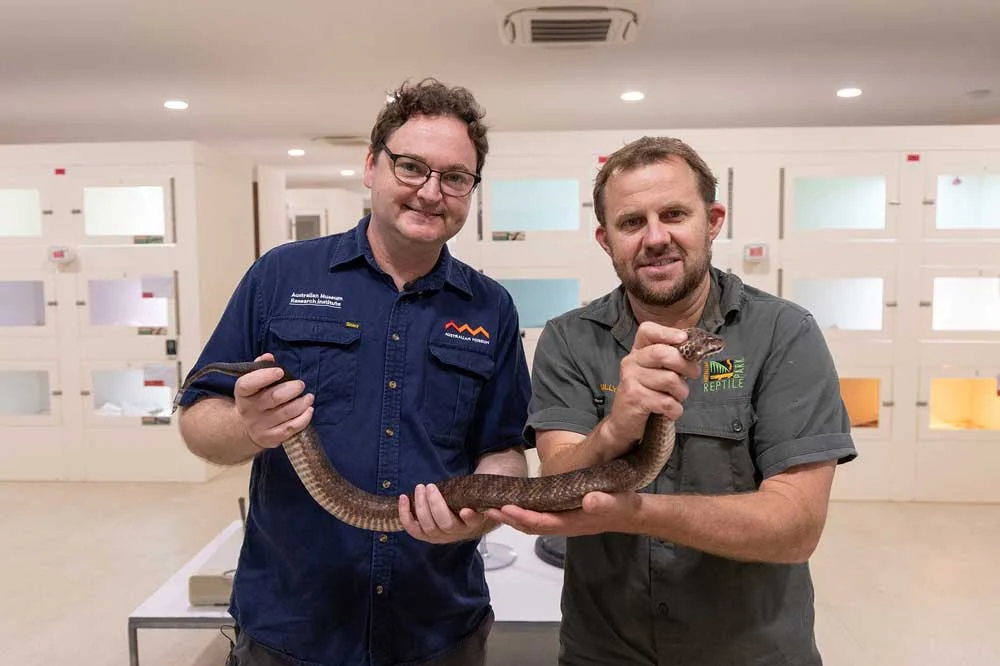
NEW SOUTH WALES, AUSTRALIA — In the sprawling, sun-baked landscape of Australia’s reptile kingdom, where formidable predators are practically a dime a dozen, a singular apex reptile has quietly been making history. Her name is Shazza, and she is, without a shred of hyperbole, a monster among her kind.
Jointly announced by the Australian Reptile Park and the Australian Museum Herpetology Department, Shazza has officially been recognized as the largest living common death adder (Acanthophis cerastinus) ever recorded. Measuring a staggering 110 centimeters (approximately 3.6 feet) in total length, this extraordinary elapid is nearly double the size of an average adult specimen of her species.
While her sheer physical dimensions are enough to command the immediate attention of herpetologists and thrill-seekers alike, Shazza is far more than a sideshow oddity. Housed securely within the specialized facilities of the Australian Reptile Park for the past nine years, she is a vital contributor to the nation’s life-saving antivenom production program. As she continues to defy biological expectations, growing at an advanced age and packing a venom yield as terrifying as her physical stature, Shazza represents a fascinating intersection of record-breaking wildlife biology and critical public health infrastructure.
Main Facts: The Anatomy of a Titan
To truly understand the anomaly that is Shazza, one must first look at the baseline statistics of the common death adder. Typically, male common death adders grow to an average length of around 42 centimeters, while females generally top out at a modest 55 centimeters.
Shazza completely obliterates these metrics. Her physical measurements paint a picture of an absolute titan:
- Total Length: 110 cm (nearly double the average female size)
- Snout-to-Vent Length: 95 cm
- Total Weight: 1.55 kg (up from 1.41 kg in 2023)
In the serpentine world, a weight of over 1.5 kilograms for a death adder is practically unheard of. These ambush predators are traditionally characterized by a stout, viper-like build—short, thick bodies coupled with broad triangular heads—but Shazza takes this robust body plan to an entirely different, almost surreal level.
Furthermore, Shazza is a cornerstone of the Australian Reptile Park’s dedicated venom extraction program. Capable of producing a phenomenal 270 milligrams of venom in a single milking session, her output doubles that of a standard common death adder. Because the park’s milking program is directly responsible for supplying the raw material needed to manufacture life-saving antivenom across Australia, Shazza’s outsized biological footprint translates directly into human lives saved.
Chronology: Nine Years of Quiet Growth Behind the Scenes
Though her public coronation as a record-breaking specimen is recent, Shazza’s journey to scientific renown has been unfolding over the better part of a decade.
- 2015–2016 (Arrival): Shazza arrived at the Australian Reptile Park as a juvenile/young adult specimen. Even in her early days at the facility, seasoned keepers recognized that she possessed atypical growth trajectories. Park Manager Billy Collett recalls his initial encounter with the snake, noting that he immediately recognized her potential to exceed the one-meter mark—a monumental milestone for the species.
- The Intervening Years: Over the next several years, Shazza adapted to life within the park’s high-security venom milking rotation. While most snakes experience a rapid growth spurt during their neonatal and juvenile phases before leveling off into a slow, steady maintenance phase, Shazza continued to defy standard developmental curves.
- 2023 (The Check-In): Researchers logged a milestone measurement in 2023, where Shazza tipped the scales at 1.41 kilograms while measuring 102 centimeters in total length. This confirmed to herpetologists that her growth, while slowing down, had not yet ceased entirely.
- Present Day (The Record Announcement): Following comprehensive updates to her measurements—clocking her at 110 cm and 1.55 kg—the Australian Reptile Park and the Australian Museum Herpetology Department formally announced her status as the largest living common death adder on record. At approximately 15 years of age, experts believe she still has minor growth potential left in her lifespan, raising the tantalizing possibility that she could eventually challenge the all-time historical record.
Supporting Data: Pushing the Boundaries of Herpetology
To appreciate how anomalous Shazza truly is, scientists look to historical benchmarks preserved in institutional archives.
The absolute largest death adder ever recorded in history is a specimen currently preserved within the Australian Museum Collection. At the time of its death, that historic venomous snake measured 117 centimeters in total length, with a snout-to-vent length of 101 centimeters.
Shazza is now hot on the heels of this historical record. Dane Trembath, Collection Manager of Herpetology at the Australian Museum Research Institute, notes that while snakes normally experience their most aggressive growth phases early in life, Shazza’s prolonged developmental timeline has blown past standard biological expectations.
“Most snakes have this initial growth spurt when they are born… she’s way beyond that so her growth will now slow down,” Trembath explained. “As she slowly grows, she may actually surpass the biggest death adder ever recorded, but we don’t know how long that is gonna take.”
Compounding the biological significance of her size is her venom capacity. A standard milking from an average common death adder yields a fraction of what Shazza produces. Delivering a consistent 270 milligrams per extraction, her biological output matches her physical scale—roughly twice the normal capacity. In the high-stakes world of toxinology, volume is everything, and Shazza’s oversized glands provide an extraordinarily rich resource for researchers and pharmaceutical producers alike.
Official Responses: Fear, Awe, and Scientific Respect
The discovery and ongoing care of a specimen like Shazza have elicited strong reactions from the professional herpetological community, blending deep scientific respect with a very healthy dose of caution.
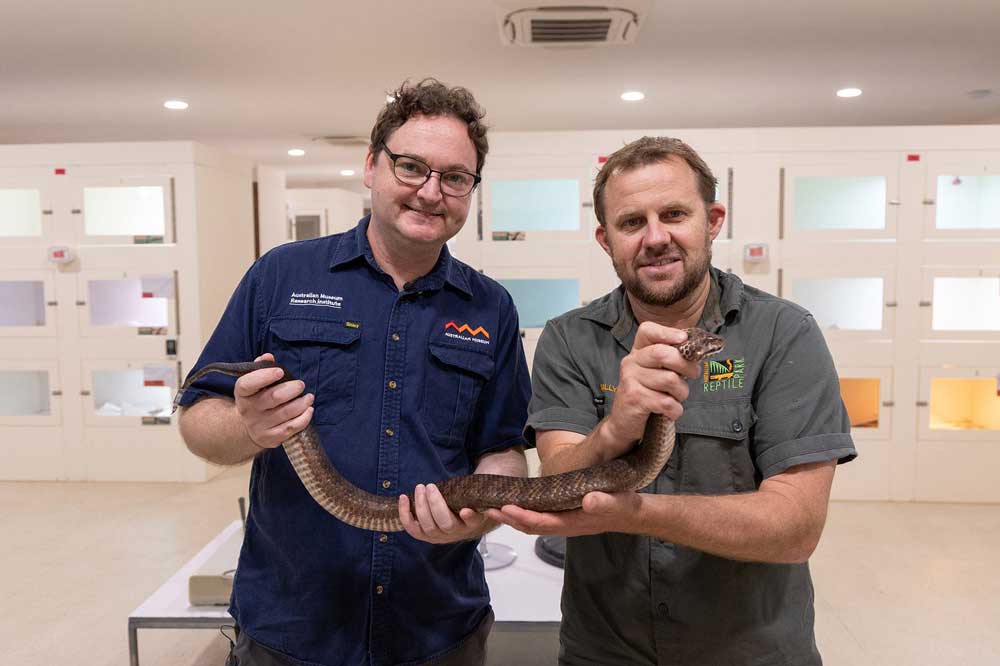
Park Manager Billy Collett, who works hands-on with some of the most dangerous animals on the planet, did not mince words when describing the psychological impact of handling the giant snake.
“The moment I first laid eyes on her… I knew she was just a monster and her potential to get over a metre was definitely there,” Collett stated in a media release. “I don’t want to get bitten by any snakes, but I cannot get bitten by her. She’s so big, her venom yields are so big, it’s frightening.”
Despite the inherent danger of managing an elapid of this magnitude, Collett is quick to pivot to the profound positive impact Shazza has on human safety. Because Australia boasts some of the world’s most venomous creatures, robust antivenom pipelines are an absolute necessity.
“Her venom yields are literally twice the size of the average Common Death Adder,” Collett emphasized, “so there’s no doubt she’s saving more human lives with the venom she’s producing.”
Dane Trembath of the Australian Museum echoed this sentiment of awe, emphasizing how rare it is to encounter a specimen that so thoroughly rewrites the field guides regarding maximum size limits for Australian elapids. For researchers who spend their lives cataloging biodiversity, Shazza represents a thrilling living outlier that challenges our understanding of reptilian longevity and growth potential.
Implications: Understanding the Death Adder Genus
Shazza’s fame casts a brilliant spotlight on her broader taxonomic family. While colloquially called "adders" and bearing a striking morphological resemblance to true vipers—complete with stout bodies, triangular heads, and vertical pupils—death adders are actually part of the Elapidae family. This means they are evolutionary cousins to cobras, mambas, coral snakes, and Australia’s own lethal taipans.
The Diversity of Death Adders
There are currently eight recognized species of death adders within the genus Acanthophis:
- Common Death Adder (Acanthophis antarcticus / cerastinus)
- Kimberley Death Adder (Acanthophis cryptamydros)
- Barkly Tableland Death Adder (Acanthophis hawkei)
- Papuan Smooth-Scaled Death Adder (Acanthophis laevis)
- Northern Death Adder (Acanthophis praelongus)
- Desert Death Adder (Acanthophis pyrrhus)
- Rough-Scaled Death Adder (Acanthophis rugosus)
- Pilbara Death Adder (Acanthophis wellsi)
Ecology and Venom Dynamics
Death adders are legendary ambush predators. Unlike active foragers like whip snakes or racers, death adders employ a patient, sedentary hunting strategy. They coil themselves into leaf litter, loose soil, or sand, using specialized camouflage to blend seamlessly into their surroundings.
To entice prey—which primarily consists of small mammals, ground-dwelling birds, frogs, and lizards—they utilize a fascinating evolutionary adaptation known as caudal luring. By wriggling the tip of their tail (which often contrasts sharply in color with the rest of their body), they mimic the movements of a small worm or insect. When an inquisitive lizard or bird approaches to investigate the "bug," the death adder strikes with blinding speed.
Their venom is a potent neurotoxin. Unlike many vipers whose venom primarily causes hemotoxic tissue damage, death adder venom specifically targets the nervous system. It interferes with nerve signaling at the neuromuscular junction, rapidly leading to progressive paralysis. If a human victim is bitten and left untreated, this neurotoxic action can cause respiratory failure and, ultimately, death.
Conservation and Public Health Significance
Because death adders frequently inhabit areas overlapping with human settlement, suburban expansion, and agricultural zones across Australia, interactions between humans and these camouflaged ambushers have historically posed significant medical challenges. Before the invention of effective antivenom, a bite from a death adder carried a grim prognosis.
Today, thanks entirely to dedicated conservation breeding programs, venom-milking facilities like the Australian Reptile Park, and scientific partnerships with institutions like the Australian Museum, death adder antivenom is readily available in medical centers across the country.
In this grand medical ecosystem, Shazza plays a disproportionately large role. By continuously pumping out record-breaking quantities of high-potency neurotoxic venom, this gentle giant—despite terrifying her handlers with her sheer mass—serves as an invaluable guardian angel for Australian public health. As she inches closer and closer to challenging the all-time historical size record, Shazza remains a living testament to the wild, untamed, and endlessly surprising nature of Australia’s unique wildlife.