NEW YORK — As global temperatures steadily rise and planetary ecosystems face unprecedented stress, conservationists are constantly searching for silver linings in the shifting natural world. While climate change threatens countless species with habitat loss, thermal stress, and extinction, a recent study offers a glimmer of hope for one of North America’s most charismatic freshwater reptiles: the wood turtle (Glyptemys insculpta).
New findings published by researchers at the Great Hollow Nature Preserve and Ecological Research Center in Connecticut reveal that wood turtles may find a crucial lifeline in the vertical geography of the northeastern United States. By trekking to higher elevations in regions like New York’s Catskill Mountains, these intelligent and long-lived reptiles could successfully weather the storm of a warming planet. However, the study also sounds an urgent alarm, highlighting glaring blind spots in current conservation frameworks that must be addressed before lowland populations are entirely squeezed out by changing temperatures.
Main Facts: Elevating the Survival Strategy of Glyptemys insculpta
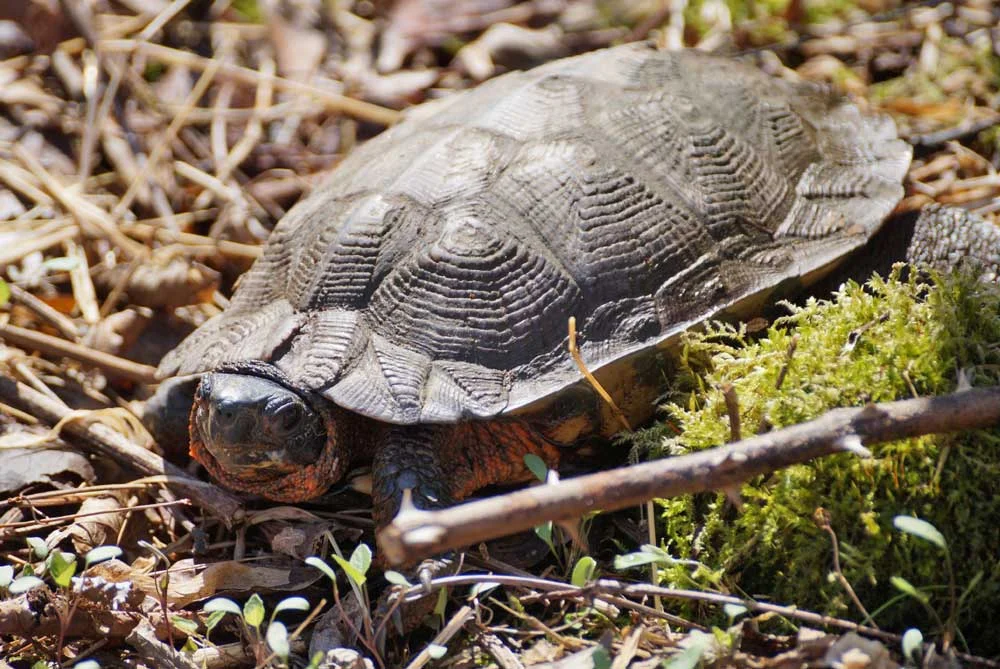
The core discovery centers on the remarkable adaptability of wood turtles when pushed toward mountainous terrain. Historically, wood turtles—recognized for their sculpted, mosaic-like upper shells, orange-hued limbs, and sharp intellect—have thrived in lowland meandering streams, adjacent floodplains, and damp terrestrial woodlands. However, as anthropogenic climate change alters the landscape, these traditional habitats are projected to degrade severely, threatened by prolonged droughts, erratic flooding, and rising ambient temperatures.
To understand how the species might respond, researchers from the Great Hollow Nature Preserve and Ecological Research Center undertook an exhaustive field survey across 28 one-kilometer stream segments in the rugged Catskill Mountains. Their findings were striking: researchers documented wood turtle populations thriving at some of the highest elevations ever officially recorded for the species.
Crucially, these high-elevation habitats provided many of the same structural and ecological features found in lowland ecosystems, such as suitable nesting substrates, clear and unpolluted running water, and adequate foraging areas. The study suggests that as lower-altitude habitats grow increasingly hostile, montane stream systems will become vital climate refuges, sustaining geographically distinct populations that have historically been overlooked by regional conservation planners.
Chronology: The Journey From Field Surveys to Climate Modeling
The path toward these revelations began with a growing recognition among herpetologists that climate change models for the northeastern United States pointed toward a grim future for lowland reptiles. To move from abstract projections to concrete ecological data, researchers initiated a multi-phase investigation into the vertical distribution of wood turtles.
Phase 1: Reconnaissance in the Catskills
In the initial stages of the project, biologists targeted the complex hydrological networks of the Catskill Mountains. Surveying 28 distinct one-kilometer stream segments, the team combed through rocky riparian zones and high-altitude tributaries. The goal was to determine whether wood turtles inhabited these steeper, colder gradients, which had previously been considered marginal or unsuitable habitat for the species due to shorter active seasons and cooler water temperatures.
Phase 2: Documenting Record Altitudes
As field surveys progressed, researchers confirmed the presence of viable wood turtle populations living at elevations previously thought to be beyond the species’ biological comfort zone. Documenting these high-altitude inhabitants proved that wood turtles possess a broader physiological tolerance than previously understood, setting the stage for deeper ecological analysis.
Phase 3: Habitat-Suitability Modeling
Following the field surveys, scientists integrated their empirical observations with broader habitat-suitability models for the northeastern United States. The spatial analysis yielded a clear trajectory: as lowland environments warm past tolerable thresholds, optimal wood turtle habitat will progressively contract and shift upward into higher-altitude zones, cementing mountain ranges like the Catskills as critical geographic strongholds.
Supporting Data: Understanding the Ecological Shift
To appreciate the gravity of these findings, one must examine the specific data driving regional habitat modeling and reptile conservation strategies in the Northeast.
- 28 Stream Segments: The breadth of the field study encompassed nearly three dozen targeted one-kilometer stretches within the Catskill montane ecosystem, ensuring a statistically robust sample size.
- Record Altitudes: The documentation of wood turtles at unprecedented elevations shatters historical assumptions regarding the vertical limits of Glyptemys insculpta.
- Contraction of Lowland Habitats: Climate projections indicate that a vast majority—potentially approaching catastrophic percentages—of existing lowland wood turtle habitats will become thermally stressed or functionally altered in the coming decades.
- The Catskills as a Thermal Hotspot: Spatial modeling confirms that the Catskill Mountain range will transition from a peripheral habitat zone into a primary climate refuge, concentrating the remaining viable populations into specific high-elevation pockets.
These data points paint a dual picture of resilience and vulnerability. While the turtles demonstrate a capacity for high-elevation survival, their long-term viability hinges entirely on whether they can successfully transition from the valleys to the peaks.
Official Responses and Scientific Perspectives
The implications of the Great Hollow Nature Preserve study have reverberated across the herpetological and conservation communities, prompting responses from wildlife biologists, ecologists, and institutional researchers.
Dr. Elaine Vance, a freshwater ecologist unaffiliated with the study, noted the profound shift in how scientists must view montane ecosystems. "For decades, we focused our conservation efforts on the broad, slow-moving river valleys where wood turtles are most easily found and studied," Vance explained. "This research forces us to look upward. The streams rushing down our mountain ranges are not just scenic waterways; they are evolutionary lifeboats."
Meanwhile, conservation planners have acknowledged a historical oversight. Because high-elevation populations were rarely documented, regional wildlife management plans rarely factored montane watersheds into wood turtle recovery blueprints. State and federal agencies are now reviewing the BioOne-published paper, titled “High-Elevation Habitat Associations of Wood Turtles (Glyptemys insculpta) in New York’s Catskill Mountains: Conservation Implications in a Changing Climate,” to update their land-acquisition priorities.
"We cannot assume that wood turtles will simply pack up and move uphill on command," cautioned a senior field biologist involved in the study. "While the high-elevation zones are there, the real question is whether the individuals stranded in degraded lowlands can bridge the geographical and anthropogenic gaps to reach them."
Implications: A Race Against Time for Glyptemys insculpta
The publication of this research opens up a critical dialogue regarding the future of reptile conservation in an era of rapid environmental transformation. Several major implications emerge from the study:
1. Rewriting Conservation Priorities
Traditional conservation strategies have prioritized the protection of large, contiguous lowland tracts where wood turtles historically concentrated. However, as climate change accelerates, these lowland areas are increasingly subjected to agricultural runoff, urban expansion, and extreme temperature fluctuations. Conservation organizations must pivot to secure high-elevation corridors, purchasing land and establishing protective easements along montane streams in the Catskills and surrounding ranges.
2. The Lowland Trap and Migration Barriers
A pressing concern raised by the researchers is the disparity in survival prospects between turtles already situated at high altitudes and those trapped in the lowlands. High-elevation turtles are inherently positioned to persist as global temperatures rise. Conversely, lowland populations face an uphill battle—literally and figuratively.
For a lowland turtle to reach the relative safety of the mountains, it must often traverse hostile landscapes fragmented by highways, residential developments, and industrial sites. Researchers emphasize that more studies are urgently required to determine whether lowland wood turtle populations possess the dispersal capacity to track climate change at the necessary pace. If they cannot migrate upward fast enough, local extinctions in the valleys could decimate total species genetic diversity.
3. Broader Lessons for Reptile Conservation
The plight of the wood turtle mirrors that of countless other ectothermic species worldwide. From sea turtles facing skewed sex ratios driven by warming sand temperatures—such as those documented on Raine Island—to freshwater turtles grappling with shifting hydrological cycles, reptiles are uniquely vulnerable to climate shifts due to their dependence on ambient environmental temperatures.
Protecting the Catskills as a wood turtle sanctuary serves as a case study in proactive climate adaptation. By identifying and safeguarding climate refuges before complete population collapses occur, conservationists can buy precious time for vulnerable species.
Conclusion
The research conducted in the Catskill Mountains by the Great Hollow Nature Preserve and Ecological Research Center provides both a sobering warning and an inspiring roadmap. Wood turtles have demonstrated a remarkable ability to adapt to higher elevations, turning rugged mountain streams into unexpected sanctuaries against a warming world.
Yet, this natural resilience is not a panacea. The survival of Glyptemys insculpta now depends on human intervention—specifically, our willingness to update conservation models, protect montane corridors, and address the daunting barriers that prevent lowland turtles from reaching higher ground. As the complete paper details in the Journal of Herpetology via the BioOne Digital Library, the window of opportunity is narrowing. By looking to the peaks, conservationists may just find the key to keeping this iconic reptile on the landscape for generations to come.