In a significant contribution to Asian herpetology, researchers have formally described a new species of venomous pit viper from the Yunnan Province of China. Published in the journal Zoological Research: Diversity and Conservation, the discovery of Trimeresurus hongheensis—commonly referred to as the Honghe green pit-viper—adds a striking new chapter to the diversity of the Trimeresurus genus. This discovery not only highlights the rich, yet fragile, biodiversity of the Honghe River Basin but also underscores the critical importance of ongoing taxonomic research in one of the world’s most ecologically complex regions.
Main Facts: A Distinct Addition to the Pit Viper Family
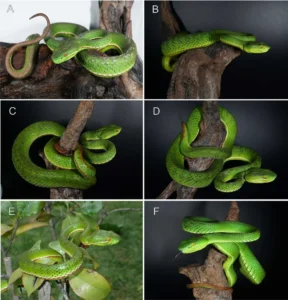
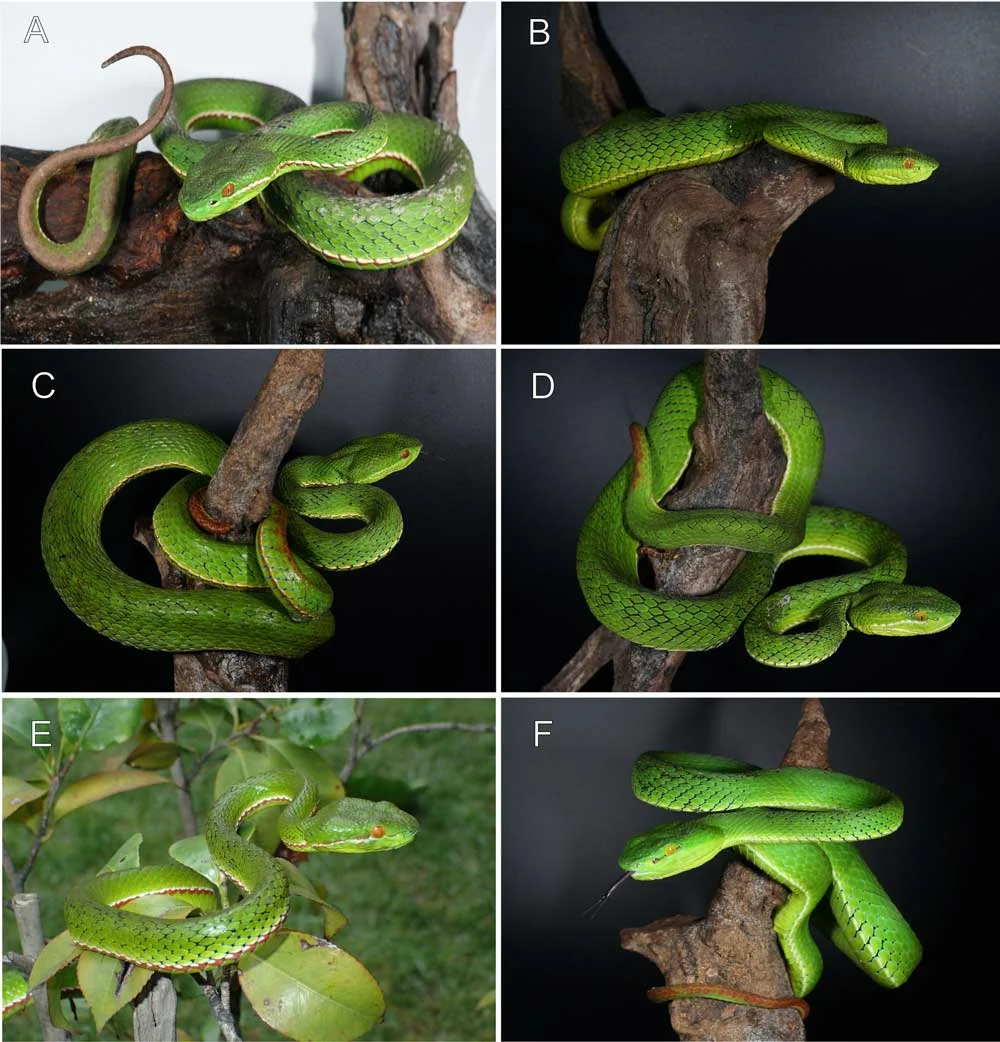
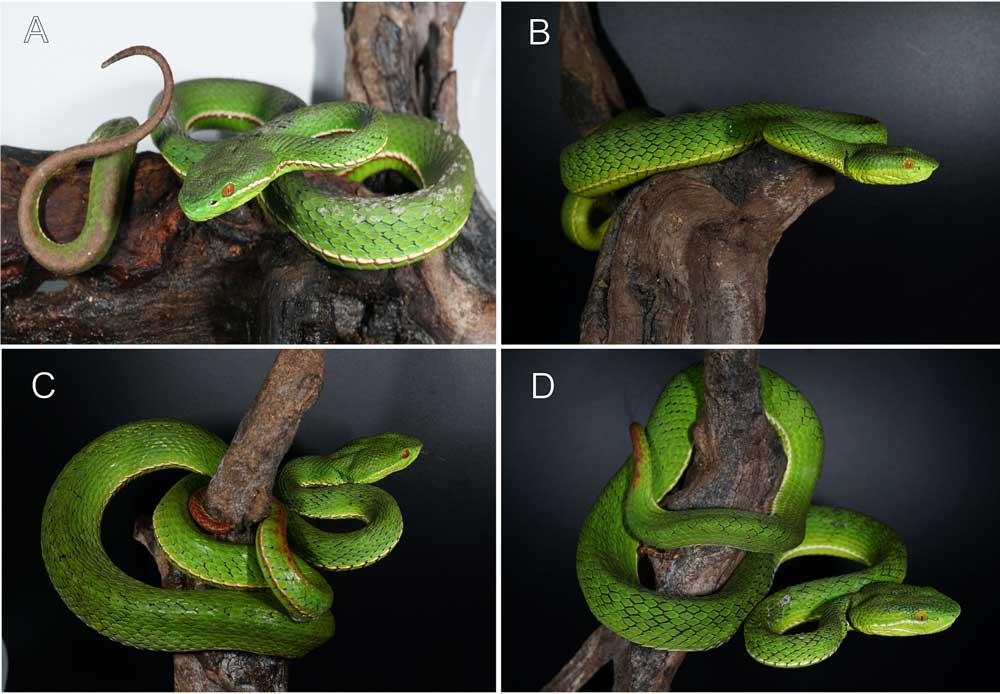
The Trimeresurus genus, part of the Crotalinae subfamily, is well-known among herpetologists for its striking colorations and specialized arboreal adaptations. The newly described Trimeresurus hongheensis is no exception. Perfectly adapted for life in the forest canopy, this snake possesses a slender, graceful body and a prehensile tail, an evolutionary trait that allows it to navigate the dense, elevated foliage of the Yunnan forests with ease.
Physical Morphology
The Honghe green pit-viper presents a sophisticated camouflage pattern. Its head and dorsum are a deep, dark green, providing excellent concealment against the forest canopy. In contrast, its belly is marked by a lighter shade of green or a soft yellow. Perhaps the most identifying feature, however, is the snake’s tail: approximately 80 percent of its length is characterized by a distinctive rusty-red coloration, which transitions into a darker, more intense red toward the tip.
Sexual dimorphism is remarkably pronounced in this species, allowing researchers to distinguish between males and females at a glance. Males possess an iris of brick red or sepia, while females display a more vibrant yellow or rusty-red iris. Furthermore, the males exhibit a notable white post-ocular stripe, often bordered by vibrant red or white, which begins near the heat-sensing pits and runs in parallel with a red stripe down the length of the body. Females, conversely, lack this white stripe entirely.
In terms of size, the species demonstrates a clear, moderate length. Field measurements indicate that males reach a snout-to-vent length (SVL) of approximately 658mm, while females are slightly larger, averaging 722mm.
Chronology: The Journey to Identification
The identification of Trimeresurus hongheensis was not a singular event, but the culmination of rigorous field surveys and subsequent integrative taxonomic analysis.
Initial Field Collections
The research process began with systematic field expeditions across the Yunnan Province. Specimens were documented and collected in forest habitats, typically perched above the ground, confirming the species’ arboreal nature. Key collection sites included:
- Mengzi City and Mingjiu: Sites where the Holotype (GXNU251201) and other representative specimens were obtained.
- Yuanjiang and Pingbian Counties: Areas where paratype specimens were identified, providing the necessary data to map the species’ range.
- Mt. Dawei: A critical location that helped establish the geographical boundaries of the species.
Integrative Analysis
Following the collection phase, the research team utilized an integrative approach, combining morphological examination with molecular phylogenetics. By comparing the DNA and physical traits of the specimens against closely related species—such as T. albolabris, T. gumprechti, T. stejnegeri, T. medoensis, and the geographically adjacent T. yunnanensis—the team was able to confirm the uniqueness of T. hongheensis. The formal description, titled "Integrative taxonomy identifies a new species of Trimeresurus Lacépède, 1804 (Reptilia: Serpentes: Viperidae) from Yunnan Province, China," was then finalized and submitted for peer review.
Supporting Data: Geographic and Evolutionary Context
The distribution of Trimeresurus hongheensis is inherently tied to the unique geography of the Yunnan Province. The species is restricted to the lower reaches of the Honghe River Basin and surrounding areas.
The Geographical Barrier
One of the most compelling pieces of data provided by the researchers is the role of natural barriers in speciation. The Ailao Mountain range and the Honghe River Basin act as a physical divide. This barrier serves as a clear boundary between T. hongheensis and its close relative, T. yunnanensis. While T. hongheensis occupies the lower reaches and areas to the east, T. yunnanensis is firmly established to the west of the Honghe River. This allopatric distribution provides a classic example of how geographical isolation contributes to the divergence of species within the Trimeresurus complex.
Genus Context
The genus Trimeresurus contains more than 150 species worldwide, all of which are venomous pit vipers. These snakes are characterized by their loreal pits, which are highly sensitive to infrared radiation, allowing them to detect the body heat of prey in near-total darkness. The discovery of T. hongheensis adds to the growing understanding of the T. albolabris complex, a group of vipers that have long challenged herpetologists due to their overlapping physical traits and subtle differences.
Official Responses and Scientific Significance
The publication of this discovery has been met with enthusiasm by the international herpetological community. The lead researchers have emphasized that the classification of T. hongheensis is not merely an exercise in naming; it is a vital step in conservation biology.
"By clearly delineating the species within the Trimeresurus complex, we can better assess the conservation status of each population," the study notes. In the past, many of these snakes were grouped together, potentially masking the vulnerability of species with more limited ranges. By identifying T. hongheensis as a distinct entity, researchers and wildlife authorities in China can now implement more targeted habitat protection policies.
The Zoological Research: Diversity and Conservation board has highlighted the importance of this study, noting that the integrative taxonomy employed provides a gold standard for future species descriptions. The availability of the study via the journal’s open-access platform ensures that scientists worldwide can access the data, facilitating further comparative studies on viperid venom composition and ecological behavior.
Implications: Biodiversity and Conservation Challenges
The discovery of Trimeresurus hongheensis carries significant implications for the future of environmental management in Yunnan.
Habitat Sensitivity
As an arboreal specialist, T. hongheensis is inherently dependent on the health of the forest canopy. The species’ reliance on specific micro-habitats within the Honghe River Basin makes it susceptible to anthropogenic threats, such as deforestation, agricultural expansion, and climate-induced changes to forest structure. The presence of this snake can now serve as a "bio-indicator" for the health of the riparian and forest ecosystems in these counties.
The Need for Continued Research
While this discovery is a triumph, it also serves as a reminder of how much remains unknown. The Yunnan Province remains one of the most biodiverse regions in the world, yet it faces immense pressure from human development. The researchers have called for:
- Extended Surveys: Further exploration of high-altitude and under-sampled areas within the Ailao Mountains to determine if the range of T. hongheensis extends beyond currently documented sites.
- Genetic Mapping: Continued molecular studies to better understand the evolutionary timeline of the Trimeresurus complex and how these vipers adapted to the specific topography of Southwest China.
- Public Awareness: Educational initiatives for local communities in Pingbian, Yuanjiang, and Mengzi to ensure that the ecological role of the Honghe green pit-viper is understood, minimizing human-snake conflicts and promoting the protection of their natural habitat.
A New Chapter in Herpetology
The formal naming of Trimeresurus hongheensis (Hónghé Zhù Yè Qīng in Chinese) marks a significant milestone. It reaffirms that even in regions where biodiversity has been studied for decades, nature still holds secrets waiting to be uncovered. For the scientific community, the focus now shifts to ensuring that the habitat of this beautiful and specialized viper is preserved for future generations. As we deepen our understanding of these creatures, we not only gain knowledge about a single species but also strengthen our grasp of the delicate, interconnected web of life in the forests of Asia.