
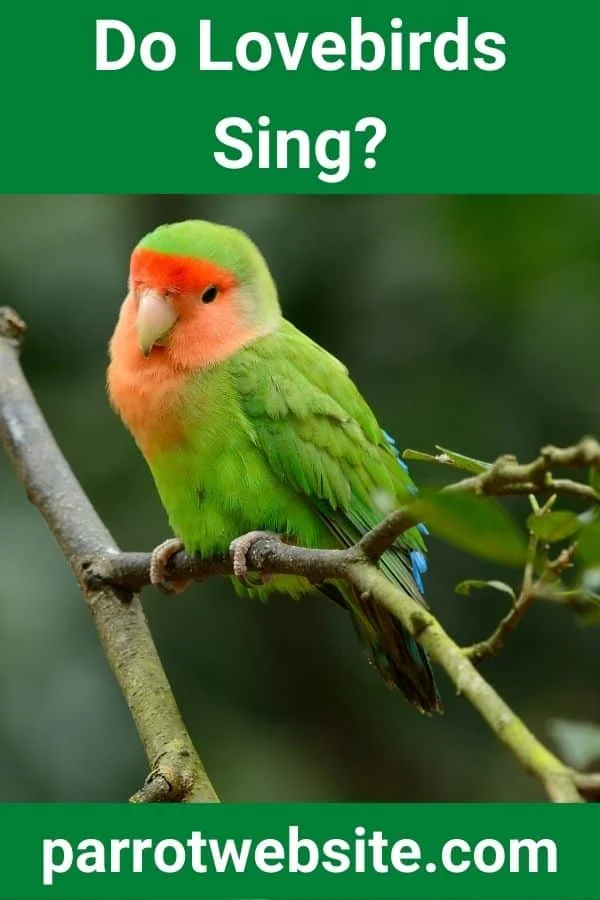
For many avian enthusiasts, the decision to bring a bird into the home is often accompanied by an expectation of "talking" parrots—the classic image of a Macaw or an African Grey repeating phrases or mimicking the doorbell. However, when prospective owners pivot toward smaller species, such as the vibrant and affectionate lovebird (Agapornis), the auditory reality of ownership is significantly different. While they may not be the chatty mimics of the parrot world, lovebirds are far from silent. They are, in fact, among the most consistently vocal and melodically active companions one can choose.
Main Facts: The Vocal Profile of the Lovebird
At the heart of the lovebird’s personality is a deep-seated need for constant communication. Unlike larger parrot species that may vocalize in bursts or specific contexts, the lovebird operates on a near-constant loop of sound.
The primary fact for any prospective owner to grasp is this: Lovebirds do not "talk" in the human sense, but they "sing" with relentless enthusiasm. Their vocalizations are composed of a complex lexicon of chirps, whistles, and trills. While they possess the biological machinery to mimic human speech, they rarely utilize it. Instead, they devote their energy to perfecting a series of melodic patterns that serve as their primary social currency.
From a behavioral standpoint, these birds are social creatures that thrive on interaction. If you live in a quiet household, a lovebird will effectively serve as your background soundtrack. They are not merely "noisy"; they are communicators. Whether they are signaling their location to a mate, reacting to environmental stimuli, or simply entertaining themselves during a quiet afternoon, lovebirds are biologically hardwired to remain vocal throughout the day.
Chronology: The Lifecycle of Sound
The development of a lovebird’s vocal repertoire is a fascinating progression that begins almost immediately after hatching.
- The Fledgling Stage: During the first few weeks of life, a lovebird’s vocalizations are limited to soft, begging peeps intended to solicit food from their parents. As they grow and begin to explore their surroundings, these peeps evolve into more distinct chirps.
- The Juvenile Phase: As young lovebirds begin to interact with their peers, they undergo a period of "vocal play." Much like a human toddler babbling, young lovebirds will experiment with different pitches and rhythms. This is the period where they begin to pick up ambient sounds in their environment, including the melodies of other birds or even the rhythmic patterns of household electronics.
- Adulthood: By the time a lovebird reaches maturity, its song is solidified. If kept in a pair—which is widely considered the gold standard for their psychological well-being—these songs begin to synchronize. Over time, a bonded pair will develop a unique "duet," a shared melody that identifies them to one another. This synchronization is a hallmark of the species, reinforcing the pair bond that gives the lovebird its name.
Supporting Data: Decibels and Dynamics
While lovebirds are physically small, they are acoustically powerful. When assessing the impact of a lovebird on a household, one must look at the frequency and intensity of their vocal output.
The Science of the "Chirp"
Research into avian acoustics suggests that small parrots like lovebirds utilize high-frequency vocalizations to ensure their messages carry over ambient noise in their natural habitats. In a domestic setting, these high-frequency chirps can be remarkably piercing. While they do not hit the extreme decibel levels of a Moluccan Cockatoo, their persistent nature—often lasting from sunrise to sunset—can be more fatiguing to the average human ear than the occasional loud "squawk" of a larger parrot.
The "Pairing" Effect
Data from avian behaviorists consistently indicates that owning a single lovebird vs. a pair changes the auditory profile of the home. A single bird will often seek to communicate with its human owner, treating them as their primary "flock." A pair, however, enters a feedback loop. One bird whistles, the other responds. This "duet" is constant. While two lovebirds are generally happier and more emotionally stable, the volume of the household will inevitably double as they maintain a constant dialogue with one another.
Official Perspectives: The Expert Consensus
Ornithologists and avian veterinarians frequently weigh in on the "talking vs. singing" debate regarding the Agapornis genus. The consensus is clear: if you are seeking a bird for its ability to mimic human language, you are looking at the wrong species.
"Lovebirds are masters of melody, not mimicry," says Dr. Elena Vance, an avian behavioral specialist. "Their vocal apparatus is designed for sharp, rhythmic sounds that allow them to communicate across dense vegetation in the wild. When we keep them in our homes, they apply that same survival instinct to their cage and their owners. Expecting a lovebird to speak is like expecting a canary to bark. It is not their nature."
Veterinarians also point out that a sudden cessation of singing is often a medical red flag. Because these birds are so inherently vocal, a quiet lovebird is often a stressed or ill lovebird. Consequently, the noise level is not just a personality trait—it is an indicator of health.
Implications for Prospective Owners
For those considering adding a lovebird to their home, the implications of their vocal nature are significant. Understanding these implications is the difference between a successful, harmonious ownership and a stressful one.
1. The Need for Environmental Enrichment
Because lovebirds use singing as a tool for boredom relief, a silent lovebird is likely an under-stimulated one. Owners must provide a variety of toys and foraging opportunities to give the bird productive outlets for its energy. If a lovebird is not whistling or chirping, it may be bored, which often leads to destructive behaviors like feather plucking.
2. The Social Requirement
The choice to keep a single lovebird is a heavy responsibility. If you do not have a partner for your bird, you must become the partner. This requires hours of daily interaction, whistling, and talking. However, be aware that even with your best efforts, you will never truly replace the companionship of another bird. This is why most ethical breeders and shelters strongly advocate for keeping lovebirds in pairs.
3. Home Environment Compatibility
Before purchasing, consider the acoustic environment of your home. If you work from home or require absolute silence for focus, a lovebird may prove challenging. Their song is not "background noise" in the way a radio is; it is a living, breathing presence that demands attention.
4. Training for Silence?
It is a common question: "Can I train my lovebird to be quiet?" The answer is a firm no. You can, however, learn to "manage" the noise through positive reinforcement. Rewarding the bird with treats or attention when it is quiet can occasionally curb excessive screaming, but you will never extinguish the natural urge to chirp. You are essentially asking a bird to suppress its primary language.
Conclusion: Embracing the Melody
The lovebird is a creature of immense spirit and constant song. To bring one into your home is to accept a permanent shift in your auditory landscape. While they may not offer the novelty of a talking parrot, they provide something arguably more beautiful: a rhythmic, melodic, and deeply social connection that spans the entire day.
Whether they are whistling a complex tune to their mate or chirping a rhythmic greeting to you as you walk through the door, the lovebird’s voice is the soundtrack of a thriving, happy, and bonded bird. For the right owner—someone who finds joy in the constant presence of a cheerful, singing companion—there is no finer choice. If you are prepared for the "incessant" nature of their vocalizations, you will find that their song is not just noise, but a heartwarming testament to their vibrant, affectionate, and endlessly communicative nature.