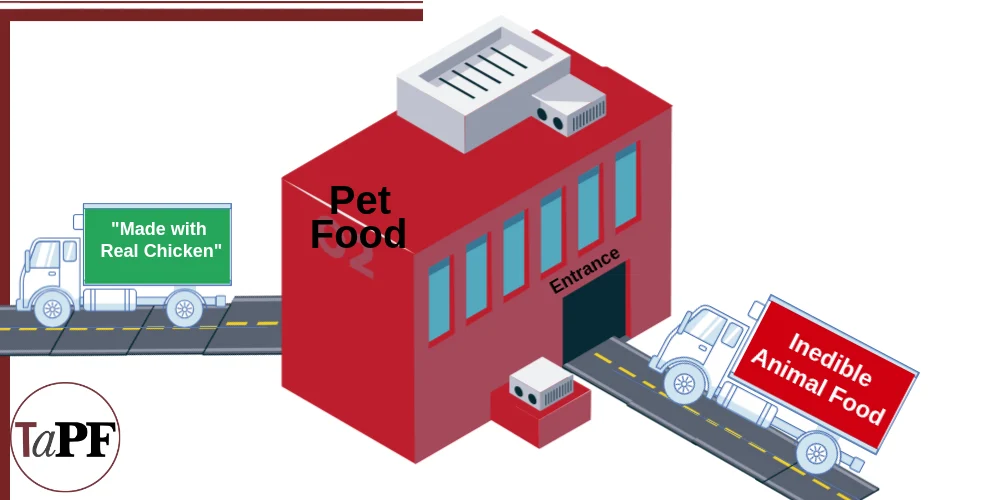
In the complex web of American food regulation, a startling discrepancy exists between the standards for what humans eat and what is permitted in the bowls of their animal companions. While federal law mandates rigorous labeling and disclosure for meat deemed unfit for human consumption, these requirements vanish the moment that material crosses the threshold of a pet food manufacturing facility. This regulatory "black hole" allows meat from diseased, dying, and even already-dead animals—legally classified as "inedible"—to be rebranded as "chicken," "beef," or "pork" on pet food labels.
The following investigative report explores the jurisdictional divide between federal agencies, the legal history of the fight for transparency, and the economic implications for a consumer base that contributes billions of dollars to the national economy.
I. Main Facts: The "Inedible" Labeling Disconnect
At the heart of the controversy is a stark transition in terminology. Under the jurisdiction of the United States Department of Agriculture (USDA), animal material that is condemned or derived from "4D" livestock—animals that are dead, dying, disabled, or diseased—must be handled with extreme caution to prevent it from entering the human food supply.
The Mandatory "Inedible" Label
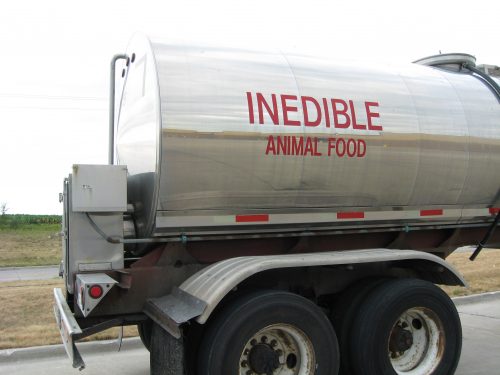
According to 9 CFR Part 325, the USDA’s Food Safety Inspection Service (FSIS) requires that any condemned material transported from a slaughter facility be marked with unmistakable clarity. The law dictates that containers such as drums or barrels must bear the words “Inedible—Not Intended for Human Food” in letters at least two inches high. For larger transport vessels, such as tank cars or trucks, the lettering must be at least four inches high.
The Vanishing Disclosure
However, once these tankers—clearly marked as carrying "inedible" waste—arrive at a pet food processing plant, the USDA’s authority ends. The Food and Drug Administration (FDA), which oversees pet food safety, does not require the "inedible" or "condemned" status to be disclosed to the end consumer. Consequently, a product that arrived at the factory as "Inedible Condemned Poultry" can legally leave the factory labeled simply as "Chicken" or "Poultry Meal."
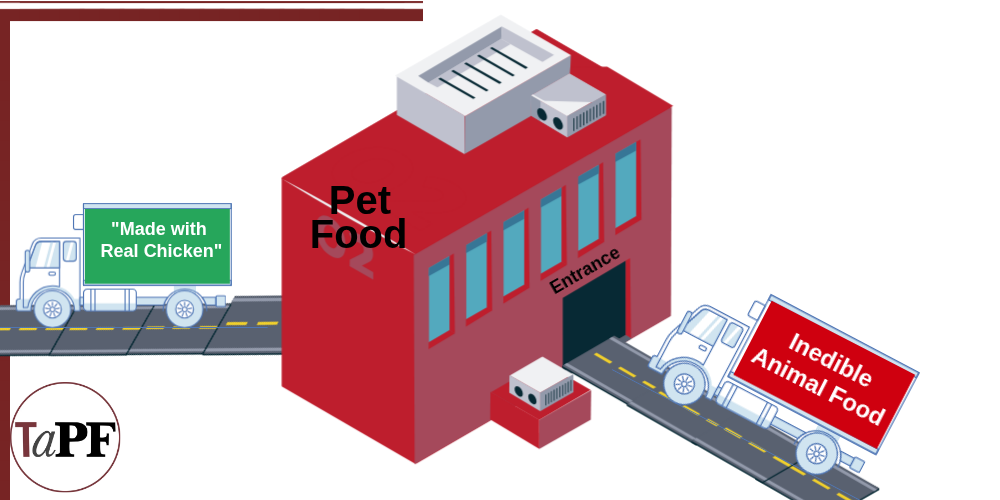
This lack of transparency means that pet owners, who often pay premium prices for what they believe is high-quality protein, may unknowingly be purchasing meat from animals that were rejected by inspectors due to systemic disease or decomposition.
II. Chronology: A Multi-Year Battle for Disclosure
The push for pet food transparency has been a long-standing struggle led by consumer advocacy groups, most notably the Association for Truth in Pet Food (ATPF). The timeline of their legal efforts reveals a pattern of regulatory delay and resistance.
- June 2022: The Association for Truth in Pet Food submitted a formal Citizen Petition to the FDA. The petition requested a simple but transformative change: that pet food labels be required to disclose if the product contains condemned, inedible, or diseased animal material.
- The 120-Day Window: Under federal law, the FDA is required to provide a substantive response to Citizen Petitions within 120 days.
- The Period of Silence: Following the 2022 submission, the FDA entered a period of protracted silence. Advocates argued that the agency was ignoring its legal mandate to respond, leaving consumers in the dark for years.
- March 16, 2026: After a delay of approximately 1,333 days, the FDA finally issued a formal response. The agency officially denied the request for disclosure.
- April 2026: In response to the denial, the ATPF filed a "Petition for Reconsideration," citing existing federal laws as the foundation for their request and arguing that the FDA’s refusal violates the spirit of the Federal Food, Drug, and Cosmetic Act.
As of late 2026, the FDA has yet to issue a final decision on the reconsideration, leaving the pet food industry in a state of "business as usual" regarding the use of 4D materials.
III. Supporting Data: The 4D Disposal Pipeline
To understand why this issue persists, one must look at the laws governing the disposal of livestock that does not make it to the slaughter floor. The USDA actually provides official suggestions for the "disposal" of 4D animals, and pet food manufacturers are a primary destination.
Consignment to Animal Food Manufacturers
Federal law explicitly states that while 4D animals cannot be sold for human consumption, they can be sold and transported if they are "consigned and delivered, without avoidable delay, to establishments of animal food manufacturers [or] renderers." This creates a legal pipeline where diseased livestock is funneled directly into the pet food supply chain.
The Scale of the Industry
The pet food industry is not a niche market; it is a massive economic engine. According to data from the American Pet Products Association (APPA), pet owners in the United States contributed $21.6 billion in federal, state, and local tax revenue in 2024 alone.
Advocates argue that this significant economic contribution entitles pet owners to the same level of transparency afforded to human food consumers. The argument is simple: if the government benefits from the billions spent on pet care, it has a moral and legal obligation to ensure those consumers are not being deceived about the ingredients they are purchasing.
IV. Official Responses: The FDA’s Justification for Secrecy
The FDA’s refusal to mandate disclosure is not based on a denial that 4D meat is used, but rather on a specific interpretation of "consumer expectations."
The "Integrity of Food" Argument
In its March 2026 response to the ATPF petition, the FDA Center for Veterinary Medicine (CVM) stated that it did not believe disclosure of condemned or diseased material was "necessary to maintain the integrity of the food, or ensure that the food meets consumer expectations."
This statement has become a lightning rod for criticism. Critics ask: Which consumer expects "Beef" to include a cow that died of a contagious disease in a field? By the FDA’s logic, as long as the material is processed into a shelf-stable kibble or canned food, the origin of the meat—no matter how diseased—does not violate the "integrity" of the final product.

The Jurisdiction Gap
The FDA also relies on the fact that once meat is rendered (cooked at high temperatures), many pathogens are destroyed. From a purely microbiological standpoint, the FDA often views rendered 4D meat as "safe" enough for animals, even if the source material was inherently "inedible." This focus on the safety of the finished product allows them to bypass the ethics of the source material.
V. Implications: Deception, Safety, and the Future of Pet Care
The implications of this regulatory loophole extend beyond mere semantics; they touch upon animal health, consumer rights, and the ethical standards of the global food supply.
1. Consumer Deception and Economic Fraud
When a consumer buys a bag of pet food labeled "Natural Chicken Formula," there is an implicit understanding that the "chicken" in the bag is similar to the chicken sold in the grocery store. If that chicken was actually a "4D" bird that died of disease and was transported in a tanker marked "Inedible," the consumer has been victims of a massive transparency gap. This can be viewed as a form of economic fraud, where inferior, waste-grade materials are sold at premium prices under misleading names.
2. Potential Health Risks
While rendering kills many bacteria, it does not necessarily eliminate all risks. Certain heat-resistant toxins, chemical residues from drugs used to treat sick animals, or even pentobarbital (an euthanasia drug sometimes found in rendered meat) can survive the manufacturing process. By allowing 4D meat into the supply chain without disclosure, the FDA makes it impossible for veterinarians or pet owners to trace potential health issues back to the source of the protein.
3. The Rise of "The List" and Alternative Markets
Because of this lack of federal oversight, consumer advocates like Susan Thixton have created independent verification systems. "The List" is an annual publication that identifies pet food manufacturers who provide signed affidavits asserting they do not use 4D meat or "inedible" ingredients. The success of such lists highlights a growing market of "pet parents" who are willing to seek out transparent brands, effectively bypassing traditional big-box pet foods that rely on rendered waste.

4. The Need for Legislative Reform
The current standoff between the FDA and consumer advocates suggests that administrative petitions may not be enough. There is a growing call for legislative action—specifically, an amendment to the Federal Food, Drug, and Cosmetic Act that would explicitly define "meat" in pet food to exclude 4D animals unless clearly labeled as "Industrial Grade" or "Inedible Sourced."
Conclusion
The divide between what the USDA labels as "inedible" and what the FDA allows to be sold as "chicken" or "beef" represents a fundamental failure in the American regulatory system. For as long as 4 inch-high "Inedible" warnings are allowed to disappear behind factory doors, pet owners will remain in the dark about the true nature of what they are feeding their animals.
As the Association for Truth in Pet Food continues to wait for a response to their Petition for Reconsideration, the $21.6 billion pet-tax-paying public is left to wonder: why is the government more interested in protecting the secrets of the rendering industry than the health and rights of the American consumer? Until the FDA aligns its labeling requirements with those of the USDA, the pet food bowl remains a place where "inedible" waste is transformed into "gourmet" meals through the simple—and legal—act of silence.