LONG BEACH, California — In a conservation effort that reads more like science fiction than standard wildlife management, federal and regional wildlife officials successfully relocated more than 200 rare olive ridley sea turtle (Lepidochelys olivacea) eggs from Southern California beaches. The emergency intervention, executed on September 25, was triggered by an imminent environmental threat: the powerful swells and destructive storm surges of Hurricane Polo, a catastrophic Category 5 storm churning off the coast of the Baja Peninsula.
The rescued clutch—originating from historic, unprecedented nests discovered days earlier in Seal Beach and Huntington Beach—now resides in a secure, temperature-controlled incubation facility at the Aquarium of the Pacific in Long Beach. This high-stakes operation marks a dramatic twist in a wildlife story that has already captivated marine biologists, conservationists, and beachgoers alike: the first-ever documented sea turtle nesting events in the history of the United States West Coast.
Main Facts
The extraordinary sequence of events unfolded along the densely populated coastline of Orange County, California, transforming local tourist beaches into impromptu marine biology laboratories.
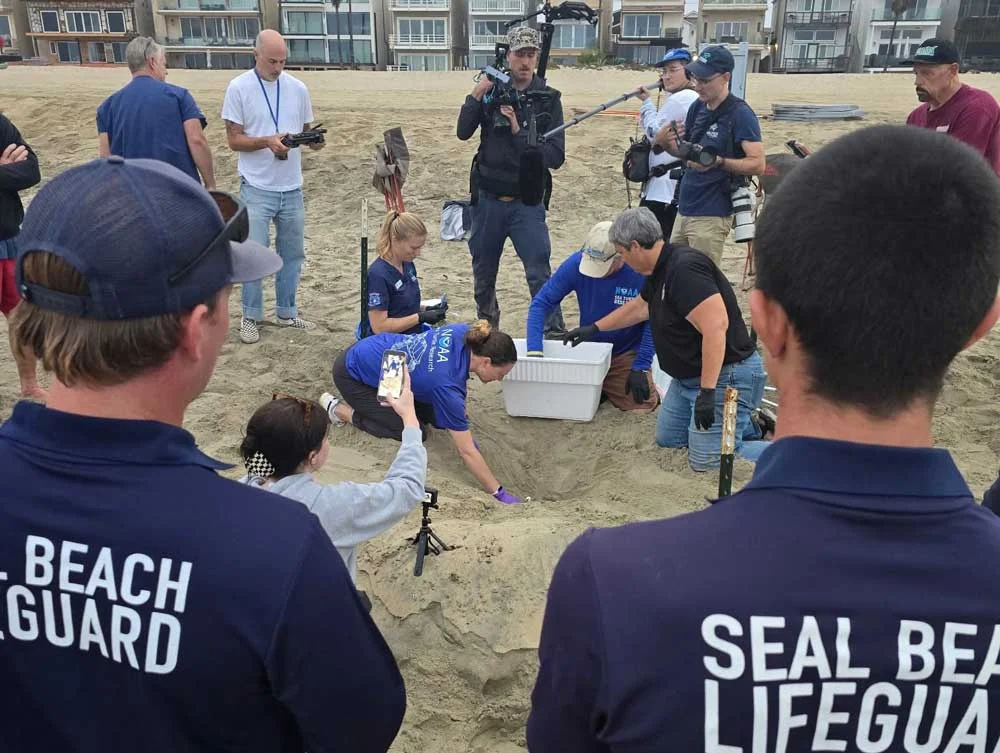
- The Rescue Operation: On September 25, the U.S. Fish and Wildlife Service (USFWS), working in tandem with marine mammal and reptile experts, excavated two distinct sea turtle nests containing a combined total of more than 200 eggs.
- The Threat: The emergency relocation was forced by Hurricane Polo. While tracking off the Baja Peninsula as a formidable Category 5 hurricane packing sustained winds of approximately 180 mph (285 km/h), the storm generated massive, dangerous swells projected to hammer the Southern California coastline from Sunday through Thursday. High tides and violent surf threatened to completely wash away or inundate the shallow nests, which would have drowned the developing embryos.
- The New Home: The vulnerable eggs were carefully transported to the Aquarium of the Pacific in Long Beach. They are currently being monitored in specialized, temperature-controlled incubation chambers designed to mimic optimal subterranean thermal conditions, with marine specialists projecting a hatching window of 45 to 60 days.
- The Historic Precedent: These eggs represent the biological offspring of history-making mothers. Just days prior, NOAA Fisheries West Coast documented the first-ever recorded sea turtle nesting event of any species on the entire U.S. West Coast, followed closely by a second, equally astonishing discovery just miles away.
Chronology of Events
To understand the magnitude of the September 25 rescue, marine biologists emphasize the astonishing timeline that preceded it. What began as an ordinary late-September week on the Southern California shore quickly evolved into a historic milestone for North American marine conservation.
September 22: Breaking Records in Surfside
The extraordinary saga began on the morning of September 22, when beachgoers and local monitors in Surfside, California—an unincorporated community nestled between Seal Beach and Huntington Beach—reported an unusual sight: a large marine reptile hauling her heavy, cumbersome body ashore in broad daylight.
NOAA Fisheries West Coast swiftly confirmed the identity of the visitor: a female olive ridley sea turtle. Observers watched in awe as the marine reptile methodically carved a body pit into the sandy shore, dug an egg chamber with her rear flippers, and deposited a clutch of eggs before expertly camouflaging the site and returning to the Pacific Ocean. Marine biologists quickly recognized the gravity of the moment. In all of recorded scientific history, no sea turtle of any species had ever been documented nesting on the mainland coast of the western United States. Cold Pacific currents and unaccommodating water temperatures had long kept nesting populations restricted to tropical and subtropical latitudes far to the south.
September 25: A Second Surprise and a Looming Catastrophe
As the scientific community was still processing the Surfside miracle, lightning struck twice. On September 25, NOAA officials received reports of a second olive ridley sea turtle nesting event. This female chose a high-profile location just a few miles south: the sandy shore immediately adjacent to Huntington Beach’s world-famous municipal pier.
However, celebration over this second historic milestone was instantly tempered by meteorological warnings. While the turtles had capitalized on unusually warm local water temperatures to make their unprecedented journey northward, those same climatic shifts had empowered distant weather systems. In the tropical waters off Mexico’s Baja Peninsula, Hurricane Polo had rapidly intensified into a monstrous Category 5 storm.
Forecasters warned that the hurricane’s immense energy would translate into heavy, destructive surf and abnormal high tides reaching the Southern California coastline by the weekend. With the newly discovered nests sitting dangerously close to the high-tide line—leaving them vulnerable to erosion, saltwater inundation, and crushing wave action—the USFWS made the executive decision to intervene. Biologists launched an emergency extraction operation, successfully recovering both clutches—totaling over 200 eggs—just hours before the outer bands of the hurricane could seal their fate.
Supporting Data & Biological Profile
The olive ridley sea turtle is an organism defined by its adaptability, global distribution, and distinct physical traits—making its sudden appearance in temperate Southern California waters all the more fascinating to researchers.
Species Overview (Lepidochelys olivacea)
- Size and Weight: The olive ridley is widely recognized as the smallest of all extant sea turtle species. Adults typically reach a length of 2.5 to 3 feet (75 to 90 cm) and generally weigh between 75 and 100 pounds (34 to 45 kg), though exceptional specimens can occasionally surpass these averages.
- Appearance: True to its common name, the species features an olive-green, heart-shaped carapace (upper shell) that is broad and slightly flattened. Their underside (plastron) ranges from a creamy white to a pale yellow.
- Lifespan and Habitat: Olive ridleys are pelagic (open ocean) creatures for much of their lives, capable of living up to 50 years. While found circumglobally, they show a strong preference for the tropical and warm subtropical waters of the Pacific, Indian, and Atlantic Oceans.
- Nesting Behavior: In the Eastern Pacific, major nesting rookeries are traditionally concentrated along the western coast of Mexico, as well as in Nicaragua, Costa Rica, and Panama. Many populations engage in arribadas—massive, synchronized nesting events where thousands of females come ashore simultaneously. Individual nesting events on isolated northern beaches, such as those documented in Orange County, are virtually unheard of in the scientific literature.
Incubation Metrics at the Aquarium of the Pacific
The relocation of more than 200 eggs to Long Beach presented a complex logistical challenge for aquarium staff. Sea turtle embryonic development is notoriously sensitive to environmental conditions, particularly temperature and moisture.
- Temperature-Dependent Sex Determination: In many sea turtle species, including olive ridleys, the incubation temperature of the nest dictates the sex of the hatchlings (warmer temperatures typically produce females, while cooler temperatures produce males). Maintaining precise thermal stability in the aquarium’s incubation units is critical to ensuring balanced development.
- Timeline: Under normal natural conditions, olive ridley eggs incubate for roughly 45 to 60 days before hatching. Aquarium biologists anticipate that the rescued hatchlings will emerge sometime in mid-to-late November, provided the embryos weathered the initial transport and stabilization phases without systemic shock.
Official Responses and Conservation Perspectives
The unprecedented nesting events and subsequent emergency rescue operation have drawn commentary from across the marine science community, highlighting both the excitement of a biological first and the sobering reality of shifting environmental baselines.
Federal wildlife agencies, including the U.S. Fish and Wildlife Service and NOAA Fisheries, have maintained a cautious yet proactive stance. In public statements released following the September 25 rescue, representatives emphasized that while the natural processes of wildlife are typically left undisturbed, the extreme and unnatural threat posed by a Category 5 hurricane mandated human intervention. Allowing the nests to remain in place would have amounted to near-certain mortality for the developing embryos, effectively erasing an invaluable scientific data point and sacrificing more than 200 lives of a protected species.
Local marine institutions have stepped up to shoulder the burden of care. Staff at the Aquarium of the Pacific expressed profound honor at being entrusted with the clutches, framing the endeavor as a frontline contribution to marine conservation and public education. Animal care teams established round-the-clock monitoring protocols for the incubation room, tracking humidity, gas exchange, and internal egg metrics to maximize survival rates.
Independent marine biologists and oceanographers have weighed in on the broader implications of the event. Many point to the unusual northern migration and successful nesting as tangible indicators of changing oceanographic conditions. As marine heatwaves—colloquially referred to in recent years as "the Blob"—and elevated sea surface temperatures increasingly characterize the Pacific coastline, species traditionally restricted to equatorial zones are expanding their ranges northward. Whether these isolated nesting events represent a permanent expansion of the olive ridley’s breeding range or merely an isolated anomaly driven by anomalous thermal currents remains one of the most pressing questions facing modern marine ecologists.
Implications for the Future
As the salvaged eggs incubate safely behind the glass walls of the Aquarium of the Pacific, the scientific and conservation communities are left to ponder the long-term meaning of the Southern California nesting events.
If the incubation is successful and the tiny olive ridleys eventually hatch, state and federal authorities will face a new set of logistical and ethical considerations: Where should the hatchlings be released? Can they adapt to the cooler waters of the California Current, or will they need to be transported to their traditional tropical habitats further south? Furthermore, wildlife managers must now grapple with the reality that Southern California beaches may no longer be immune to sea turtle nesting. As global climate patterns continue to shift and ocean temperatures trend upward, beach patrols, lifeguards, and coastal municipalities along the Pacific coast may need to undergo specialized training to identify, monitor, and protect future sea turtle nests.
For now, all eyes are fixed on the temperature-controlled incubation chambers in Long Beach. Over the next month and a half, the fate of more than 200 olive ridley sea turtle eggs hangs in the balance—a fragile bridge between an unexpected natural milestone and the unpredictable fury of a changing climate.