Main Facts
Paleontologists have unearthed a groundbreaking piece of evolutionary history in the badlands of Colorado. A multi-institutional team of researchers has formally described a newly discovered species of extinct alligator, named Mandrasuchus milleri, which now stands as the oldest known confirmed alligatorine in the fossil record.
Recovered from the fossil-rich Lower Paleocene strata of the Denver Basin’s Corral Bluffs, Mandrasuchus milleri lived during a critical, highly volatile period in Earth’s history—the immediate aftermath of the Cretaceous-Paleogene (K-Pg) extinction event that wiped out the non-avian dinosaurs approximately 66 million years ago.
Key defining characteristics of Mandrasuchus milleri include:
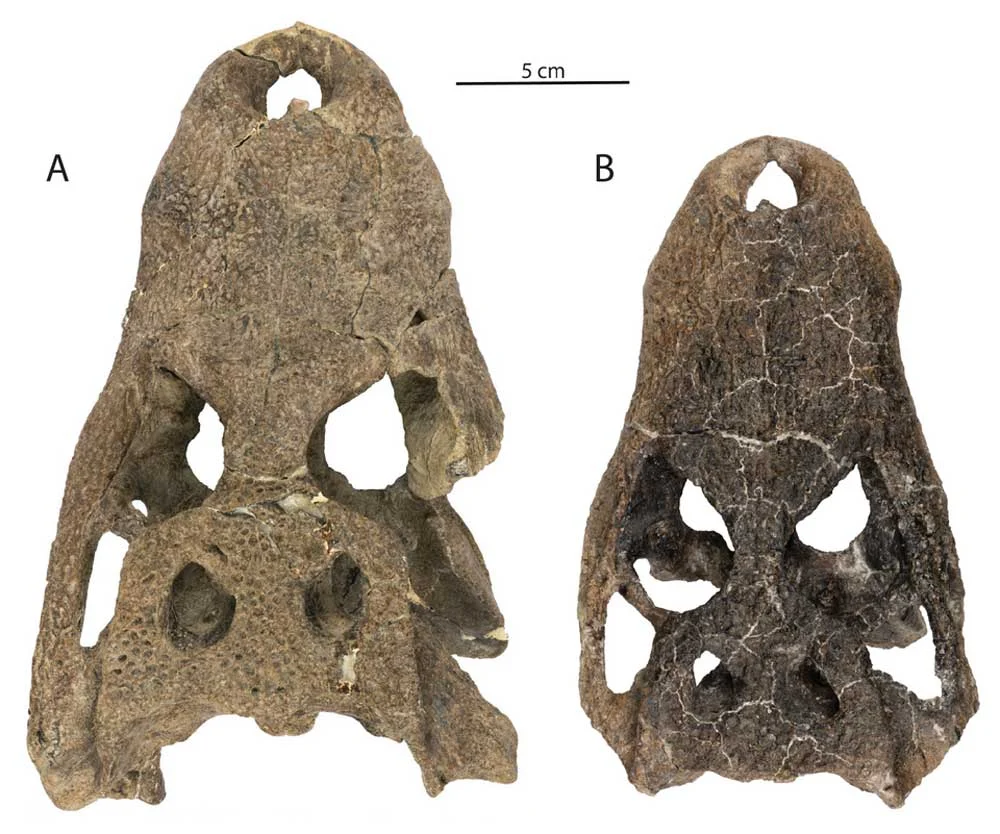
- Distinctive Morphology: The species is primarily identified by its blunted rostrum (snout) and unique globular caudal (posterior) dentition.
- Dietary Adaptations: Its rounded, crushing teeth and broad snout structure indicate it operated as a macro-generalist, capable of consuming a diverse array of prey ranging from soft-bodied animals to armored creatures.
- Size and Behavior: Researchers estimate that M. milleri reached an adult length of approximately 2 meters (6.5 feet) and exhibited habits consistent with burrowing behavior.
- Phylogenetic Significance: The species occupies a crucial, previously unresolved branch of the crocodylian family tree, shedding light on how surviving reptile lineages radiated across North America during the early Paleocene epoch.
The formal description of the animal was published in the Journal of Vertebrate Paleontology under the title, "New alligatorid, Mandrasuchus milleri, from the Early Paleocene (Danian) of the Denver Basin supports earliest Paleocene North American alligatorid radiation."
Chronology of the Discovery
The unearthing of Mandrasuchus milleri is the culmination of meticulous fieldwork, advanced geological dating, and painstaking laboratory preparation that unfolded over several years within the Denver Basin.
The Corral Bluffs Project
The Corral Bluffs site, located just east of Colorado Springs, has long been recognized as a premier paleontological window into the dawn of the Age of Mammals. While the area has yielded extraordinary mammal and plant fossils detailing the rapid recovery and diversification of life following the asteroid impact that ended the Mesozoic Era, the reptile and amphibian records from these specific layers have remained comparatively scarce.
During routine excavations in the Lower Paleocene (Danian stage) deposits of the Denver Formation, field researchers came across unassuming, potato-sized rock nodules weathering out of the hillside. These mineralized structures—known as phosphate-rich rock concretions—frequently form around organic remains, acting as natural time capsules that protect delicate bone and tissue from the crushing pressures of geological compaction.
Extraction and Preparation
Extracting fossils from these hard nodules requires delicate laboratory work using pneumatic air scribes and chemical preparation methods. As researchers—including E. J. Lessner, S. M. Sherman, H. Petermann, E. Panigot, F. Duffy, and T. R. Lyson—began peeling away the stone matrix from the Corral Bluffs specimens, they realized they were dealing with something entirely unprecedented.
The skull fragments and dental batteries did not match any known Paleocene crocodilian. The unusual, blunt snout and the heavy, bulbous teeth at the back of the jaw marked the specimen as a distinct taxon. Subsequent phylogenetic analyses confirmed that this was not merely a new species, but a foundational lineage that helps bridge a massive gap in our understanding of early crocodilian evolution.
Supporting Data and Anatomical Analysis
To understand the evolutionary significance of Mandrasuchus milleri, scientists must examine the unique anatomical toolkit that allowed this reptile to survive a global extinction event and thrive in a radically shifting ecosystem.
Dentition and Diet: The Macro-Generalist Strategy
The most striking feature of Mandrasuchus milleri lies inside its mouth. Unlike modern American alligators (Alligator mississippiensis), which feature relatively conical, pointed teeth suited for seizing fish, birds, and mammals, M. milleri possessed specialized globular caudal dentition.
- Crushing Power: The rear teeth are rounded and stout, designed not for piercing, but for withstanding immense crushing pressure.
- Dietary Breadth: This morphology suggests that M. milleri was a macro-generalist. Its diet likely encompassed large terrestrial prey when available, but was heavily supplemented by hard-shelled aquatic and semiaquatic organisms. Researchers believe the reptile utilized its back teeth to crush the shells of freshwater mollusks, crustaceans, and potentially even early freshwater turtles that populated the dynamic river systems of the Paleocene Denver Basin.
Anatomy of the Snout
Coupled with its specialized teeth, M. milleri possessed a blunted rostrum. A shorter, wider snout generally indicates a more generalized biting regime, capable of generating higher torsional and compressive forces at the tip of the jaws compared to the elongated, slender snouts of fish-eating specialists (such as gharials or false gavials).
Size and Burrowing Lifestyle
Reaching an estimated length of roughly 2 meters, M. milleri was a mid-sized predator in its environment. However, its biological impact extended beyond simple predation. Evidence suggests that the animal may have engaged in active burrowing.
This behavioral hypothesis is heavily supported by the nature of its fossilization. The phosphate-rich rock nodules that encased the M. milleri remains are believed by researchers to have formed as a direct result of decaying soft tissues interacting with localized bacterial activity. Intriguingly, scientists theorize that some of these mineralized concretions may represent the physical remains of the reptile’s underground burrows or den sites. Burrowing would have provided M. milleri with a crucial thermal refuge, shielding the cold-blooded predator from the dramatic climate fluctuations that characterized the early Danian world.
Official Responses and Scientific Perspectives
The discovery of Mandrasuchus milleri has generated considerable excitement within the global paleontological community, particularly among researchers specializing in archosaur evolution and post-extinction ecosystem recovery.
The research team—a collaborative effort featuring E. J. Lessner, S. M. Sherman, H. Petermann, E. Panigot, F. Duffy, and T. R. Lyson—emphasizes that M. milleri represents a vital anchor point in a previously murky section of the evolutionary tree.
In their published study, the authors categorize the new species as a representative of an "unresolved portion of the crocodylian phylogeny." For decades, evolutionary biologists have debated the exact branching order of early alligatorines. Because the fossil record immediately following the K-Pg boundary is notoriously patchy in many parts of the world, linking Cretaceous ancestors to modern clades has proven exceptionally difficult.
By introducing a well-preserved, securely dated early Paleocene alligatorid from North America, the Corral Bluffs discovery provides a much-needed phylogenetic waypoint. Independent paleontologists not involved in the initial study have praised the find, noting that the combination of cranial architecture, unique dental specializations, and clear stratigraphic provenance makes Mandrasuchus milleri an instant classic in vertebrate paleontology literature.
Implications for Evolution and Paleoclimatology
The unearthing of Mandrasuchus milleri extends far beyond the description of a single prehistoric reptile; it holds profound implications for how we understand ecosystem survival, post-extinction radiations, and ancient North American climates.
Surviving the Impact Winter
When a six-mile-wide asteroid struck the Yucatan Peninsula 66 million years ago, it plunged the planet into a prolonged "impact winter," blanketing the globe in darkness, collapsing food webs, and causing the extinction of roughly 75% of all plant and animal species on Earth. While non-avian dinosaurs perished, certain lineages—including mammals, birds, turtles, and crocodilians—managed to squeak through.
The survival of early alligatorines like Mandrasuchus milleri demonstrates the remarkable resilience of semi-aquatic, generalized predators. Capable of surviving on detritus, carrion, and a wide variety of small aquatic or burrow-dwelling prey, these reptiles weathered the ecological collapse far better than large terrestrial herbivores and carnivores.
The North American Radiation
The discovery strongly supports the hypothesis of an earliest Paleocene North American alligatorid radiation. As the devastation of the K-Pg boundary slowly cleared, surviving reptilian lineages began to rapidly diversify to fill vacant ecological niches across the western interior of North America.
The Denver Basin, with its continuous sedimentary record spanning the boundary, acts as a natural laboratory for observing this renaissance of life. The presence of a specialized, burrowing, macro-generalist alligator like M. milleri proves that within a few hundred thousand years of the asteroid impact, complex ecosystems and specialized predatory niches had already re-established themselves.
Future Horizons
As laboratory work continues on the Corral Bluffs material, paleontologists remain hopeful that additional specimens of Mandrasuchus milleri—and perhaps contemporaneous sister taxa—will be brought to light. Each nodule cracked open in the lab offers another glimpse into a world recovering from apocalypse, reminding researchers of nature’s endless capacity for adaptation and survival.