Main Facts
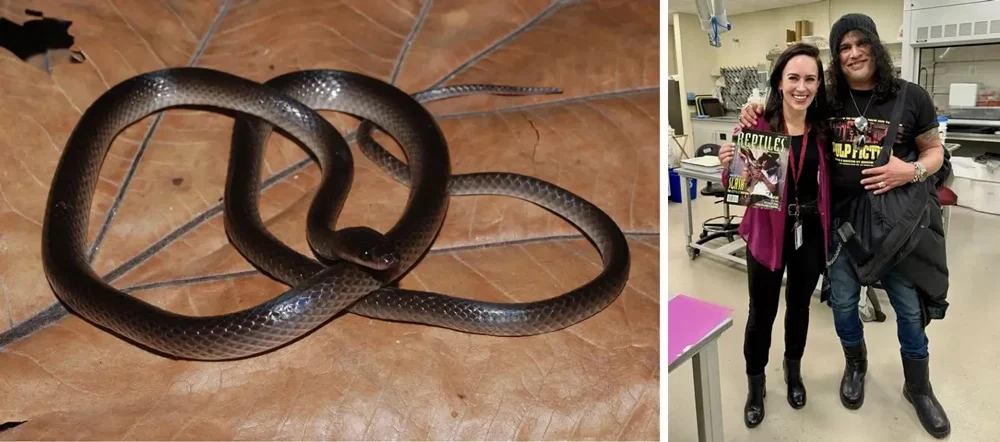
In a remarkable intersection of hard rock history and evolutionary biology, a newly discovered species of snake native to the tropical rainforests of New Guinea has been officially named in honor of Saul Hudson—globally renowned as Slash, the iconic lead guitarist of Guns N’ Roses. The newly classified reptile, scientifically designated as Lielaphis slashi and commonly known as Slash’s groundsnake, represents a significant addition to the biodiversity of the Papuan region.
The formal description of the species was published in the peer-reviewed scientific journal Zootaxa in a paper titled "A new species of Papuan groundsnake (Squamata: Colubridae: Lielaphis) from New Guinea." The collaborative research effort was spearheaded by herpetologists from the Louisiana State University (LSU) Museum of Natural Science and Chicago’s prestigious Field Museum.
For the lead scientists involved in the discovery, the naming of Lielaphis slashi is more than just a taxonomic milestone; it is the realization of a lifelong childhood dream. Both senior researcher Sara Ruane and discoverer Chris Austin grew up as devoted fans of Guns N’ Roses and passionate amateur herpetologists—scientists who study reptiles and amphibians. The convergence of their lifelong musical idols and their professional dedication to wildlife has culminated in an international scientific headline, drawing widespread attention from both the music industry and the global conservation community.
The snake itself is a slender, forest-dwelling reptile characterized by distinct morphological traits, including unique scale counts that differentiate it from other known members of the Lielaphis genus. Through a rigorous combination of field expeditions, modern molecular genetics, and ecological niche modeling, the research team successfully established that L. slashi is an entirely distinct lineage that warrants its own unique species classification.
Chronology of Discovery
The scientific journey of Lielaphis slashi spans nearly two decades, evolving from a serendipitous field encounter in the remote jungles of New Guinea into a cutting-edge genomic study conducted across multiple premier research institutions.
2006: The Field Discovery
The story of Slash’s groundsnake began in 2006 during a scientific expedition to the island of New Guinea. Dr. Chris Austin, a professor and curator of herpetology at the Louisiana State University Museum of Natural Science, was conducting field research in the region’s hyper-diverse ecosystems. While navigating the dense tropical terrain, Austin collected an unfamiliar specimen of a groundsnake. Although the animal exhibited traits common to the broader family of Papuan snakes, its exact taxonomic identity remained elusive in the field. The specimen was preserved and brought back to the museum archives, awaiting the right technological advancements and expert collaboration to unravel its identity.
2016: The Partnership Begins
A decade after its initial collection, the mystery of the New Guinea groundsnake began to clear. In 2016, Dr. Austin teamed up with Dr. Sara Ruane—then a postdoctoral researcher and now the Field Museum’s Associate Curator of Herpetology—to re-examine the enigmatic specimen. Ruane, who had harbored a lifelong fascination with both reptiles and rock music, immediately recognized the specimen’s potential significance. Together, Austin and Ruane initiated a deep-dive morphological assessment, comparing the physical attributes of the New Guinea snake against historical museum records and related species across the Indo-Pacific.
2025: Genetic Validation and Final Classification
As morphological assessments alone could not definitively prove whether the snake represented an isolated regional variant or a genuinely new species, the team expanded their methodology. In 2025, Dr. Tianqi Huang, a postdoctoral researcher at the Field Museum, joined the collaborative project to spearhead the molecular genetics component. Utilizing state-of-the-art sequencing technologies, Huang and the team analyzed the DNA extracted from the 2006 specimen. The genetic data provided definitive proof that the snake was distinct from all other known species in the genus Lielaphis. With both genetic and physical evidence securely in hand, the team finalized their description, culminating in the publication of their findings in Zootaxa.
Supporting Data and Scientific Methodology
To ensure that the classification of Lielaphis slashi met the highest standards of modern taxonomy, the research team employed a multi-disciplinary framework combining classical physical morphology, advanced molecular phylogenetics, and ecological distribution modeling.
Morphological Analysis
Taxonomy relies heavily on physical characteristics to differentiate species. The researchers meticulously examined the specimen’s scale patterns, body proportions, and coloration. When compared against established species within the Lielaphis genus, the New Guinea specimen exhibited distinct variations in the number and arrangement of its dorsal and ventral scales. While these subtle physical differences raised initial suspicions that the snake might be novel, morphology alone is often insufficient in complex tropical genera, necessitating genetic confirmation.
Cutting-Edge Genetic Sequencing
To move beyond subjective physical observations, Dr. Tianqi Huang led a comprehensive molecular analysis.
"Using multiple cutting-edge genetic analyses, we found that L. slashi is genetically distinct from other similar snakes in the same genus," Huang explained in an official Field Museum press release. "The combination of physical characteristics, like differences in numbers of scales when compared with other species, and the genetic evidence is what led us to realize that it is an entirely new species."
The DNA sequencing confirmed that the genetic divergence between L. slashi and its closest relatives was significant enough to establish it as a distinct evolutionary lineage.
Ecological Niche Modeling
Beyond genetics and physical anatomy, the research team sought to understand the biological context of the newly discovered snake. They utilized ecological modeling—a computational method that uses environmental and climatic data to predict a species’ preferred habitat. The results demonstrated that Lielaphis slashi occupies a specific ecological niche, exhibiting habitat preferences that differ markedly from morphologically similar snakes found within the same geographic theater. This behavioral and environmental separation further reinforced the validity of the new species designation.
Official Responses and Personal Connections
The announcement of Lielaphis slashi has generated widespread media attention, largely due to the profound personal connection the researchers share with the legendary musician whose name the snake now bears.
The Researchers’ Childhood Inspirations
For Dr. Sara Ruane, senior author of the Zootaxa paper and Associate Curator of Herpetology at the Field Museum, the discovery represents a full-circle moment spanning three decades.
"Guns N’ Roses has been one of my favorite bands since I was in first grade, and by fifth grade, I had already told my teacher that I wanted to be a herpetologist—a scientist who studies reptiles—when I grew up," Ruane shared.
Her passion for reptiles was famously cemented by print media of the era, a sentiment echoed by her co-researchers.
"When I was twelve years old and got my copy of REPTILES Magazine in the mail, and it had a picture of Slash holding his pet reticulated python on the cover, I thought, ‘This guy is so cool.’"
Slash is well-known among fans and animal enthusiasts alike for his lifelong affinity for reptiles. Long before exotic pets became mainstream among celebrities, the top-hatted guitarist famously kept and cared for numerous snakes, frequently featuring them in interviews and photo shoots during the peak of Guns N’ Roses’ global fame in the late 1980s and 1990s. By bridging the worlds of rock stardom and herpetology, the magazine covers of his youth directly inspired the career path of the scientists who would one day name a species in his honor.
Slash’s Response to the Honor
Upon learning that a newly discovered rainforest dweller from New Guinea had been named Lielaphis slashi, the legendary musician expressed profound gratitude and amusement. In a statement released through the Field Museum, Slash remarked:
"As a long-time herpephile, I am extremely honored and humbled to have Lielaphis slashi from New Guinea named after me. It is really exciting, I never would have imagined this moment would arrive."
The endorsement highlights the authentic crossover appeal of the discovery, bridging pop culture iconography with serious academic research.
Implications for Biodiversity and Conservation
While the naming of a snake after a rock icon provides a brilliant pop culture hook, the discovery of Lielaphis slashi carries deep, serious implications for global biodiversity, rainforest conservation, and our understanding of island biogeography.
Uncharted Biodiversity in New Guinea
New Guinea is the largest tropical island in the world and remains one of the planet’s last true biological frontiers. Its rugged topography, dense rainforests, and isolated mountain ranges create countless microclimates that foster extraordinary levels of endemic biodiversity. However, much of this terrain remains difficult to survey, meaning countless species of insects, amphibians, reptiles, and mammals have yet to be formally documented by science.
The discovery of L. slashi underscores just how much of New Guinea’s natural wealth remains hidden in museum archives and unexplored jungles. Each newly identified species acts as a critical piece of the ecological puzzle, helping scientists understand how complex tropical ecosystems evolved and how different species partition resources within shared habitats.
The Urgency of Rainforest Conservation
The tropical forests of New Guinea face mounting environmental pressures, including commercial logging, agricultural expansion, mining operations, and the broader impacts of global climate change. Documenting species like Slash’s groundsnake is the foundational first step toward effective conservation policy. Before governments and international bodies can establish protected areas or enact conservation legislation for endangered habitats, scientists must first catalog the species that live within them.
By bringing mainstream media attention to the discovery of Lielaphis slashi, researchers hope to leverage Slash’s global celebrity platform to spotlight the broader plight of tropical conservation. Engaging the public through high-profile stories helps foster broader appreciation for misunderstood and often reviled animals like snakes, shifting public perception from fear to fascination.
Accessing the Research
For academics, students, and wildlife enthusiasts eager to examine the technical details of the classification, the complete research paper—"A new species of Papuan groundsnake (Squamata: Colubridae: Lielaphis) from New Guinea"—is publicly accessible. It can be downloaded in PDF format directly through the Zootaxa website, providing an open-access blueprint of the rigorous morphological, genetic, and ecological data that secured Slash’s permanent place in the annals of zoological history.