COLORADO — Deep within the fossil-rich badlands of Colorado’s Denver Basin, paleontologists have unearthed the remains of a remarkable prehistoric reptile that is shaking up our understanding of crocodilian evolution. Named Mandrasuchus milleri, this newly identified species represents the oldest known true alligatorine ever discovered, stomping onto the scene during a pivotal, volatile epoch in Earth’s history when life was desperately rebounding from the cataclysmic mass extinction that wiped out the non-avian dinosaurs.
Published in the Journal of Vertebrate Paleontology, the discovery sheds brilliant new light on how ancestral crocodilians adapted, survived, and radiated outward across North America in the immediate wake of the asteroid impact that ended the Cretaceous period. Complete with a bizarre set of crushing teeth, a rounded snout, and potential subterranean habits, M. milleri is proving to be a fascinating outlier in the grand evolutionary family tree of modern alligators and caimans.
Main Facts: Meet Mandrasuchus milleri
The newly minted species, Mandrasuchus milleri, was identified from exceptionally well-preserved fossil fragments recovered from the Lower Paleocene strata of the Denver Formation at Corral Bluffs, a treasure trove of ancient ecosystems located just east of Colorado Springs.
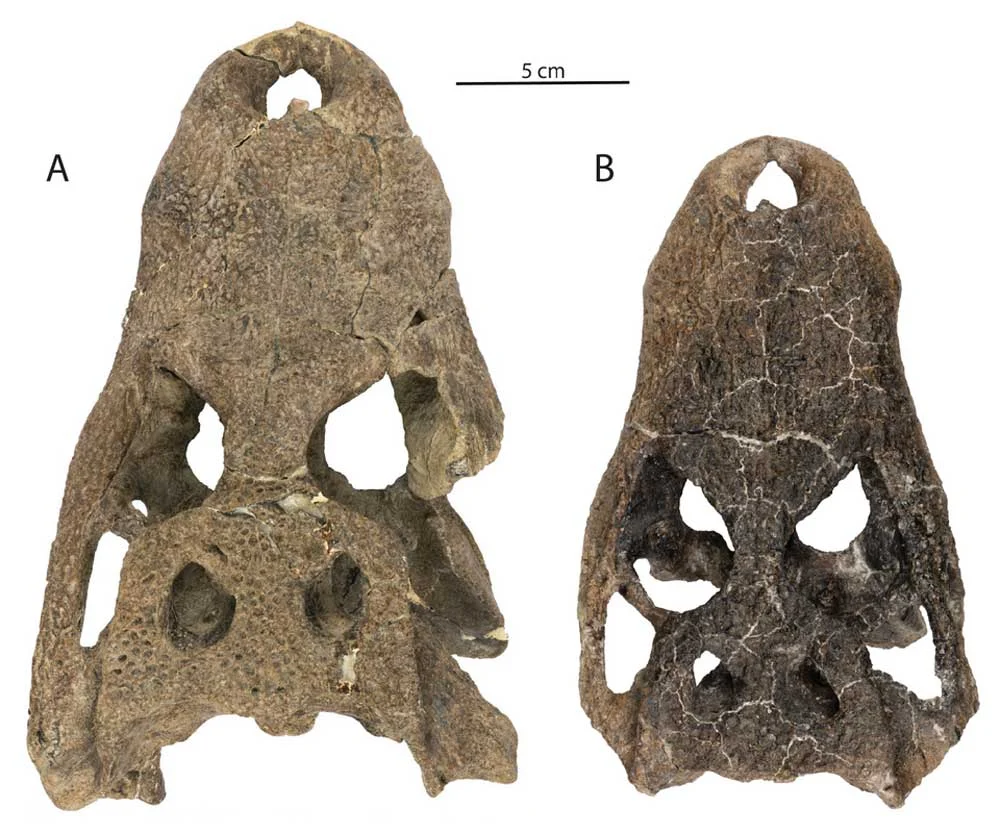
A dedicated team of researchers—comprising E. J. Lessner, S. M. Sherman, H. Petermann, E. Panigot, F. Duffy, and T. R. Lyson—identified the animal as a distinct genus and species based on a suite of unique anatomical features. Most notably, M. milleri boasts a blunt, rounded rostrum (snout) paired with globular caudal dentition—meaning its rear teeth are rounded and bulbous rather than sharp and conical.
- Size and Scale: Paleontological estimates suggest that M. milleri reached a respectable length of approximately 2 meters (roughly 6.5 feet) from snout to tail-tip. While dwarfed by modern American alligators that can exceed 4 meters, a two-meter predator would have been an apex aquatic and semi-aquatic threat in its local ecosystem.
- Dietary Generalist: The blunt snout and heavy, rounded posterior teeth strongly indicate that M. milleri operated as a macro-generalist. Rather than relying solely on fish, this reptile likely utilized its powerful jaws to crush hard-shelled prey. Its diet likely included freshwater turtles, large crustaceans, and mollusks, alongside softer-bodied prey items.
- Subterranean Habits: Intriguingly, geological evidence implies that M. milleri may have been a burrower, using its robust body and limbs to excavate dens in the prehistoric landscape.
Chronology: Life After the Asteroid Impact
To truly appreciate the significance of Mandrasuchus milleri, scientists must place it within a strict chronological framework. The story of M. milleri begins during the Danian stage of the Early Paleocene epoch, roughly 66 to 62 million years ago.
Just a few million years prior to the appearance of M. milleri, the Cretaceous-Paleogene (K-Pg) extinction event wiped out roughly 75% of all plant and animal species on Earth, most famously the non-avian dinosaurs. While massive terrestrial predators vanished overnight, certain cold-blooded vertebrates—including turtles, choristoderes, and early crocodilians—managed to weather the nuclear winter-like conditions brought on by the asteroid strike.
The Timeline of Discovery and Evolution
- ~66 Million Years Ago (The K-Pg Boundary): The global extinction event devastates ecosystems worldwide. Freshwater and semi-aquatic habitats prove to be refugia for ancestral crocodilians.
- Early Paleocene (Danian Epoch): Forests begin to reclaim the North American continent. In what is now the Denver Basin, a rich network of rivers, floodplains, and ponds develops, creating an ideal habitat for surviving reptiles.
- The Rise of Mandrasuchus milleri: It is within this recovering landscape that M. milleri emerges. Its appearance marks the earliest confirmed radiation of alligatorines in North America.
- Modern Era (2020s): Paleontologists working at the Corral Bluffs site unearth the delicate, phosphate-encased fossil remains of the ancient reptile.
- September 2026: Following years of rigorous preparation, comparative anatomy, and phylogenetic analysis, the formal description of Mandrasuchus milleri is published in the Journal of Vertebrate Paleontology.
Supporting Data: Unlocking the Secrets of Corral Bluffs
The Corral Bluffs site in Colorado has long been celebrated for its ability to preserve the fragile dawn of the Age of Mammals. However, the discovery of Mandrasuchus milleri proves that the locality is equally vital for understanding reptilian survivors.
One of the most compelling aspects of the M. milleri find involves the physical state of the fossils themselves. Researchers noted that the skeletal remains were frequently discovered encased inside hard, phosphate-rich rock nodules (concretions). These mineralized masses form when chemical conditions in the sediment—often triggered by decaying organic soft tissue and localized bacterial activity—precipitate minerals rapidly around a buried object.
This geological quirk played a pivotal role in the preservation of M. milleri, protecting delicate skull bones and tooth rows from being crushed or scattered by geological compaction over tens of millions of years. Even more fascinatingly, the research team hypothesizes that some of these very concretions may represent the fossilized remains of the reptile’s underground burrows. If confirmed, this provides rare, direct behavioral evidence that early alligatorines sought refuge underground to regulate their body temperatures or escape environmental stress during the volatile post-extinction climate shifts.
Official Responses and Scientific Significance
The formal unveiling of Mandrasuchus milleri has generated considerable excitement within the global paleontological community. Because crocodilian fossils from the earliest Paleocene are exceptionally rare, filling in the gaps of their lineage has long been a frustrating endeavor for researchers.
In their published abstract, titled "New alligatorid, Mandrasuchus milleri, from the Early Paleocene (Danian) of the Denver Basin supports earliest Paleocene North American alligatorid radiation," the authors emphasize the animal’s placement within the evolutionary tree.
According to the study’s authors, M. milleri occupies what they describe as an "unresolved portion of the crocodylian phylogeny." In plain terms, this means the species sits at a critical junction in the family tree where ancestral traits blur together, making it difficult to definitively link it to modern lineages without exceptional fossil evidence.
"The discovery of Mandrasuchus milleri is a massive puzzle piece," noted evolutionary biologists tracking the find. "For a long time, the immediate aftermath of the K-Pg extinction was thought to be a quiet period for crocodilians. M. milleri demonstrates that these animals were actively evolving, diversifying into new ecological niches, and experimenting with specialized diets and behaviors almost immediately after the dust settled."
By establishing M. milleri as the earliest confirmed alligatorine, the research team has given scientists a reliable baseline to measure how modern alligators and their extinct cousins diverged throughout the Cenozoic era.
Implications: Rethinking the Resilience of Crocodilians
The implications of the Mandrasuchus milleri discovery extend far beyond the borders of Colorado. They touch upon fundamental questions regarding how life recovers from mass extinction events and how specialized traits evolve under environmental pressure.
1. Ecological Plasticity
The macro-generalist diet of M. milleri—facilitated by its crushing, globular teeth—highlights a brilliant survival strategy. In a world recovering from an ecological collapse, being a specialist (an animal that relies on a single food source) is a death sentence. By possessing the dental machinery to crunch through hard-shelled prey like turtles and freshwater crustaceans, M. milleri unlocked a reliable, calorie-rich food supply that many other predators could not access.
2. Subterranean Survival
The hypothesis that M. milleri engaged in burrowing adds a new layer to our understanding of how cold-blooded animals survived extreme fluctuations in temperature during the early Paleocene. While burrowing behavior is well-documented in some modern crocodilians and their extinct relatives, finding evidence of it in the oldest known alligatorine suggests that subterranean living may have been a key adaptation that helped lineage ancestors survive the K-Pg impact winter.
3. A Window Into the Denver Basin’s Ancient Past
As climate change forces modern ecosystems to adapt at unprecedented rates, studying past epochs of global recovery provides vital context. The Denver Basin serves as a natural laboratory for observing how life re-established itself after a total planetary reset. Mandrasuchus milleri stands as a testament to nature’s resilience—a rugged, armor-plated survivor that carved out a successful niche in the shadows of a changing world, leaving behind a fossil record that scientists are only just beginning to fully decode.
For further reading and access to the complete scientific paper, consult the official study, "New alligatorid, Mandrasuchus milleri, from the Early Paleocene (Danian) of the Denver Basin supports earliest Paleocene North American alligatorid radiation," available now via the Journal of Vertebrate Paleontology.