Main Facts
In an era where artificial intelligence blurs the line between reality and fabrication, a recent incident in Southern California has demonstrated the tangible, costly consequences of digital deception. What began as a viral social media rumor quickly escalated into a full-scale municipal emergency after a local resident generated and reported a fake image of a highly venomous African snake lurking in a suburban tree.
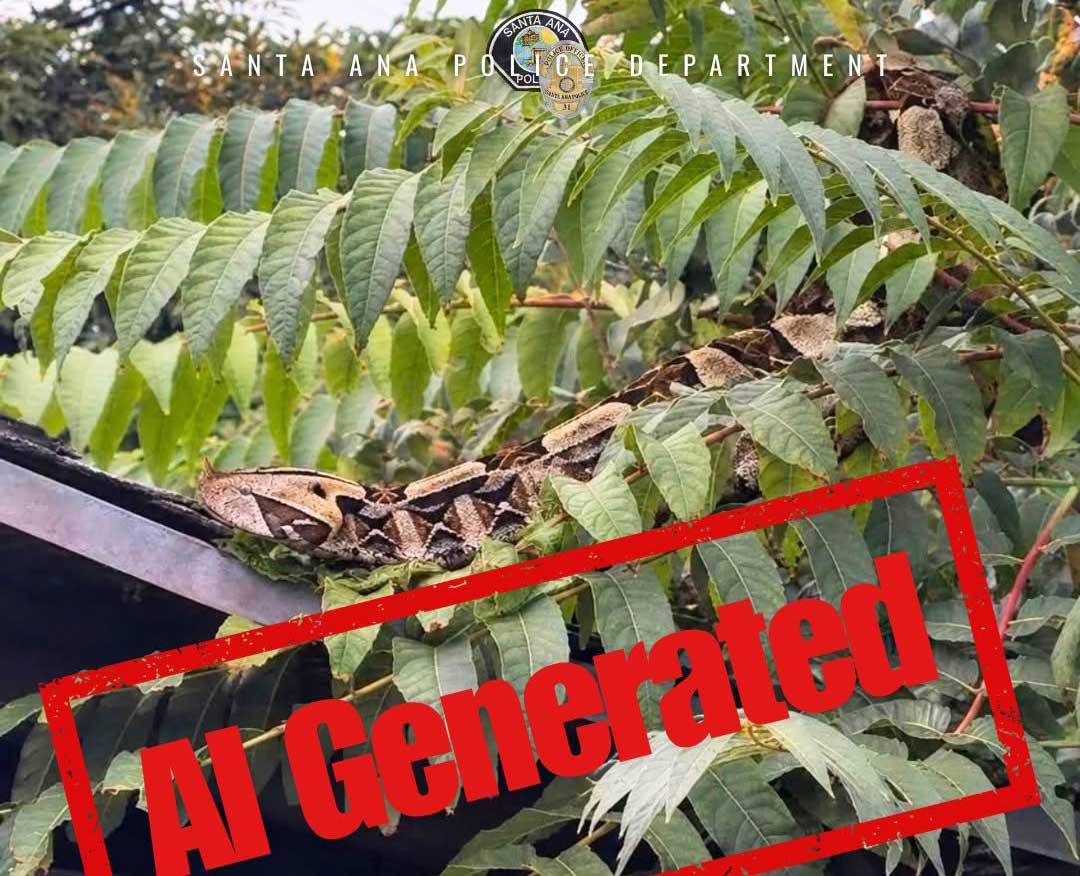
The hoax centered on a purported sighting of a Gaboon viper (Bitis gabonica) in Santa Ana, California. The digital creation, engineered to look like the massive, heavy-bodied reptile was perched in a tree, triggered a multi-day panic, extensive police deployment, and the emergency consultation of professional herpetologists.
While internet sleuths and reptile enthusiasts quickly pointed out glaring anatomical and behavioral discrepancies in the photo—most notably that Gaboon vipers are terrestrial ambush predators ill-equipped for arboreal life—local authorities were legally obligated to treat the report as a credible threat to public safety.
The creator of the image, identified by news outlets as Joel Ciprian, ultimately confessed to law enforcement that the photograph was entirely AI-generated. The prank, however, has graduated from an online stunt to a serious legal matter. The Santa Ana Police Department (SAPD) announced they are actively preparing a criminal case to be submitted to the Orange County District Attorney’s Office. Ciprian faces potential misdemeanor charges for making a false report of an emergency, an offense that carries a penalty of up to one year in county jail due to the extensive municipal resources wasted during the manhunt for the phantom serpent.
Chronology of the Incident
September 29: The Seed of the Sighting
The saga began on September 29, when an emergency call and subsequent digital posts alerted authorities to an unusual and terrifying wildlife encounter. An individual, later identified as Joel Ciprian, claimed to have spotted a massive, highly venomous snake resting in a tree within a residential neighborhood in Santa Ana. To substantiate the claim, an image was circulated showing what appeared to be a patterned, thick-bodied Gaboon viper coiled among branches.
The Immediate Social Media Backlash
Almost immediately after the Santa Ana Police Department issued a public safety bulletin regarding the alleged sighting, the image made its rounds across various online platforms, including reptile enthusiast forums and local community groups. While the general public felt a palpable sense of alarm, online sleuths and professional herpetologists instantly raised red flags. Commenters pointed out that the lighting, scale, and specific positioning of the snake defied the natural history of the species. Despite these early digital warnings, public safety protocol dictated that law enforcement could not dismiss a credible-sounding report of a lethal exotic pet roaming free in a populated area.
The Ground Investigation
Acting on the report, the SAPD launched a comprehensive field investigation. Recognizing the gravity of the situation—Gaboon vipers possess some of the longest fangs in the animal kingdom and a potent hemotoxic venom—authorities did not rely solely on standard patrol officers. The department enlisted the services of expert herpetologists to thoroughly comb the neighborhood, inspect trees, and search undergrowth for any sign of the animal. After hours of meticulous searching, experts and officers found zero evidence of a snake matching the description, color, or scale of the creature depicted in the viral photograph.
The Confession and Fallout
Faced with mounting pressure from investigators and the total lack of physical evidence supporting his claims, the reporting party was re-interviewed by law enforcement. During this follow-up, Ciprian admitted the truth: the image was entirely artificial, born from generative AI tools, and the emergency report was completely fabricated.
Supporting Data and Context
The Real Danger: Anatomy and Behavior of the Gaboon Viper
To understand why the Santa Ana Police Department mobilized such an urgent response, one must understand the biological profile of the Gaboon viper (Bitis gabonica). Native to the rainforested regions of central, eastern, and sections of southern Africa, this species is a marvel—and a terror—of the natural world.
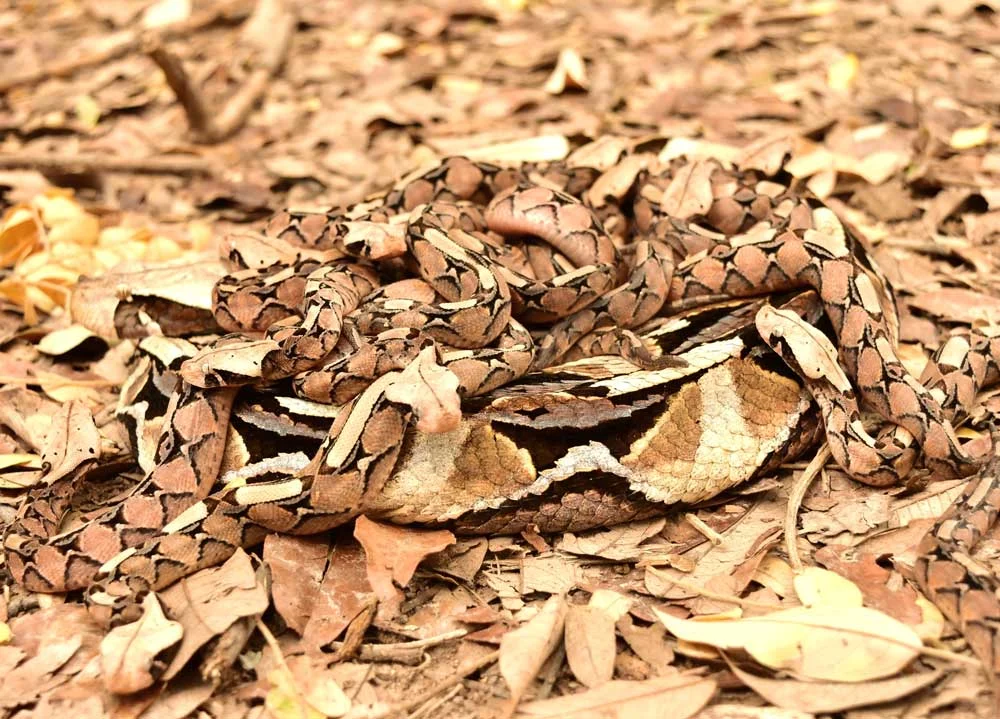
- Size and Weight: The Gaboon viper holds the title of the heaviest viper species in the world. While typical adults grow to lengths between 4 and 5 feet, exceptionally large specimens can weigh upwards of 20 pounds, possessing a remarkably thick, heavy-set body.
- Venom and Dentition: These snakes boast the longest fangs of any venom-producing snake species, sometimes measuring over two inches in length. Their venom apparatus delivers a potent mix of hemotoxins and cytotoxins designed to destroy tissue, disrupt blood clotting, and cause massive internal hemorrhaging. A bite from a Gaboon viper is a medical emergency requiring immediate antivenom administration.
- The Arboreal Myth: A primary reason digital sleuths flagged the Santa Ana photo as fake is the snake’s ecology. Gaboon vipers are terrestrial ambush predators. They spend the vast majority of their lives resting quietly on the forest floor, relying on their intricate, leaf-like geometric patterning for camouflage as they wait for rodents, small mammals, and ground birds to pass by. While it is not entirely physically impossible for one to temporarily elevate itself, they are notoriously poor climbers. Finding one comfortably established high up in a tree—as depicted in the AI-generated image—flies in the face of established herpetological science.
Municipal Waste and Resource Allocation
The financial and logistical toll of the hoax cannot be overstated. When emergency services are dispatched, public resources are diverted away from genuine crises. In this case, the Santa Ana Police Department expended significant time and labor:
- Patrol units were tied up securing the perimeter and interviewing residents.
- Specialized wildlife handlers and expert herpetologists were retained, requiring emergency service fees.
- Neighborhood anxiety spiked, leading to unnecessary fear among families, pet owners, and local schools.
Official Responses
Law enforcement agencies are increasingly finding themselves forced to adapt to crimes facilitated by artificial intelligence. The Santa Ana Police Department’s handling of the incident reflects a zero-tolerance stance on actions that drain public funds and terrorize communities for the sake of internet notoriety or personal amusement.
According to statements gathered by the Los Angeles Times and CBS News, the SAPD is meticulously assembling a formal case file to hand over to the Orange County District Attorney’s Office. Prosecutors are expected to review charges related to filing a false police report and misuse of emergency services. Under California law, making a false report of an emergency (often classified under Penal Code provisions regarding false reporting) can be prosecuted as a misdemeanor, carrying penalties that include probation, community service, and up to one year in county jail.
Legal analysts note that as generative AI tools become more sophisticated and accessible, prosecutors are eager to set legal precedents that deter individuals from weaponizing synthetic media against civic institutions. While formal charges had not officially been filed at the time of initial reports, legal experts indicated that indictments or formal complaints could emerge as early as the following day.
Implications
The Santa Ana Gaboon viper incident is far more than a bizarre local news oddity; it serves as a cautionary tale with profound implications for the digital age, law enforcement, and public trust.
1. The Weaponization of Generative AI
For years, discussions surrounding AI manipulation focused on political deepfakes, financial fraud, and identity theft. This incident broadens the scope, demonstrating how easily generative AI can be weaponized to manipulate local hyper-realities. If an individual can effortlessly generate a hyper-realistic image of a lethal exotic predator in a suburban tree, the potential for malicious actors to cause localized panic—whether for pranks, extortion, or social media clout—is virtually limitless.
2. The Dilemma for Law Enforcement
Police departments operate under a mandate of public safety. When an image or report surfaces indicating an immediate physical threat—such as a loose apex predator or a venomous animal—authorities do not have the luxury of waiting for internet sleuths to debate authenticity on social media. They must act swiftly. This incident highlights the growing burden placed on municipal agencies, who must now invest time and technological resources into verifying whether digital media is real before deploying boots on the ground.
3. The Erosion of Public Trust
As fake media becomes more pervasive, public skepticism rises. Ironically, while the police were forced to verify a fake threat, future real emergencies might be met with dangerous skepticism from a public conditioned to assume everything online is AI-generated. This "boy who cried wolf" dynamic poses a long-term threat to emergency communication and community safety.
Ultimately, the phantom viper of Santa Ana stands as a stark reminder of the friction between the digital frontier and the physical world. As Joel Ciprian prepares to face potential jail time and legal accountability, the message to the public is clear: while AI can generate a fictional monster with the click of a button, the legal and financial consequences of unleashing that monster into the real world are entirely authentic.