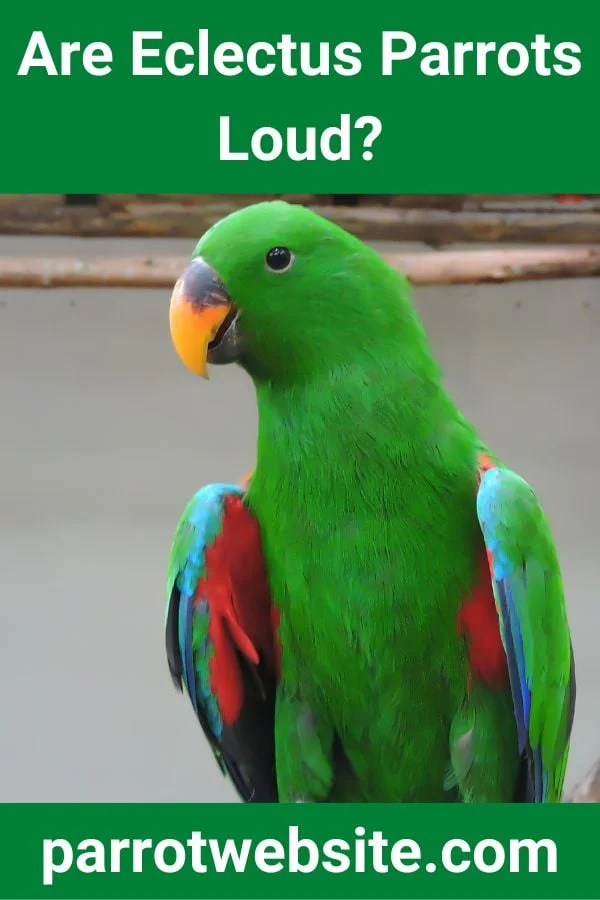
For many prospective pet owners, the allure of the Eclectus parrot is undeniable. With their stunning, vibrant plumage—often compared to fine velvet—and their reputation for being among the more temperamentally balanced parrot species, they are a popular choice for avian enthusiasts. However, before welcoming one into your home, one factor must be weighed above all others: vocalization. While they are frequently labeled as "quiet" within the parrot community, prospective owners must understand that this is a relative term.
To live with an Eclectus is to accept a partner that communicates through a spectrum of sound, ranging from soft, melodic coos to piercing, high-decibel alarm calls. This report provides a detailed examination of the noise profile, behavioral implications, and husbandry requirements of the Eclectus parrot.
Main Facts: Understanding the Soundscape of the Eclectus
When considering an Eclectus parrot, it is essential to calibrate your expectations. While they are significantly quieter than species like the Macaw or the Cockatoo, they remain, by definition, a loud household pet.
The typical daily routine of an Eclectus involves a mix of sounds. For the majority of the day, these birds are relatively soft, emitting gentle chirps, whistles, and conversational chattering—a behavior particularly noted in females. However, they possess a powerful, natural alarm call designed for long-distance communication in the wild. This call can reach levels of up to 115 decibels. To put this into perspective, 115 decibels is roughly equivalent to a chainsaw or a loud rock concert. While these bursts are usually brief, they are sharp, sudden, and non-negotiable.
Ultimately, if you are looking for a pet that remains silent, a parrot is not the correct choice. The Eclectus is an "occasionally loud" companion, and the capacity to handle these unpredictable, high-decibel moments is a prerequisite for ownership.
Chronology: The Daily Cycle of Vocalization
The vocal patterns of an Eclectus are heavily dictated by their biological clock and social needs. Managing these cycles is the key to a harmonious living environment.
Morning and Daytime Activity
As social creatures, Eclectus parrots naturally become active at sunrise. The morning is often characterized by a "flock call"—a standard behavior where the bird checks in with its human family. Throughout the day, the bird will fluctuate between quiet, melodic vocalizations and periods of high-energy play. During these active hours, the bird may use vocalizations to express excitement, request food, or simply demand interaction.
The Importance of Nighttime Silence
One of the most frequent misconceptions is that parrots require variable sleep schedules. In reality, an Eclectus should maintain a strict, 12-hour sleep cycle. If your bird is vocalizing at night, it is a clear indicator that their environment is not conducive to rest.
To ensure nighttime silence, owners should:
- Establish a Rigid Schedule: Put the bird to bed at the same time every evening.
- Control Light Levels: Once the bird is in its enclosure, all lights should be extinguished. A heavy, breathable cover is often recommended to signal that "flock time" is over and it is time to sleep.
- Reduce Ambient Noise: The sleep area should be quiet. External traffic noise or television sounds can startle a bird, leading to restless vocalizations or, worse, night frights.
Supporting Data: Why Parrots "Scream"
To understand why an Eclectus screams, one must view the behavior through an ethological lens. In the wild, these birds operate in large flocks. Their piercing calls are their version of a long-distance telephone call, used to alert others of predators or to maintain contact with their mates across vast distances.
When kept as a pet, the "flock" is comprised of the human family. A scream is often an expression of:
- Attention-Seeking: The bird feels bored or neglected and is attempting to draw you back into its orbit.
- Alarm/Fear: The bird senses a threat or a change in the environment that it finds alarming.
- Frustration: The bird has unmet needs, such as a lack of mental stimulation, improper diet, or insufficient physical exercise.
Data suggests that parrots who are provided with adequate foraging opportunities—puzzles, shreddable toys, and complex feeding stations—exhibit fewer instances of stress-related screaming. By keeping the bird mentally engaged, the owner reduces the likelihood of the bird resorting to loud vocalizations simply to relieve boredom.
Expert Perspectives: The Art of Conversation
Eclectus parrots are widely regarded as some of the most articulate talkers in the avian world. While they may not be as prolific as the African Grey, they are often praised for the clarity and "human-like" quality of their speech.
The Trainer’s Approach
Training an Eclectus to talk requires patience and consistency. The most effective method is Positive Reinforcement Training (PRT). By associating specific words with treats, praise, or affection, the owner creates a positive feedback loop.
- Clarity is Key: Speak slowly and clearly. The bird will mirror the intonation it hears most often.
- Integration: Do not keep "lesson time" separate from "play time." Incorporating vocabulary practice into daily bonding activities ensures the bird does not lose interest.
- Individual Variation: It is vital to acknowledge that not every Eclectus will become a conversationalist. Just as humans have varying levels of aptitude for language, so too do these birds. Some may learn dozens of phrases, while others may prefer to mimic the sound of the microwave or the dog barking.
Implications for Prospective Owners
If you are considering bringing an Eclectus into your home, you must consider the long-term commitment. These birds can live for 30 to 50 years, and their noise levels are a constant factor.
Assessing Your Environment
Before adoption, ask yourself:
- Neighbors: Do you live in an apartment or townhome with shared walls? If so, the 115-decibel alarm call may be a source of conflict.
- Lifestyle: Do you have the time to provide the social interaction that prevents boredom-based screaming?
- Tolerance: Can you handle the sudden, intense noise that is a natural part of a bird’s healthy behavioral expression?
Troubleshooting Excessive Noise
If an Eclectus begins to exhibit "excessive" noise—screaming that persists for long periods—it is a cry for help. The first step should always be a veterinary examination to rule out health issues. If the bird is healthy, examine the environment:
- Dietary Boredom: Are you rotating their treats and fresh produce?
- Lack of Sleep: Is the bird receiving an uninterrupted 12-hour rest period?
- Social Deficit: Is the cage in a high-traffic area where the bird feels included, or is it isolated in a quiet room?
Conclusion: The Reality of Ownership
The Eclectus parrot is a beautiful, intelligent, and highly social creature that brings immense joy to the lives of its owners. While they are often marketed as a "quieter" parrot, this label should not be interpreted as "silent." They are birds, and by their very nature, they are vocal, expressive, and occasionally loud.
For those who are prepared to embrace the full range of their personality—the soft, sweet whistles in the morning and the occasional, startling alarm call during the day—the Eclectus is an unmatched companion. By prioritizing their sleep, mental stimulation, and social needs, owners can manage the noise level effectively, ensuring that the bond between bird and human remains strong for decades to come. Before finalizing your decision, spend time with the species, visit a sanctuary or a reputable breeder, and experience the reality of their vocalizations firsthand. Only then can you truly determine if the song of the Eclectus is the right fit for your home.