HYDERABAD, INDIA — In a significant boost to the understanding of South Asia’s herpetological wealth, a collaborative team of Indian researchers has formally described two new species of geckos belonging to the genus Hemidactylus. Unearthed from the rocky terrain of the Nalgonda and Warangal districts in Telangana State, these nocturnal reptiles belong to the Hemidactylus brookii species group and the murrayi clade.
The formal description of Hemidactylus cairnicola and Hemidactylus koyaorum not only highlights the remarkable evolutionary diversification occurring within the Central Plateau of the Deccan Peninsula but also underscores how much of India’s micro-endemic biodiversity remains scientifically undocumented. The findings were published in the European Journal of Taxonomy.
Main Facts: Meet India’s Newest Reptilian Residents
The discovery introduces two distinct, highly specialized gecko species adapted to specific regional microhabitats within Telangana.
Hemidactylus cairnicola
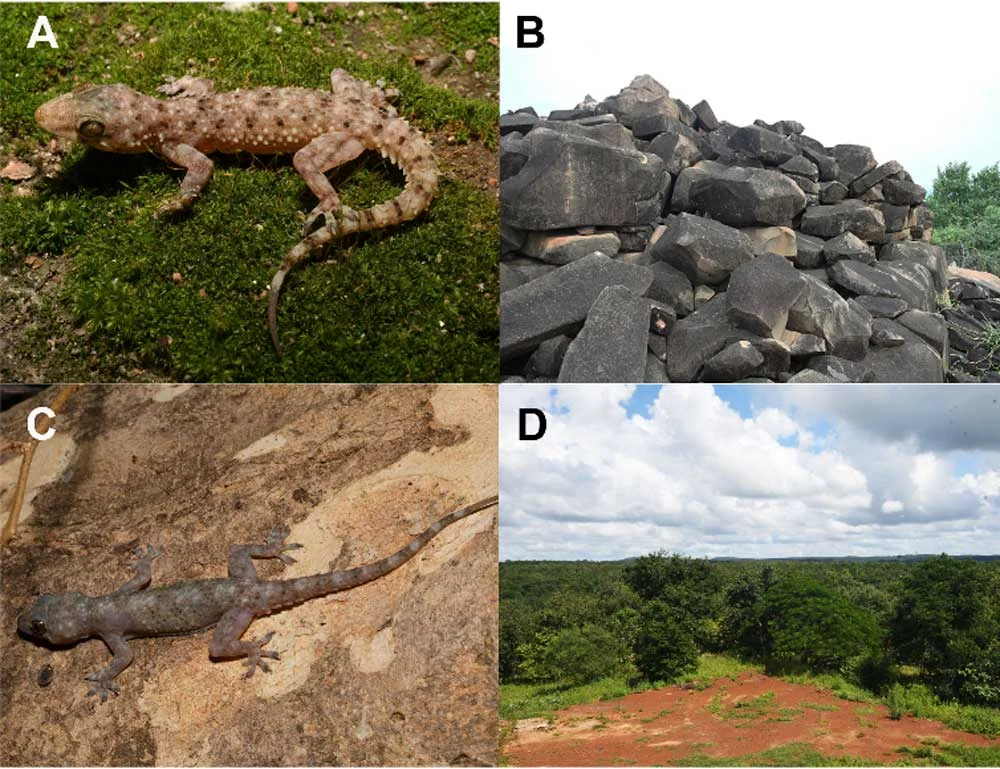
Discovered in the rugged rocky scrub forests of the Nalgonda District, Hemidactylus cairnicola is a medium-sized gecko measuring up to 49 millimeters in snout-to-vent length. It possesses a robust, slightly depressed body paired with a distinct, broad head.
- Physical Appearance: Its dorsal scalation features granular scales intermixed with enlarged, strongly keeled, conical tubercles arranged in 13 to 15 longitudinal rows stretching from the occiput to the tail base. The ventral side features roughly 31 to 32 scale rows across its width and 137 to 145 longitudinal ventral scales. Males are distinguished by possessing seven or eight femoral pores on each side.
- Coloration and Camouflage: H. cairnicola exhibits a dynamic light-brown to gray color palette capable of shifting to match its rocky background. Its head is marked by dark spots accompanied by paired preocular and postocular streaks, while irregular dark bands span its body and tail. The underside remains unpatterned and lighter in hue.
- Habitat and Ecology: True to its name—derived in part from its affinity for rock cairns—this nocturnal species spends daylight hours retreating deep into rock crevices. It emerges after dusk to hunt insects. Observers have noted individuals basking on exposed rock surfaces during cooler winter mornings and rainy days. It frequently coexists near human settlements, traditional Lambada communities, and other regional reptiles, including skinks, agamid lizards, various geckos, and the Indian sand boa (Eryx johnii).
Hemidactylus koyaorum
Endemic to the Deccan Peninsula biogeographic zone, Hemidactylus koyaorum is currently known strictly from its type locality within the Warangal District of Telangana.
- Taxonomic Position: Like its sibling discovery, it sits comfortably within the Hemidactylus brookii group and the murrayi clade. Morphological and genetic analyses reveal it is most closely related to Hemidactylus treutleri.
- Genetic Divergence: Mitochondrial ND2 gene sequencing confirmed deep genetic divergence. H. koyaorum exhibits an uncorrected sequence divergence of 7.0% to 13.5% when compared to H. treutleri. Furthermore, the two newly discovered species—H. cairnicola and H. koyaorum—are separated from one another by a significant 9.5% to 10.0% sequence divergence, validating their status as distinct evolutionary lineages.
Chronology of the Discovery: From Fieldwork to Formal Description
The path to uncovering these cryptic species spanned several years of meticulous field surveys, specimen collection, and rigorous laboratory analysis.
Phase 1: Regional Field Surveys (2018–2022)
Herpetologists and researchers operating across various tracts of Telangana routinely monitored remote scrub forests, rocky outcrops, and agrarian fringes. Recognizing that the vast Deccan Plateau harbored understudied reptile complexes—particularly within the ubiquitous Hemidactylus brookii aggregate—the team targeted areas with complex geological formations, such as the boulder-strewn landscapes of Nalgonda and Warangal.
Phase 2: Specimen Collection and Morphological Assessment
During night-time foraging surveys, researchers collected voucher specimens of unclassified Hemidactylus morphotypes. Back in the laboratory, detailed morphological data was cataloged. Scale counts, pore arrangements, body proportions, and color patterns were meticulously measured and compared against historical type specimens and existing literature for South Asian geckos.
Phase 3: Molecular Phylogenetics and Genetic Sequencing
Because many Hemidactylus species are "cryptic"—meaning they look nearly identical externally while maintaining distinct genetic identities—morphological data alone was insufficient. Tissue samples were extracted for mitochondrial DNA analysis. Amplifying and sequencing the ND2 gene allowed researchers to construct phylogenetic trees, confirming that the populations from Nalgonda and Warangal represented novel genetic lineages separated from H. treutleri and other regional congeners by millions of years of evolutionary history.
Phase 4: Peer Review and Taxonomic Publication
With morphological distinctiveness and genetic divergence firmly established, the team drafted the formal taxonomic descriptions. The manuscript, titled "Two new cryptic species of Hemidactylus (Reptilia: Gekkonidae) allied to H. treutleri from Telangana, India," underwent rigorous peer review before its acceptance and publication in the European Journal of Taxonomy.
Supporting Data: The Multidisciplinary Research Team
This groundbreaking taxonomic revision was made possible through an interdisciplinary collaboration spanning several premier scientific and conservation institutions across India. The research team comprises:
- Bharath Bhupathi — Freshwater Biology Regional Centre, Zoological Survey of India, Hyderabad, Telangana.
- Sumidh Ray — P.G. Department of Zoology, Fakir Mohan University, Balasore, Odisha.
- B. Laxmi Narayana — Zoological Survey of India, FPS Building, Indian Museum Campus, Kolkata, West Bengal.
- Amirtha Balan — Nehru Zoological Park, Bahadurpura, Hyderabad, Telangana.
- Deepa Jaiswal — Wildlife Institute of India, Chandrabani, Dehradun, Uttarakhand.
- Pratyush P. Mohapatra — Freshwater Biology Regional Centre, Zoological Survey of India, Hyderabad, Telangana.
The integration of researchers from zoological surveys, academic departments, wildlife institutes, and urban zoological parks highlights a unified national effort to catalog India’s hidden vertebrate fauna.
Official Responses and Scientific Significance
While formal press statements from environmental ministries are rolling out, leading herpetologists and members of the research collective have emphasized the profound ecological implications of this discovery.
Speaking on the challenges of identifying cryptic species, lead investigators noted that the Hemidactylus brookii complex has historically served as a "species dump"—a taxonomic catch-all where numerous distinct regional populations were lumped together under a single umbrella name due to superficial similarities.
"For decades, regional variations in widely distributed gecko groups were ignored or dismissed as simple geographic color morphs," a representative from the research team remarked during an informal briefing. "By combining classical morphological taxonomy with modern molecular phylogenetics, we are peeling back layers of hidden diversity. What looks like a common house gecko to the untrained eye in a rural Telangana village turns out to be an evolutionary masterpiece millions of years in the making, found nowhere else on Earth."
Conservationists have similarly lauded the discovery, pointing out that naming a species is the vital first step toward protecting its habitat. Without formal scientific descriptions, localized endemics risk disappearing quietly due to habitat degradation before conservation frameworks can even be applied to them.
Implications: Conservation, Land Use, and Future Biodiversity Horizons
The discovery of Hemidactylus cairnicola and Hemidactylus koyaorum carries wide-ranging implications for ecology, regional land-use planning, and India’s broader conservation strategies.
1. Micro-Endemism and Habitat Vulnerability
Both species are currently known only from their respective type localities in Nalgonda and Warangal. Micro-endemic species—those restricted to extremely small, specialized geographic zones—are inherently vulnerable to environmental shifts. The rocky scrub forests and boulder habitats favored by these geckos are frequently subjected to anthropogenic pressures, including stone quarrying, real estate expansion, overgrazing by livestock, and agricultural encroachment. The destruction of black rock cairns and natural rock formations directly threatens the microhabitats these geckos rely on for thermoregulation and diurnal shelter.
2. Redefining Urban and Rural Coexistence
Interestingly, H. cairnicola was documented in close proximity to human habitations, agricultural lands, and traditional Lambada settlements. This overlap demonstrates that certain native reptiles can persist in human-modified landscapes, provided critical structural elements (such as exposed rock piles and stone walls) remain intact. However, it also highlights the urgent need to educate local communities about the ecological value of these harmless, insect-eating lizards, which naturally regulate pest populations.
3. A Call for Taxonomic Re-evaluation Across India
The success of uncovering two distinct lineages within Telangana suggests that the Deccan Peninsula—and the Indian subcontinent as a whole—remains vastly under-explored. Herpetologists predict that applying similar integrative taxonomic frameworks (combining DNA barcoding with detailed morphological work) to other widespread reptile groups will likely unearth dozens of additional cryptic species.
4. Policy and Conservation Action
Conservation planners must now factor these newly minted endemics into regional biodiversity registers. Protecting select rocky outcrops as micro-reserves or heritage sites could safeguard not only H. cairnicola and H. koyaorum but also an entire assemblage of neglected desert and scrub-dwelling fauna, from agamid lizards to specialized snakes like the Indian sand boa.
As India continues to modernize and develop its infrastructure, discoveries like those in Nalgonda and Warangal serve as a timely reminder: safeguarding the nation’s natural heritage requires paying attention not just to iconic megafauna in sprawling national parks, but also to the silent, scaled inhabitants thriving in the rocky crevices right in our backyards.