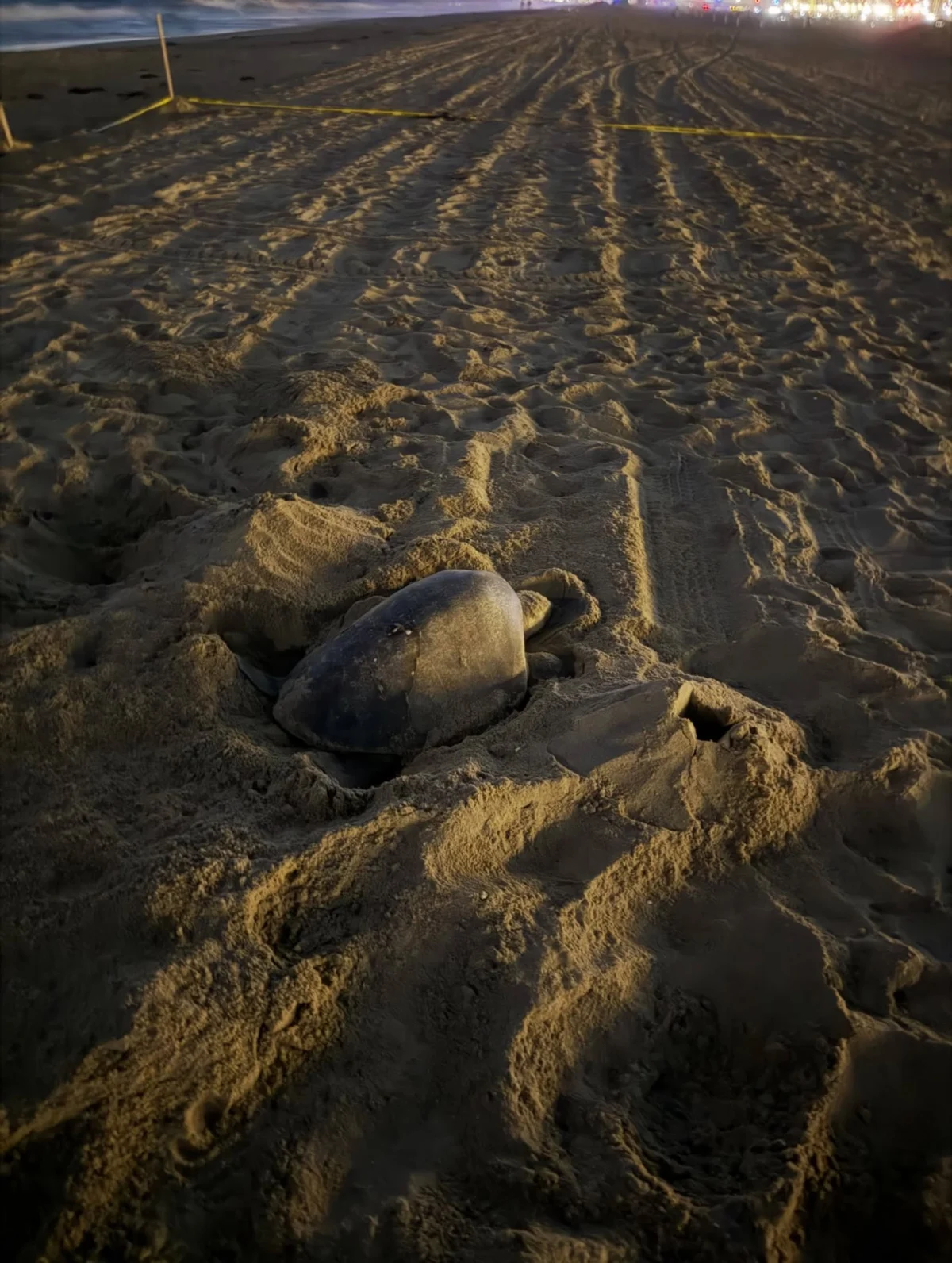
LOS ANGELES & ORANGE COUNTY, CALIF. — In what marine biologists are calling a historic and paradigm-shifting wildlife event, the United States West Coast has recorded its very first instances of sea turtle nesting. NOAA Fisheries West Coast announced on September 22 that an olive ridley sea turtle (Lepidochelys olivacea) was documented digging a nest and depositing eggs on a public beach in Surfside, California.
Just 72 hours later, in a stunning geographical anomaly that has stunned conservationists and marine researchers alike, a second nesting event occurred just a few miles down the coast. According to official reports from NOAA, an unidentified sea turtle came ashore to lay eggs in Huntington Beach, mere yards from the city’s world-famous municipal pier.
These unprecedented occurrences have transformed quiet Southern California stretches of sand into frontline conservation zones. As federal, state, and local agencies mobilize to protect the vulnerable clutches, scientists are left questioning whether these events are isolated anomalies or the vanguard of a shifting marine ecosystem driven by warming Pacific waters.
Main Facts: A Historic First for the U.S. West Coast
To understand the magnitude of the September events, one must look at the historical boundaries of sea turtle behavior in North America. While sea turtles frequently nest along the warm, tropical, and subtropical shores of the southeastern United States—particularly Florida, Georgia, and the Carolinas—the Pacific coast of the U.S. has never been a documented nesting ground.
While small populations of green sea turtles (Chelonia mydas) are known to forage and reside year-round in the warm-water effluent of the San Gabriel River—which marks the border between Los Angeles and Orange County—they have never been observed laying eggs on Southern California shores.
The Surfside nesting event definitively shatters this historical precedent. For the first time in recorded history, an olive ridley sea turtle completed a successful nesting sequence on a U.S. West Coast beach. The subsequent Huntington Beach event, occurring only three days later with an as-yet-unidentified species, suggests that these may not be erratic, one-off behaviors by a single disoriented animal, but rather part of a broader, unfolding ecological narrative.
Chronology of Events
The unfolding of this extraordinary week along the Southern California coastline followed a rapid succession of discoveries that caught wildlife officials and local authorities by surprise:
- September 22: NOAA Fisheries West Coast publicly announces that an olive ridley sea turtle (Lepidochelys olivacea) was observed coming ashore in Surfside, California. The animal successfully excavated a nest and deposited her eggs before returning to the Pacific Ocean. Wildlife biologists quickly identified the species and cordoned off the area.
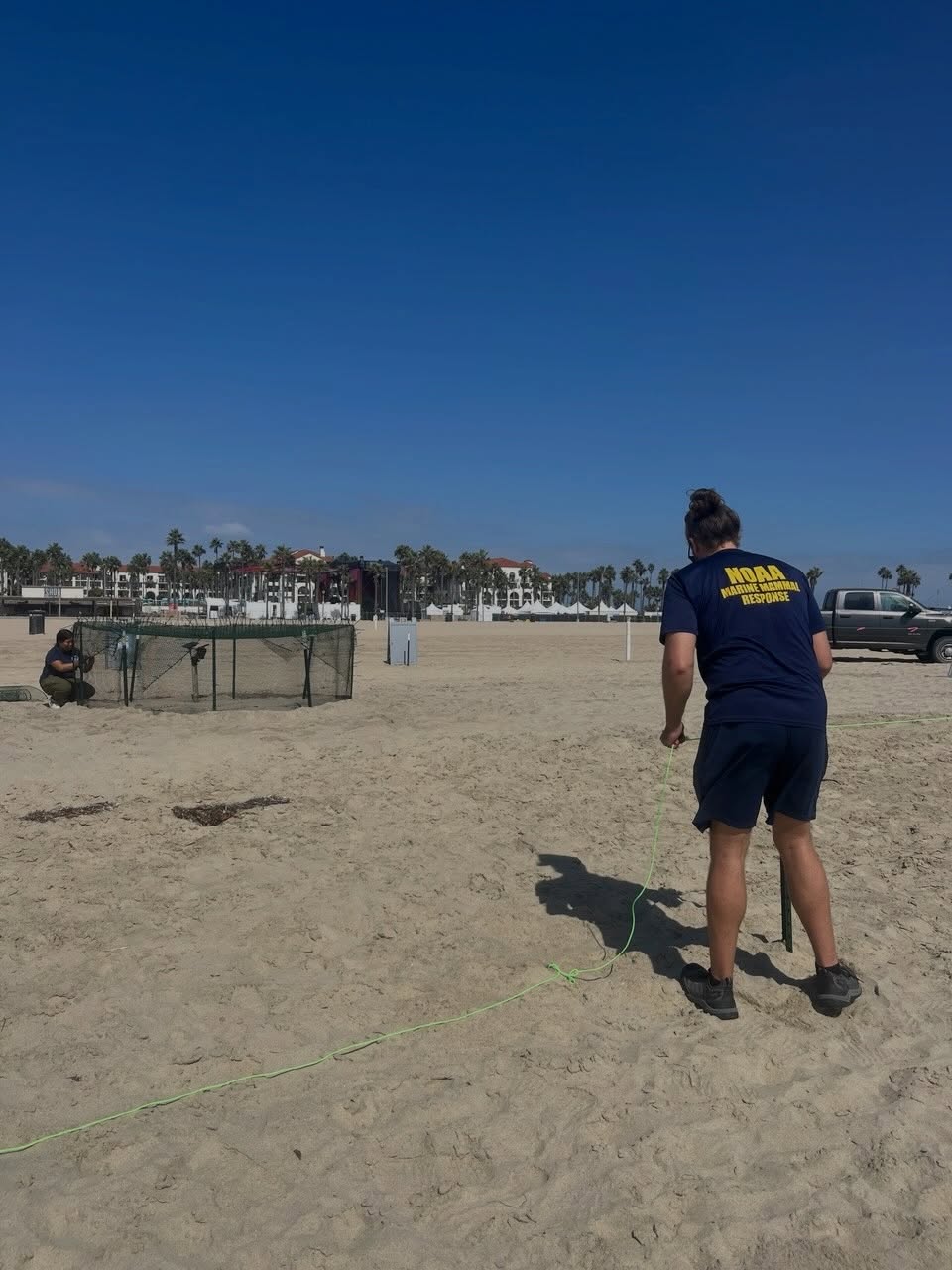
- September 23–24: Federal, state, and local marine partners mobilize to assess the Surfside nest. Protective wooden and mesh barriers are constructed around the site, and specialized interpretive signage is deployed to educate the public while keeping curious beachgoers at a safe distance.
- September 25: Just a few miles south of the Surfside location, a second sea turtle—initially left unidentified by responding agencies—is spotted crawling onto the sands of Huntington Beach, near the iconic Huntington Beach Pier. Local fire department personnel and marine officials respond to secure the area as the animal deposits her clutch.
- Late September to Present: A joint task force of local, state, and federal entities establishes round-the-clock monitoring protocols for both nesting sites. The incubation period begins, with officials projecting a critical hatching window roughly 45 to 60 days post-deposition.
Supporting Data & Biological Profile of the Olive Ridley
The protagonist of the Surfside event, the olive ridley sea turtle, is a fascinating subject of marine biology. Recognized as the smallest of all extant sea turtle species, mature adults typically weigh in at around 100 pounds and measure between 2.5 and 3 feet in length. Despite their modest stature relative to leatherbacks or loggerheads, they boast a robust lifespan of up to 50 years.
Global Distribution and Nesting Habits
Olive ridleys have a circumglobal distribution, inhabiting tropical and subtropical waters primarily within the Pacific, Indian, and Atlantic Oceans. In the Eastern Pacific basin, their major nesting strongholds are traditionally found much further south, concentrated along the coasts of Mexico, Nicaragua, Costa Rica, and Panama.
In these regions, olive ridleys are world-famous for their synchronized mass nesting events, known as arribadas (meaning "arrivals" in Spanish), where hundreds of thousands of females come ashore simultaneously to lay eggs. For a solitary female to break away from these tropical migration corridors and travel thousands of miles north into Southern California waters to nest is an extraordinary behavioral departure.
Environmental Catalysts: The Super El Niño Factor
Marine scientists examining the data point to a significant environmental driver behind this northward migration: elevated ocean temperatures. Current meteorological and oceanographic conditions feature a powerful super El Niño cycle, causing sea surface temperatures off the coast of Southern California to spike dramatically. On multiple days leading up to the nesting events, nearshore water temperatures approached an unseasonably warm 80 degrees Fahrenheit.
This thermal anomaly effectively transformed the Southern California bight into a temporary subtropical habitat, likely cueing the turtles—which rely on warm water temperatures for metabolic regulation and reproductive signaling—that they were in an environment suitable for nesting.
Official Responses and Conservation Efforts
The sudden appearance of nesting marine reptiles in densely populated urban beach communities presented an immediate logistical challenge for wildlife managers. Southern California beaches are among the most heavily trafficked recreational zones in the United States, seeing millions of visitors annually.
In a joint statement released via social media, NOAA Fisheries outlined the multi-agency response:
"Our team of local, state, and federal partners will monitor the nesting sites throughout the incubation period, which typically lasts for 45-60 days. Both areas are fenced, protected, and have interpretive signage. We urge beachgoers to steer clear and not disturb the sites."
Local agencies, including the Huntington Beach Fire Department and municipal lifeguards, worked alongside marine mammal and reptile rescue organizations to establish secure perimeters. Heavy-duty fencing and clear informational plaques now surround both the Surfside and Huntington Beach nests.
Biologists are maintaining a constant vigil to protect the eggs from natural predators, tidal washouts, and human interference. Because sea turtle eggs are vulnerable to compaction, poaching, and thermal extremes, the active management of these urban nests represents a high-stakes conservation effort.
Ecological Implications and Future Outlook
While the immediate focus remains on securing the nests through their 45-to-60-day incubation window, marine biologists and ecologists are already looking at the broader implications of these historic events.
The Incubation and Hatching Dilemma
The timing of the nesting events introduces a complex biological variable. Sea turtle sex determination is temperature-dependent (higher temperatures produce more females, while cooler temperatures produce males). Furthermore, the metabolic development of the embryos relies heavily on stable ambient sand temperatures.
With ocean and air temperatures currently elevated due to the super El Niño, the embryos are developing under unusually warm conditions. However, meteorologists project that seasonal shifts could cause coastal air and water temperatures to drop significantly over the next month and a half. Scientists are intensely monitoring how the developing hatchlings will fare if the Southern California coastline experiences a rapid cooling trend before the expected emergence window in late November or December. If the sand cools down too drastically, it could impact hatching success rates.
Climate Change and Shifting Habitats
On a macro scale, the Surfside and Huntington Beach nestings are being viewed through the lens of global climate change. As ocean temperatures continue to rise globally, marine species are increasingly expanding their geographic ranges poleward in search of suitable thermal habitats.
While the San Gabriel River green sea turtle population has long demonstrated that marine reptiles can survive in Southern California waters year-round, nesting requires an entirely different physiological and behavioral threshold. The successful drive to dig a nest and lay eggs indicates that the physiological triggers for reproduction are shifting northward.
Anthropogenic Pressures: The Plastic Threat
As these hatchlings prepare to face the Pacific Ocean, conservationists also emphasize the perilous state of the marine environment they are entering. Beyond natural predation and shifting climate patterns, modern sea turtles face severe anthropogenic threats. Research underscores that sea turtles frequently fall victim to plastic ingestion—often succumbing to marine debris at rates even higher than many species of sea birds and marine mammals. Ensuring that these historic hatchlings make it safely from the sand to the surf is only the first step in a much larger battle for marine conservation.
What Lies Ahead
For now, the eyes of the global marine science community remain fixed on two small, fenced-off plots of sand in Orange County, California. Whether these nests successfully hatch and produce the first native generation of West Coast sea turtles remains to be seen. Regardless of the immediate outcome, the events of late September have permanently rewritten the distribution maps of Pacific sea turtles, signaling a new and unpredictable era for marine life on the United States West Coast.