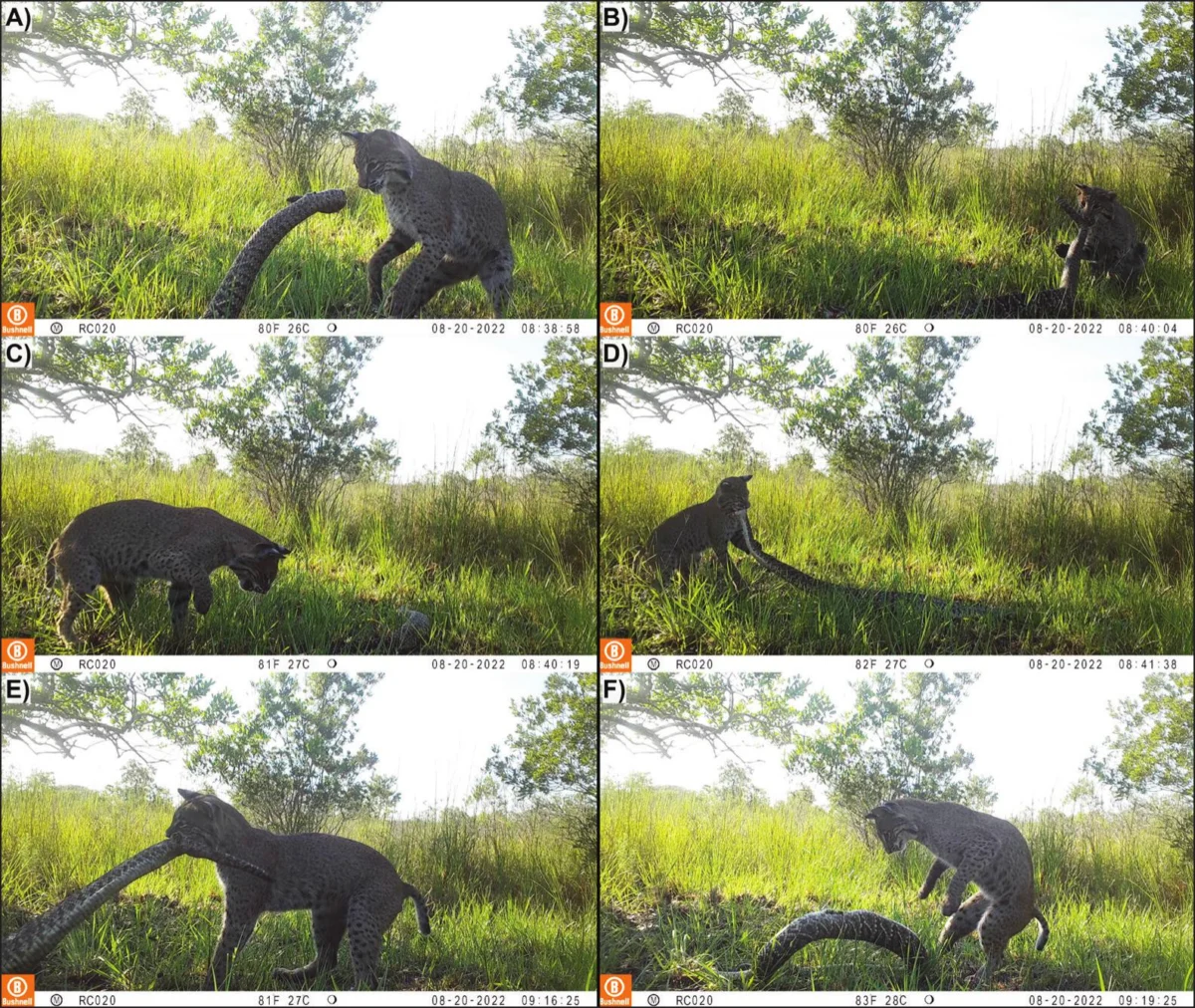
FLORIDA — In the shadowy expanses of rural Florida, wildlife cameras frequently capture the mundane midnight wanderings of white-tailed deer, the silent glides of owls, and the occasional startled raccoon. However, a recent deployment at a University of Florida research facility has yielded something far more extraordinary: rare, frame-by-frame photographic documentation of a bobcat (Lynx rufus) actively hunting, battling, and subduing an adult Eastern diamondback rattlesnake (Crotalus adamanteus).
The gripping encounter, which unfolded across a tense two-hour window on August 20, 2022, provides researchers with unprecedented primary evidence of a mammalian predator successfully engaging one of North America’s most formidable venomous serpents. Published in the journal Southeastern Naturalist, the discovery sheds new light on the ecological role of bobcats as apex predators capable of taking down dangerous, large-bodied reptiles—a behavior that scientists suspect extends to managing invasive snake populations across the American Southeast.
Main Facts: A Rare Window Into Wilderness Predator Dynamics
The groundbreaking interaction was recorded at the University of Florida Range Cattle Research and Education Center, situated in Ona, Hardee County. Researchers Mohamed Khalil Meliane, Peyton E. Niebanck, Nicole Rita, Samantha Nunn, and E. Hance Ellington had deployed a network of remote field cameras designed to monitor general wildlife interactions and biodiversity across the working cattle ranch.
Among these devices was a strategically positioned Bushnell Core camera mounted precisely 50 centimeters above the ground. Configured to capture burst shots of three consecutive images per motion trigger, with a rapid 0.6-second recovery interval, the camera was primed to catch rapid movements that standard wildlife setups often miss.
When the researchers later retrieved the data card, they discovered a sequence of 38 distinct photographs detailing a prolonged, methodical predatory assault. The target of the bobcat’s aggression was a mature Eastern diamondback rattlesnake—a heavyweight among vipers, known for its potent hemotoxic venom, thick musculature, and lethal defensive strike capabilities.
According to the research team, this sequence provides the first definitive, primary photographic proof of a bobcat actively hunting an adult Eastern diamondback rattlesnake. While anecdotal accounts of wild cats tackling snakes occasionally circulate, concrete scientific documentation has historically been exceedingly scant. Prior to this event, the only notable recorded interaction involving a bobcat and this specific venomous species occurred in Georgia back in 2001. In that instance, researchers discovered Eastern diamondback remains inside a bobcat’s stomach contents; however, that post-mortem evidence could not definitively confirm whether the feline had hunted the snake or merely scavenged an already dead carcass.
The Florida footage eliminates any ambiguity, confirming that bobcats are active, calculated predators capable of neutralizing heavily armed venomous prey.
Chronology of the Conflict: A Calculated Assault
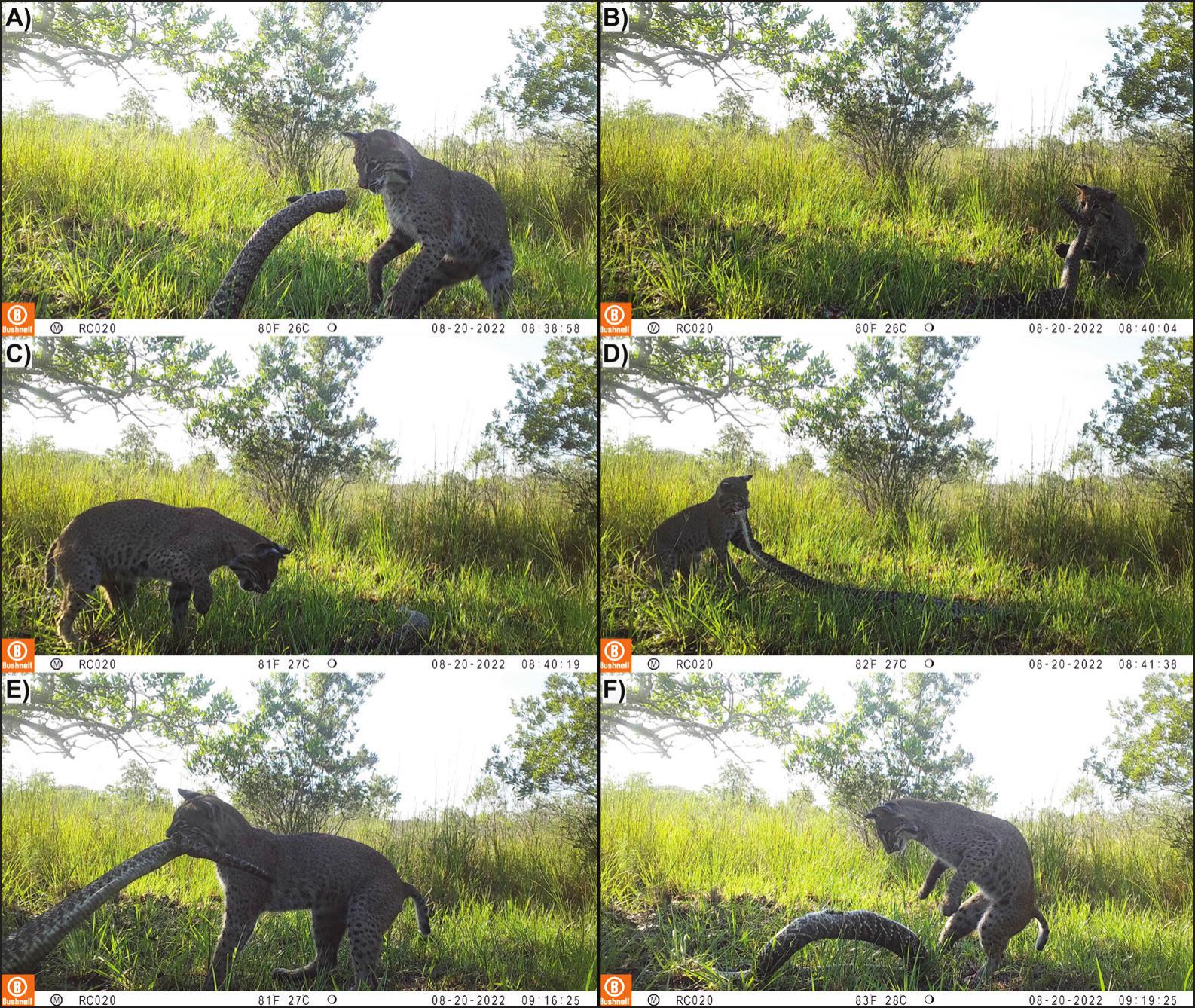
The 38 photographs retrieved from the camera trap allowed the research team to reconstruct a minute-by-minute timeline of the nearly two-hour encounter, revealing a tactical, calculated approach by the feline predator. Rather than launching a reckless, impulsive strike that could easily result in a fatal venom injection, the bobcat engaged in a calculated war of attrition.
Phase 1: Caution and Probing
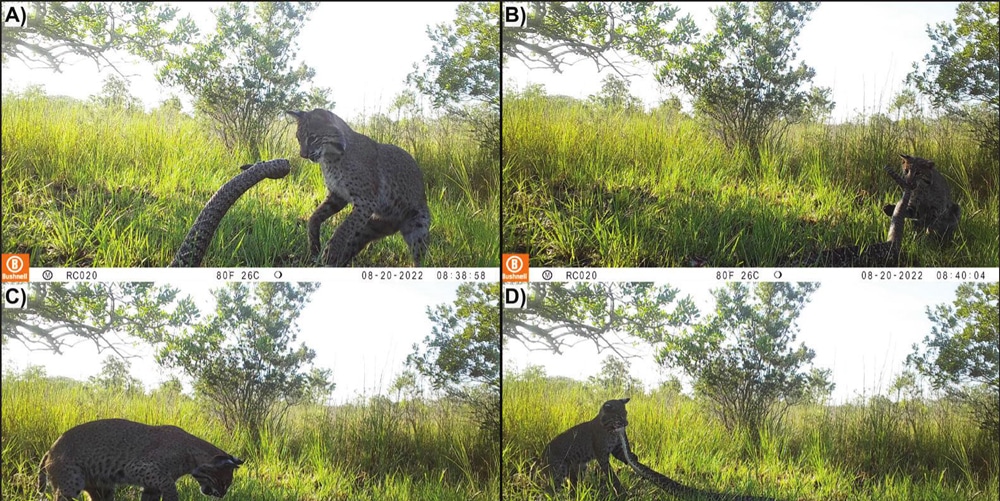
The sequence begins with the bobcat cautiously sizing up its quarry. Early frames show the wildcat carefully avoiding the rattlesnake’s dangerous, buzzing tail. Bobcats, possessing sharp reflexes and acute spatial awareness, are well aware of the lethal potential harbored in a viper’s head, but they must also respect the whip-like defensive strikes of a contracting tail.
Phase 2: The Initial Strike and Clawing
Within moments, the tactical dynamic shifts. The camera captured the bobcat seizing the rattlesnake’s contracting tail firmly in its jaws, holding it for approximately five seconds. As the serpent thrashed to defend itself, the bobcat transitioned to using its paws, relentlessly clawing the snake’s body for a continuous 20-second interval. Deep wounds began to manifest along the reptile’s midsection as the cat’s sharp retractile claws pierced tough scales.
Phase 3: The Strategic Lull
Following the intense burst of clawing, the bobcat executed a surprising tactical pause. The images show the feline stepping back and resting near the snake for roughly 29 seconds. Behavioral ecologists note that this pause likely served to let the rattlesnake exhaust itself, minimize the cat’s own energy expenditure, and keep it safely out of striking range while the venomous snake processed the stress of the initial assault.
Phase 4: The Final Subdual
With the snake sufficiently worn down, the bobcat re-engaged with lethal precision. The camera recorded the predator biting directly into the rattlesnake’s head for an extended 114 seconds—nearly two full minutes of sustained pressure designed to crush the skull and neutralize the primary delivery system of the venom.
Following the prolonged head-bite, the bobcat briefly returned to biting the tail for six seconds. Later photographs in the sequence show the massive rattlesnake completely overturned on its back. Even in this vulnerable, disoriented state, the snake continued to make uncoordinated, desperate attempts to strike back at its tormentor, though all defensive maneuvers proved entirely unsuccessful against the agile predator.
Supporting Data: Camera-Trap Technology Revolutionizing Field Ecology
The success of this documentation underscores a broader technological shift in wildlife biology. Traditional field research relies heavily on radio telemetry, direct visual observations, and scat analysis—methods that often miss fleeting, nocturnal, or high-intensity predator-prey conflicts.
The Bushnell Core camera trap utilized in Hardee County, Florida, represents a leap forward in automated ecological monitoring. By configuring the device with a low mounting angle (50 cm) and a rapid burst-trigger mechanism, the researchers were able to capture high-resolution behavioral data without human interference or the presence of an observer altering animal behavior.
This methodology has increasingly paid dividends in tracking elusive predator behaviors across the American Southeast. For instance, remote camera traps have recently illuminated other unexpected dietary habits and predatory capabilities of Lynx rufus.
In 2022, separate camera-trap deployments in the Florida Everglades captured bobcats raiding the nesting sites of invasive Burmese pythons (Python bivittatus), consuming their eggs. This marked the first definitive documentation of a native mammalian nest predator targeting the invasive constrictors. Furthermore, a 2021 investigation pieced together evidence of a bobcat killing an adult female Burmese python, identified through distinctive claw scratches on the carcass and behavioral caching signs left at the scene.
When viewed collectively, these data points paint a picture of the bobcat as an opportunistic, highly adaptable apex generalist whose predatory repertoire extends far beyond small rodents, rabbits, and birds.
Official Responses and Ecological Implications
The publication of the Southeastern Naturalist paper has generated significant interest within the herpetological and mammalian ecology communities. Wildlife biologists view the documentation not merely as a fascinating snapshot of nature "red in tooth and claw," but as an observation with profound implications for ecosystem management.
Expanding the Predator Paradigm
"Documenting interactions of this nature is exceptionally difficult because they happen spontaneously in remote areas and often conclude very quickly," noted field researchers tracking southeastern predators. "Catching a bobcat take down an adult Eastern diamondback rattlesnake—a species that commands immense respect even among experienced handlers—demonstrates the sheer tactical intelligence, agility, and resilience of Lynx rufus."
Ecologists have long understood that bobcats sit comfortably in the intermediate predator guild, but accumulating evidence suggests they punch well above their weight class. By tackling large vipers and engaging with dangerous prey, bobcats demonstrate a behavioral plasticity that allows them to exploit varied food webs across fragmented and shifting landscapes.
Implications for Invasive Species Control
Perhaps the most exciting implication of the Florida study relates to the ongoing battle against invasive species in the American Southeast, particularly the proliferation of large constrictors like the Burmese python.
While the Eastern diamondback rattlesnake is a native species playing a vital role in local rodent control, the region’s burgeoning python populations represent an unmitigated ecological disaster, decimating native mammal and bird populations in the Everglades and surrounding wetlands. The confirmation that bobcats possess the physical capability, weaponry, and behavioral strategies to hunt, kill, and consume large-bodied snakes—ranging from venomous vipers to massive constrictors—suggests that native carnivores may play a more active role in biological resistance against invasive reptiles than previously understood.
While native predators alone cannot eradicate or fully control invasive python populations, conservationists suggest that healthy bobcat populations could act as a natural check, preying upon juvenile and sub-adult pythons, and occasionally subduing larger specimens.
Conclusion: A Testament to Wilderness Resilience
The 38 photographs captured in Hardee County do more than simply fill a gap in academic literature; they serve as a vivid reminder of the raw, untamed dynamics playing out daily in rural and semi-wild landscapes across Florida. As suburban development encroaches upon natural habitats, understanding the complex interspecies relationships between native predators and dangerous or invasive reptiles becomes increasingly critical for effective wildlife management.
For now, the open-access paper—titled "Photographic Evidence of a Bobcat (Lynx rufus) Attack on an Eastern Diamondback Rattlesnake (Crotalus adamanteus)"—stands as a milestone in field biology, immortalizing the day a clever wildcat outmaneuvered one of the wilderness’s most formidable predators.