
ONA, FLORIDA — In the wild, dramatic showdowns often occur out of sight, leaving researchers to piece together the secrets of predator-prey dynamics through faint tracks, scat, or occasional scavenging evidence. However, a stroke of ecological good fortune in the Sunshine State has yielded a groundbreaking visual record.
A remotely triggered field camera in rural Florida has captured a rare, nearly two-hour sequence of 38 sequential photographs detailing a fierce, calculated predation event: a wild bobcat (Lynx rufus) actively hunting, battling, and overcoming a massive adult Eastern diamondback rattlesnake (Crotalus adamanteus).
Published in the Southeastern Naturalist under the title "Photographic Evidence of a Bobcat (Lynx rufus) Attack on an Eastern Diamondback Rattlesnake (Crotalus adamanteus)," the documentation provides primary, undeniable proof of a felid successfully targeting and neutralizing one of North America’s most formidable venomous snakes. The findings not only offer a rare window into the behavioral ecology of Florida’s native predators, but they also significantly expand our scientific understanding of bobcats as apex predators capable of taking down large, dangerous reptiles.
Main Facts: The Anatomy of a Calculated Ambush
The encounter took place on August 20, 2022, at the University of Florida Range Cattle Research and Education Center, situated in Ona, Hardee County. The observation site is a working agricultural landscape that harmonizes cattle management with rich native wildlife habitats, making it an ideal frontier for studying animal interactions.
The scientific team behind the discovery—comprising researchers Mohamed Khalil Meliane, Peyton E. Niebanck, Nicole Rita, Samantha Nunn, and E. Hance Ellington—was not explicitly hunting for snake-and-cat battles. Instead, they had deployed a network of automated trail cameras to broadly monitor wildlife activity and interspecies dynamics across the property.
The device responsible for capturing history was a Bushnell Core trail camera, mounted strategically at a height of 50 centimeters (roughly 20 inches) above the ground. The unit was programmed with highly sensitive parameters: whenever motion triggered the sensor, it fired a rapid burst of three photographs, followed by a remarkably swift recovery interval of just 0.6 seconds. This rapid-fire capability proved crucial, capturing crisp, chronological frames of an event that could easily have been missed by standard motion-detection cameras with longer delays.
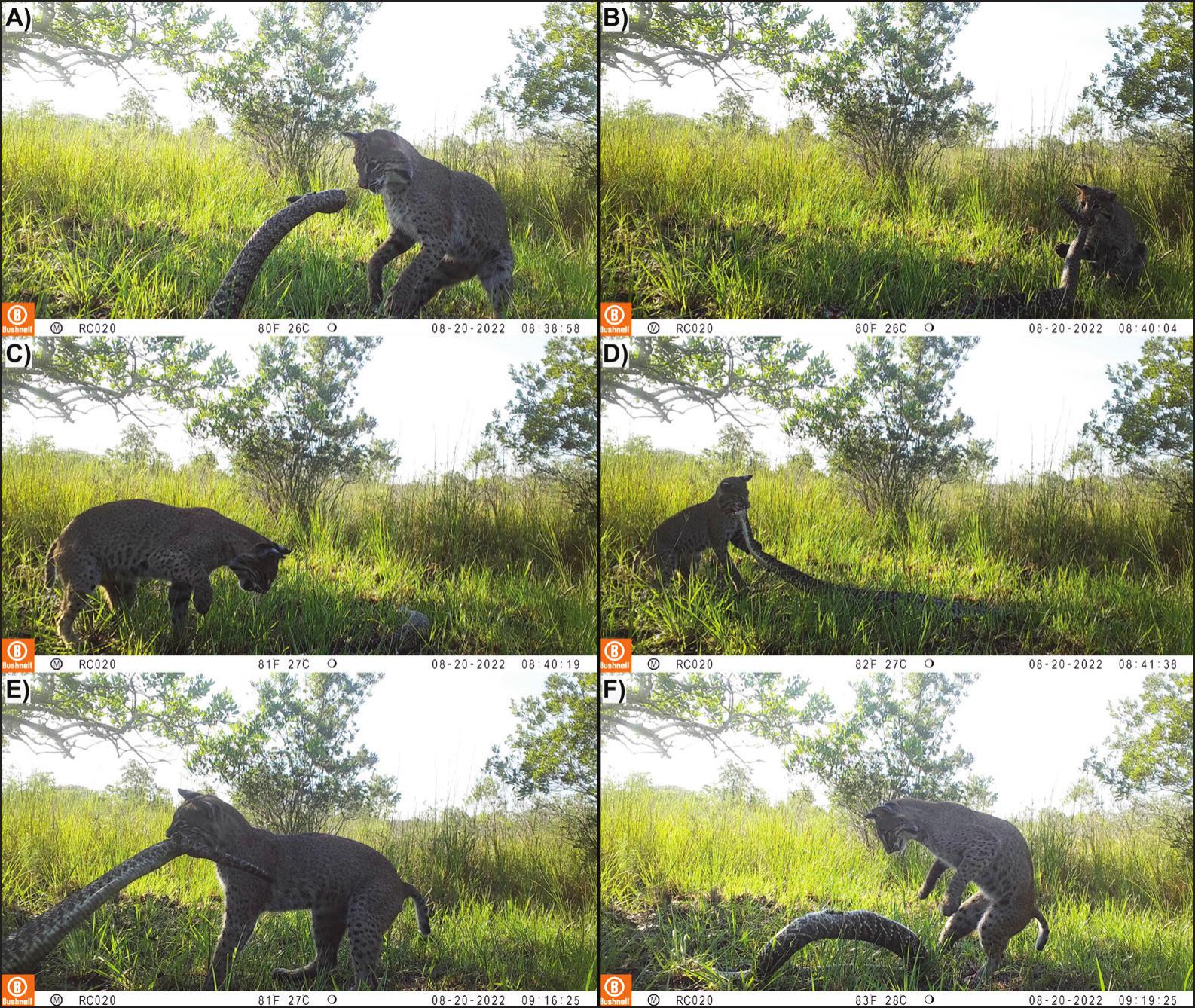
When researchers later retrieved and reviewed the memory cards, they uncovered a cinematic sequence of 38 photographs unfolding over a span of nearly two hours. The images depict a methodical, highly strategic takedown. Rather than engaging in a reckless, impulsive strike that could easily result in a fatal venom injection from the rattlesnake, the bobcat systematically neutralized the reptile. The photographic evidence reveals the cat biting the snake’s tail, stepping back to avoid defensive lunges, viciously raking its body with razor-sharp claws, and ultimately delivering crushing bites directly to the reptile’s head.
Subsequent frames showed the Eastern diamondback overturned, bearing severe, debilitating wounds to its head, midbody, and tail. The meticulous nature of the attack highlights the high degree of tactical intelligence and adaptability possessed by Lynx rufus.
Chronology of the Conflict: A Step-by-Step Breakdown
By carefully analyzing the time stamps and micro-intervals between the camera triggers, the research team successfully reconstructed a precise timeline of the battle. The sequence demonstrates a calculated strategy of exhaustion and calculated risk management:
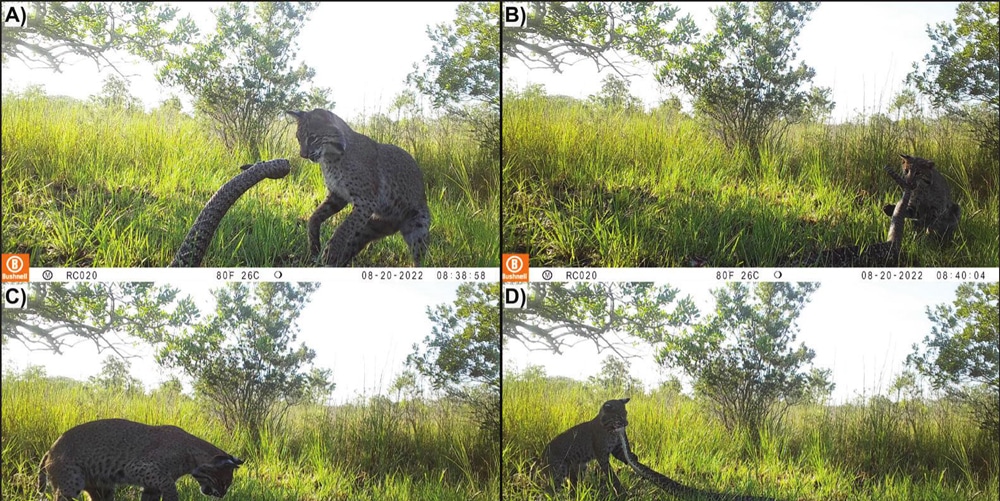
- Initial Assessment and Maneuvering: The sequence begins with the bobcat cautiously approaching and sizing up the adult rattlesnake. The first frames show the wild cat deftly dodging and avoiding the snake’s lethal, vibrating tail.
- The Tail Grab: Seizing a moment of vulnerability, the bobcat lunges forward and clamps its jaws onto the rattlesnake’s contracting tail. According to the data, the cat held the tail in its grip for approximately five consecutive seconds, restricting the snake’s movement and throwing off its defensive equilibrium.
- The Clawing Phase: Transitioning from restraint to physical damage, the bobcat then spent roughly 20 seconds viciously clawing at the rattlesnake’s scaled body, inflicting deep lacerations and wearing down the reptile’s stamina.
- Strategic Respite: In a display of tactical patience, the bobcat then stepped back, resting near the snake for 29 seconds. Wildlife biologists note that this pause likely allowed the predator to catch its breath while keeping a watchful eye on the disoriented prey, minimizing the risk of a desperate, blind strike.
- The Fatal Head Strike: Following the brief rest, the bobcat re-engaged with maximum aggression. It clamped its jaws down directly onto the rattlesnake’s head, maintaining this crushing grip for an astonishing 114 seconds. This sustained pressure would have neutralized the snake’s primary weapon—its venom delivery system—while crushing its skull.
- Concluding Strikes: After releasing the head, the bobcat delivered a final six-second bite to the tail. Later frames captured the massive rattlesnake overturned entirely onto its back. Even in its death throes, the reptile continued to weakly attempt defensive strikes against the cat, though these final efforts were entirely unsuccessful.
Supporting Data: The Scarcity of Documented Encounters
To understand why this photographic sequence is generating excitement in the herpetological and mammalogical communities, one must look at the historical rarity of documented bobcat-rattlesnake interactions.
Prior to this study, hard evidence of bobcats successfully preying upon adult Eastern diamondback rattlesnakes was virtually nonexistent in scientific literature. The only notable historical precedent occurred in Georgia back in 2001. During that incident, researchers examining the stomach contents of a deceased bobcat discovered the physical remains of an Eastern diamondback rattlesnake.
However, while that anatomical discovery proved that the bobcat had consumed the snake, it left a crucial scientific question unanswered: Did the bobcat actively hunt, fight, and kill the venomous reptile, or did it simply happen upon an already dead snake and scavenge the carcass? Because of this ambiguity, the Georgia case could not definitively classify Lynx rufus as an active predator of adult Crotalus adamanteus.
The Florida camera-trap data completely bridges this knowledge gap. By capturing the active ambush, the grappling phases, the sustained biting, and the defensive retaliation in real-time, the new study provides the world’s first irrefutable, primary visual proof of a bobcat hunting and defeating a living, healthy adult Eastern diamondback rattlesnake.
Furthermore, this encounter does not stand entirely alone in modern trail-camera discoveries regarding bobcat diets. In recent years, automated remote cameras have completely revolutionized our understanding of cryptic carnivore behavior. For instance, in 2022, trail cameras in the Florida Everglades captured bobcats feeding on the hidden eggs of invasive Burmese pythons (Python bivittatus). This marked the very first documented evidence of a native mammalian nest predator targeting Burmese python eggs.
Just a year prior, in 2021, field researchers documented evidence indicating that bobcats possess the physical capability to kill adult Burmese pythons as well. Investigators discovered the fresh carcass of a dead adult female python bearing distinct claw scratches, alongside environmental signs at a nearby caching site that matched the classic behavioral signatures of a bobcat kill and storage pattern.
Official Responses and Expert Perspectives
The research team emphasizes that these accumulating pieces of evidence point to a much broader ecological reality: bobcats are vastly more versatile, formidable, and opportunistic predators of large and dangerous reptiles than previously credited in traditional textbooks.
"This documented interaction significantly adds to the historically limited documentation of bobcats as predators of large reptiles," the researchers noted in their published findings.
For decades, ecological textbooks have primarily pigeonholed bobcats as generalist predators specializing in small mammals—such as rabbits, mice, and voles—along with birds and the occasional small fawn. While mammals certainly make up the vast majority of a bobcat’s diet, observations like the one in Hardee County demonstrate that flexible predators will readily exploit high-risk, high-reward food sources when the opportunity presents itself.
Independent wildlife biologists and herpetologists who were not involved in the study have echoed the significance of the findings. Commenting on the tactical maneuvers captured by the Bushnell camera, experts have pointed out the extraordinary calculation required for a medium-sized cat (typically weighing between 15 and 30 pounds) to engage an Eastern diamondback rattlesnake—a heavy-bodied viper capable of delivering a lethal dose of cytotoxic venom that can destroy tissue, induce hemorrhaging, and easily kill a mammalian predator of comparable size.
The fact that the bobcat executed the takedown with minimal apparent injury to itself speaks volumes about the evolutionary instincts and physical agility of Lynx rufus. By targeting the tail to control movement and swiftly transitioning to the head to neutralize the fangs, the cat demonstrated an innate, sophisticated understanding of how to mitigate the risks associated with hunting venomous prey.
Implications: Ecosystem Dynamics and Invasive Species Control
The confirmation that bobcats routinely tackle large, dangerous, and even invasive reptiles carries profound implications for conservation, wildlife management, and our understanding of food web dynamics in the American Southeast.
1. Re-evaluating Apex Predators and Venomous Prey
Historically, venomous snakes are often viewed strictly as apex predators within their micro-habitats, facing few natural threats outside of raptors (such as hawks and eagles), wild pigs, and human interference. The new photographic evidence reinforces the understanding that native mammalian carnivores play a more active role in regulating rattlesnake populations than previously assumed. While bobcats are unlikely to hunt rattlesnakes indiscriminately due to the inherent risk of envenomation, the knowledge that they can successfully execute such hunts changes how we view the top-down pressure exerted on viper populations.
2. Combating Invasive Species in the Everglades
Perhaps the most exciting implication of this research trajectory is the potential role native predators might play in managing ecological crises. With the catastrophic spread of invasive Burmese pythons across South Florida, conservationists have long searched for natural controls. The documentation of bobcats eating python eggs (2022) and showing the capacity to kill adult pythons (2021) suggests that native wildlife is beginning to adapt to the presence of these massive invasive constrictors.
While bobcats alone cannot stop the python invasion, their adaptability as generalist predators means they are slowly integrating invasive reptiles into their dietary repertoire. This behavioral plasticity could serve as a valuable natural buffer against the unchecked expansion of invasive species in fragile ecosystems like the Everglades.
3. The Future of Wildlife Monitoring
Finally, the success of this study underscores the immense value of modern remote camera-trap technology. Cryptic, nocturnal, or solitary animals like bobcats are notoriously difficult to observe through direct human observation. By deploying affordable, high-sensitivity trail cameras programmed with rapid burst settings, researchers are pulling back the curtain on secret ecological dramas that have played out unseen for millennia.
As technology continues to advance, wildlife biologists anticipate that many more hidden predator-prey dynamics will come to light, continually reshaping our understanding of the natural world.
For those interested in reading the full, peer-reviewed scientific paper detailing this remarkable encounter, "Photographic Evidence of a Bobcat (Lynx rufus) Attack on an Eastern Diamondback Rattlesnake (Crotalus adamanteus)" is available as an open-access publication via the BioOne Digital Library.