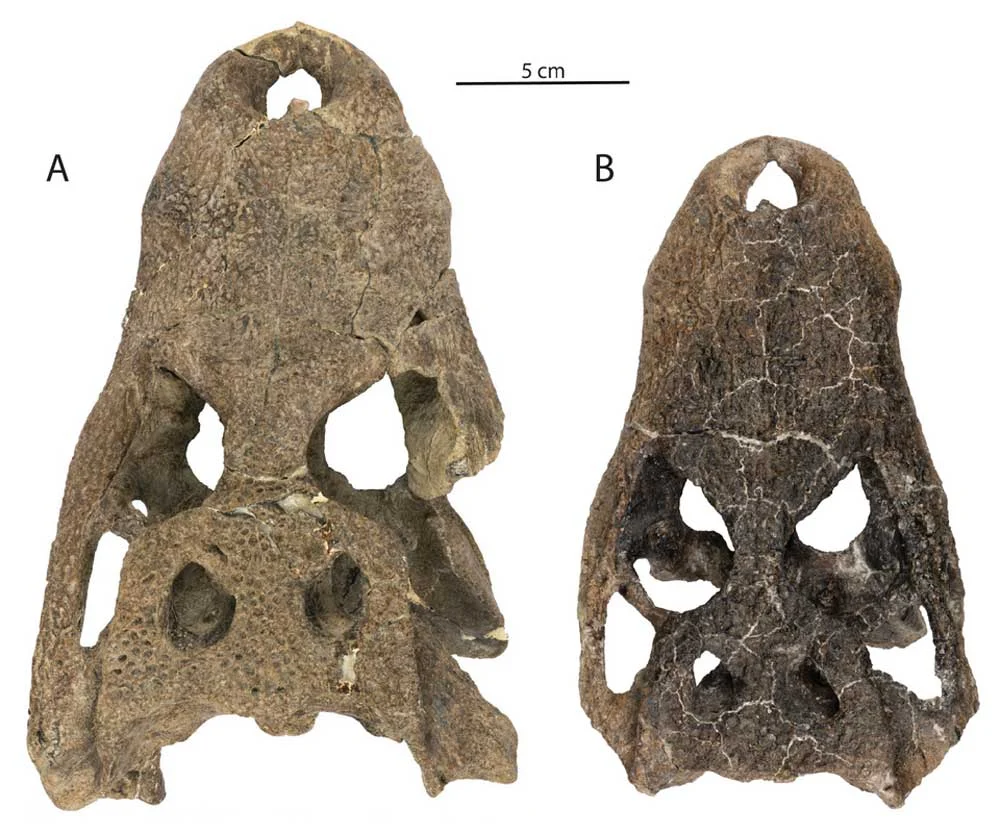
COLORADO — Deep within the fossil-rich badlands of Colorado’s Denver Basin, paleontologists have unearthing a remarkable piece of prehistoric history. Researchers have formally described a newly discovered species of extinct alligator, Mandrasuchus milleri, hailing from the Lower Paleocene deposits of Corral Bluffs.
According to the team of scientists behind the discovery, Mandrasuchus milleri represents the oldest known crocodilian of its kind—the earliest confirmed alligatorine—prowling North America in the immediate aftermath of the cataclysmic asteroid impact that wiped out the non-avian dinosaurs some 66 million years ago.
The find not only adds a fascinating new branch to the evolutionary tree of crocodilians but also provides unprecedented insight into how life rebounded during a critical turning point in Earth’s history. The detailed findings have been published in the Journal of Vertebrate Paleontology.
Main Facts: Meet Mandrasuchus milleri
The discovery of Mandrasuchus milleri marks a significant milestone in vertebrate paleontology. Unearthed in the rugged terrain of Corral Bluffs within the Denver Formation, the fossilized remains paint a vivid picture of a medium-sized predator uniquely adapted to its post-apocalyptic environment.
Key physical and ecological characteristics of Mandrasuchus milleri include:
- Size and Build: Researchers estimate that M. milleri grew to approximately 2 meters (6.5 feet) in length, making it a formidable presence in its freshwater ecosystem.
- Distinctive Anatomy: The species was identified primarily by its blunted rostrum (snout) and globular caudal (posterior) dentition—rounded, peg-like teeth designed for crushing rather than slicing.
- Dietary Versatility: Due to its robust snout shape and crushing teeth, scientists classify M. milleri as a macro-generalist. Its diet likely ranged widely, incorporating large prey items as well as hard-shelled organisms such as mollusks, crustaceans, and potentially turtles.
- Burrowing Behavior: Evidence suggests that this ancient reptile may have possessed burrowing habits, a survival strategy that could have helped it weather extreme environmental fluctuations.
Chronology: Unearthing the Past in the Denver Basin
The story of Mandrasuchus milleri spans millions of years of geological formation and decades of modern scientific detective work.
The Paleocene Dawn (approx. 66–60 Million Years Ago)
Immediately following the Cretaceous-Paleogene (K-Pg) extinction event that ended the reign of the dinosaurs, North America entered the Paleocene epoch. The Denver Basin, particularly the area now known as Corral Bluffs, transformed into a lush, river-laced landscape teeming with recovering ecosystems. It was in this shifting world that Mandrasuchus milleri established itself as an apex or near-apex aquatic predator, capitalizing on newly opened ecological niches.
Discovery and Fieldwork
The fossils that would eventually define M. milleri were painstakingly recovered from the sedimentary layers of the Denver Formation by a dedicated team of researchers, including E. J. Lessner, S. M. Sherman, H. Petermann, E. Panigot, F. Duffy, and T. R. Lyson.
Working in the challenging terrain of Corral Bluffs, the team realized they had stumbled upon something unusual when examining the cranial and dental remains. The distinct, globular shape of the back teeth and the shortened, blunted snout deviated sharply from previously cataloged crocodilian species from the same timeframe.
Formal Description and Publication
Following years of preparation, comparative analysis, and phylogenetic placement, the researchers formally introduced the species in an academic paper titled "New alligatorid, Mandrasuchus milleri, from the Early Paleocene (Danian) of the Denver Basin supports earliest Paleocene North American alligatorid radiation." The abstract and study went live on the Journal of Vertebrate Paleontology website, drawing immediate attention from the global paleontological community.
Supporting Data: Exceptional Preservation at Corral Bluffs
One of the most compelling aspects of the Mandrasuchus milleri discovery is how the fossils were preserved.
Fossils within the Corral Bluffs strata are occasionally found encased in dense, phosphate-rich rock nodules known as concretions. These mineral-rich structures can form rapidly around organic remains, shielding delicate bones and teeth from the destructive forces of erosion, compaction, and scavenging.
The Science of Concretions
According to the research team, these phosphate-rich nodules likely formed as a result of decaying soft tissue and localized bacterial activity in and around the burial site. As organic matter decomposed, chemical reactions altered the local pH and mineral saturation of the surrounding sediment, causing calcium phosphate to precipitate tightly around the skeletal remains.
Clues to a Subterranean Lifestyle
Intriguingly, the researchers theorize that some of these preserved fossil-bearing concretions might not be random geological accidents at all. Instead, they could represent the fossilized remains of the reptile’s own subterranean burrows.
If M. milleri actively constructed and inhabited burrows, it would explain both the pristine condition of certain skeletal elements and the animal’s ability to survive the volatile climatic shifts of the early Paleocene. Burrowing would have offered crucial thermal insulation, protection from predators, and refuge during periods of drought or intense seasonal change.
Official Responses and Expert Insights
The unveiling of Mandrasuchus milleri has sparked widespread discussion among evolutionary biologists and vertebrate paleontologists, particularly regarding its placement in the crocodilian family tree.
The research team highlighted that M. milleri represents a vital new representative of what they term an "unresolved portion of the crocodylian phylogeny." In simpler terms, the species occupies a critical branch on the evolutionary tree that scientists have long struggled to map with absolute certainty. By bridging the gap between ancestral forms and modern alligatorines, M. milleri provides a crucial anchor point for future phylogenetic studies.
Independent paleontologists not directly involved in the study have praised the discovery for shedding light on a notoriously murky period of reptile evolution. While the immediate aftermath of the dinosaur extinction is well-documented for mammals and certain plant species, the recovery of large-bodied cold-blooded vertebrates has remained comparatively under-studied.
"Finding a well-preserved, morphologically distinct alligatorine right at the dawn of the Paleocene gives us a front-row seat to how these resilient predators adapted while the rest of the planet was picking up the pieces," noted one paleoclimatology researcher familiar with the Denver Basin strata.
Implications: What Mandrasuchus milleri Tells Us About Evolution and Survival
The implications of the Mandrasuchus milleri discovery extend far beyond the borders of Colorado, offering broader lessons about evolutionary resilience and the adaptability of crocodilians.
1. Rapid Radiation in Post-Extinction Ecosystems
The presence of M. milleri in the Early Paleocene supports the hypothesis of an early Paleocene North American alligatorid radiation. Rather than merely surviving the K-Pg extinction event in a stagnant holding pattern, alligator ancestors appear to have rapidly diversified, evolving specialized traits—such as crushing dentition and generalist diets—to exploit new food sources in changing river systems.
2. Dietary Adaptations and Ecological Success
The macro-generalist lifestyle of M. milleri underscores a key survival strategy shared by many successful survivors of mass extinction events: flexibility. By being able to pivot between hunting large aquatic prey and crushing hard-shelled organisms like turtles, freshwater crabs, and mollusks, M. milleri insulated itself against food web collapses that decimated more specialized predators.
3. Unlocking the Mysteries of Ancient Behavior
The potential link between fossilized concretions and burrowing behavior opens exciting new avenues for paleoethology (the study of ancient animal behavior). If further analysis confirms that M. milleri and its contemporaries regularly engineered subterranean shelters, it may force paleontologists to re-evaluate how semi-aquatic reptiles coped with ancient climate extremes—insights that could even inform our understanding of how modern species might respond to contemporary climate volatility.
Conclusion
As research in the Denver Basin continues, Corral Bluffs proves once again to be a world-class treasure trove of prehistoric life. Mandrasuchus milleri stands as a testament to the tenacity of nature, a two-meter armored survivor that clawed, crushed, and burrowed its way out of the ashes of the dinosaur age and into the annals of scientific history.