LONG BEACH, Calif. — In an unprecedented conservation rescue effort, wildlife officials have relocated more than 200 olive ridley sea turtle eggs from Southern California beaches to a controlled facility just days after making marine biology history. The U.S. Fish and Wildlife Service (USFWS), working in tandem with NOAA Fisheries and marine mammal experts, intervened to save the fragile clutches from impending extreme weather generated by powerful Hurricane Polo, currently churning off the Baja California Peninsula as a destructive Category 5 storm.
The emergency relocation marks a dramatic, high-stakes chapter in what is already considered one of the most remarkable wildlife events in modern Pacific West Coast history: the first-ever documented sea turtle nesting events on the beaches of California.
Main Facts
The extraordinary sequence of events began in late September, when wildlife authorities confirmed that at least two olive ridley sea turtles (Lepidochelys olivacea) had successfully crawled ashore in Orange County to deposit their eggs. This behavior is typically observed in the warm, tropical, and subtropical waters of Mexico, Central America, and parts of the Indo-Pacific, making the Southern California appearances a stunning biological anomaly.
However, the historic milestone quickly turned into a logistical and environmental race against time. Hurricane Polo, an intensifying Category 5 storm packing sustained winds near 180 mph (285 km/h), began generating massive ocean swells and abnormal tidal surges. Forecasters predicted that these dangerous surf conditions and high tides would inundate the California coastline from Sunday through Thursday, threatening to wash away, drown, or crush the shallow subterranean nests.
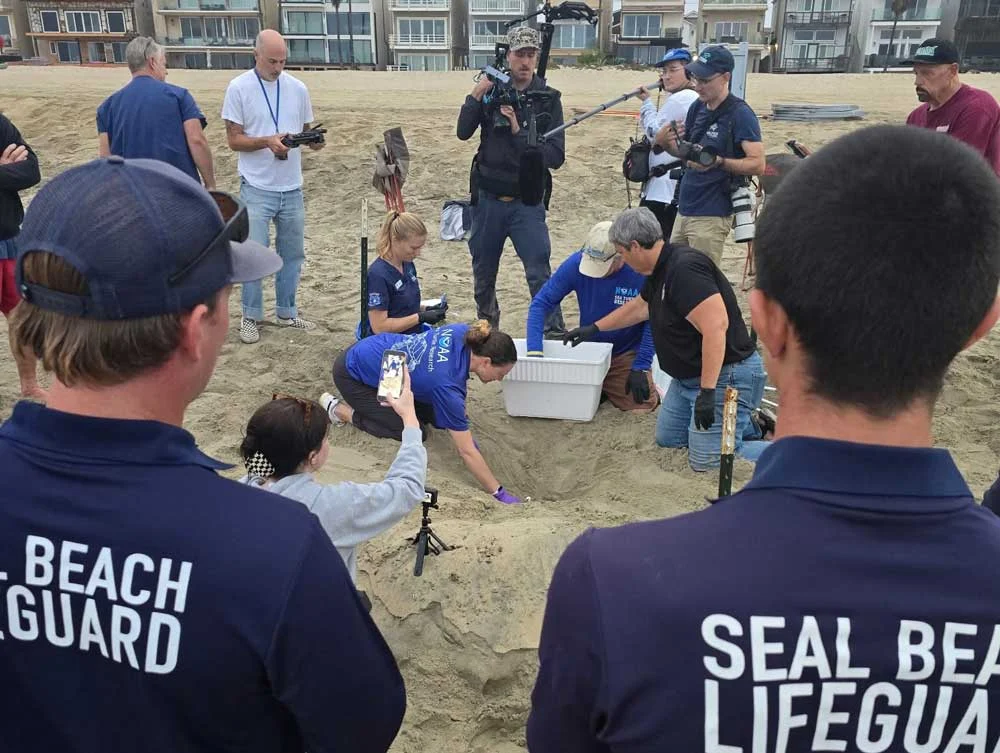
To prevent a catastrophic loss of the clutches, USFWS personnel—alongside specialized marine biologists—excavated the two nests found in Seal Beach and Huntington Beach. The fragile eggs, numbering over 200 in total, were carefully transported to the Aquarium of the Pacific in Long Beach. There, they have been placed in specialized, temperature-controlled incubation chambers. Experts estimate that, if viable, the hatchlings will emerge in approximately 45 to 60 days.
Chronology of Events
The unfolding narrative of California’s first sea turtle nesting season reads like a meticulously timed script, shifting rapidly from celebration to emergency response over the course of a single week.
September 22: A Historic First
NOAA Fisheries West Coast made a startling announcement that stunned the marine science community: an olive ridley sea turtle was observed in broad daylight digging a nest and laying her eggs on a beach in Surfside, California. Marine biologists immediately recognized the profound significance of the event. Never before in recorded history had any species of sea turtle nested on the Pacific Coast of the United States. Experts scrambled to monitor the site, establish protective perimeters, and understand the climatic and environmental factors that might have driven the reptile so far north of her traditional range.
September 25: The Second Nest Discovered
Just three days after the historic Surfside discovery, history repeated itself a mere few miles to the south. According to NOAA reports, a second olive ridley sea turtle was spotted hauling herself onto the sand in Huntington Beach, dangerously close to the city’s world-famous pier. She successfully deposited her clutch before returning to the Pacific Ocean. This second nest amplified both the excitement among researchers and the urgency surrounding the protection of the eggs, as public visibility in the heavily frequented tourist area presented distinct management challenges.
September 25 (Later That Day): The Hurricane Threat and Emergency Relocation
Almost simultaneously with the discovery of the second nest, meteorological models for Hurricane Polo locked onto a severe trajectory. Originally tracked as a formidable tropical system, Polo rapidly intensified into a catastrophic Category 5 hurricane off the Baja Peninsula.
Recognizing that the incoming high tides, severe coastal erosion, and dangerous surf would inevitably destroy the natural nests buried just feet beneath the sand, the USFWS made the executive decision to intervene. Field teams executed a delicate, high-precision extraction of the eggs. By evening, the precious cargo had been successfully transferred to the safety of the Aquarium of the Pacific in Long Beach, transitioning the eggs from an unpredictable marine environment to a state-of-the-art life-support incubation setup.
Supporting Data and Species Profile
To understand the magnitude of this event, it is necessary to examine the biology and typical distribution of the olive ridley sea turtle, alongside the meteorological fury driving the current emergency.
The Olive Ridley Sea Turtle (Lepidochelys olivacea)
- Size and Weight: The olive ridley is widely recognized as the smallest of all extant sea turtle species. Adults typically reach a length of about 2.5 to 3 feet (75 to 90 cm) and weigh roughly 100 pounds (45 kg).
- Lifespan: These resilient marine reptiles can live up to 50 years in the wild, navigating vast ocean expanses and feeding primarily on crabs, shrimp, rock lobsters, tunicates, and algae.
- Global Distribution: Found worldwide in tropical and warm temperate waters, olive ridleys maintain major populations in the Pacific, Indian, and Atlantic oceans. Pacific populations are predominantly concentrated along the western coasts of Mexico, Nicaragua, Costa Rica, and Panama, where they famously engage in synchronized mass nesting events known as arribadas.
- Conservation Status: While globally the olive ridley is the most abundant sea turtle, individual populations face severe threats from historical harvesting, incidental capture in commercial fisheries (bycatch), marine debris, and coastal habitat degradation. They are currently listed under the U.S. Endangered Species Act as either threatened or endangered, depending on the specific regional population.
Hurricane Polo: The Catalyst for Intervention
Category 5 hurricanes represent the pinnacle of tropical cyclone intensity on the Saffir-Simpson scale, characterized by sustained winds exceeding 157 mph (252 km/h). Hurricane Polo’s explosive intensification off the Baja Peninsula generated massive, long-period southerly swells capable of reshaping coastlines hundreds of miles away.
Oceanographic data indicated that Huntington Beach and surrounding coastal zones would experience severe wave action, combining with high astronomical tides to create coastal flooding. Natural sea turtle nests—which rely on precise moisture, gas exchange, and thermal stability in the sand—cannot survive being permanently waterlogged or scoured away by surging surf. Without human intervention, the developing embryos would have undoubtedly suffocated or been washed out to sea.
Official Responses and Conservation Perspectives
The unprecedented nature of the nesting events and the subsequent emergency rescue prompted widespread commentary from federal agencies, marine biologists, and aquarium directors.
Federal wildlife officials emphasized that while interference with wildlife is generally discouraged, extreme anomalies and imminent environmental disasters justify proactive intervention.
"When faced with a Category 5 hurricane tracking directly toward an entirely unprecedented natural phenomenon, our priority must shift to maximizing the survival potential of these animals," noted a USFWS spokesperson involved in the rescue operation. "We are in uncharted territory. The fact that olive ridley sea turtles are nesting in Southern California forces us to adapt our management protocols in real-time."
At the Aquarium of the Pacific, animal care teams mobilized immediately to design optimal conditions for the rescued clutches. Replicating the subterranean environment of a natural beach nest requires meticulous calibration of temperature and humidity.
"Our primary goal is to ensure these eggs remain viable and healthy through their incubation window," said a senior marine biologist at the Long Beach facility. "We are utilizing specialized, temperature-controlled incubation units that mimic the natural thermal profiles required for olive ridley development. If everything goes according to plan, we are looking at a 45-to-60-day timeline before we see any potential hatching activity."
Local marine conservation groups have also praised the swift coordination between NOAA Fisheries, the USFWS, and municipal authorities in Huntington Beach and Seal Beach, who managed to secure the nesting sites from curious beachgoers prior to the extraction.
Broader Implications: Climate Change and Marine Shifts
Beyond the immediate drama of hurricane-proofing sea turtle nests, scientists and researchers are grappling with the larger ecological implications of this event.
A Warming Ocean and Expanding Ranges
For decades, marine zoologists have tracked the northward migration of various tropical and subtropical marine species along the Pacific coast of North America. Driven by rising ocean temperatures, marine heatwaves—often colloquially referred to as "The Blob" and subsequent El Niño events—have progressively warmed the coastal waters of California and the Pacific Northwest.
While sea turtles have occasionally been sighted swimming off the coast of California during warm-water years, active nesting has never before been recorded so far north. The successful navigation and egg-laying of these female olive ridleys suggest that warming waters may be expanding the operational thermal envelope for nesting females, encouraging them to seek out novel beaches as their traditional tropical breeding grounds face overcrowding, erosion, or rising temperatures.
Future Management Challenges for Wildlife Agencies
This event serves as a bellwether for wildlife management agencies in the 21st century. As global climate patterns shift, conservationists must prepare for species to appear in unexpected habitats outside their historical ranges.
- Monitoring and Public Education: State and federal agencies will likely need to increase public outreach along Southern California beaches to educate beachgoers, local governments, and law enforcement on how to identify and protect sea turtle crawls and nests.
- Infrastructure and Coastal Development: Highly urbanized Southern California beaches present unique hazards for nesting marine life, including artificial lighting that disorients hatchlings, heavy foot traffic, and mechanical beach-grooming equipment.
- Emergency Protocols: The successful rescue of the Polo-threatened eggs demonstrates the necessity of maintaining flexible, well-funded emergency response networks capable of deploying specialized marine rescue teams at a moment’s notice.
As the incubation period progresses inside the secure walls of the Aquarium of the Pacific, researchers across the country will be watching closely. Whether these eggs successfully hatch, and whether future summers will bring more nesting sea turtles to the shores of California, remains one of the most compelling and rapidly evolving stories in modern American conservation.