WASHINGTON D.C. – In the wake of the 2007 pet food recall—the most catastrophic event of its kind in history—the United States Congress took decisive action to reform an industry that had proven itself vulnerable to lethal contamination. The resulting legislation, codified as part of the Food and Drug Administration Amendments Act (FDAAA) of 2007, was intended to usher in a new era of transparency and safety. However, nearly two decades later, a comprehensive investigation into the implementation of these laws reveals a pattern of regulatory inertia, industry interference, and a startling disregard for statutory deadlines.
While Congress mandated that the Food and Drug Administration (FDA) establish rigorous new standards for pet food ingredients, processing, and labeling by September 2009, the agency has failed to fulfill the most critical components of these requirements. Today, pet owners remain in a state of regulatory limbo, navigating a marketplace that lacks the federal protections promised by law seventeen years ago.
The Core Mandates of 21 USC 2102
The 2007 crisis, which involved the intentional adulteration of wheat gluten and rice protein concentrate with melamine and cyanuric acid, resulted in the deaths of thousands of companion animals across North America. In response, Section 1002 of the FDAAA (later codified as 21 USC 2102, "Ensuring the Safety of Pet Food") directed the Secretary of Health and Human Services to work through the FDA to establish three specific pillars of safety:
- Pet Food Ingredient Standards: Definitive federal requirements for what can legally constitute an "ingredient" in pet food.
- Pet Food Processing Standards: Stringent rules governing the manufacturing and handling of pet food to prevent contamination.
- Updated Labeling Standards: Requirements for labels to include comprehensive "nutritional and ingredient information" to empower consumers with transparency.
Congress was explicit regarding the timeline: these regulations were to be finalized "not later than 2 years after September 27, 2007."
A Chronology of Delays and Deregulation
The timeline of the FDA’s compliance—or lack thereof—paints a troubling picture of a federal agency struggling to meet its obligations to the public.
2007–2009: The Missed Deadline
The September 2009 deadline passed without the implementation of any of the three required standards. During this period, the pet food industry began a protracted lobbying effort to shape the coming regulations, while the FDA cited the complexity of the rulemaking process as a primary cause for the delay.
2015: Partial Compliance via FSMA
It took eight years for the FDA to address the second mandate: processing standards. These were eventually folded into the broader Food Safety Modernization Act (FSMA). While the implementation of the "Current Good Manufacturing Practice, Hazard Analysis, and Risk-Based Preventive Controls for Food for Animals" was a significant step, it arrived six years past the congressional deadline.
2018: The Legislative Erasure of Ingredient Standards
The most controversial turn in this chronology occurred in 2018. For over a decade, the FDA had failed to establish the ingredient standards required by the 2007 law. Rather than finalizing these standards, a legislative maneuver effectively deleted the requirement.
Senator Rand Paul (R-KY) introduced an addendum to an unrelated bill that stripped the FDA of its obligation to establish pet food ingredient standards. Documents later obtained via the Freedom of Information Act (FOIA) by filmmaker Kohl Harrington revealed that this addendum was not a spontaneous legislative act. Instead, records indicate that the FDA, the American Feed Industry Association (AFIA)—a powerful trade group—and members of the Association of American Feed Control Officials (AAFCO) collaborated on the language that ultimately removed these consumer protections from the law.
2017–2024: The Labeling Standoff
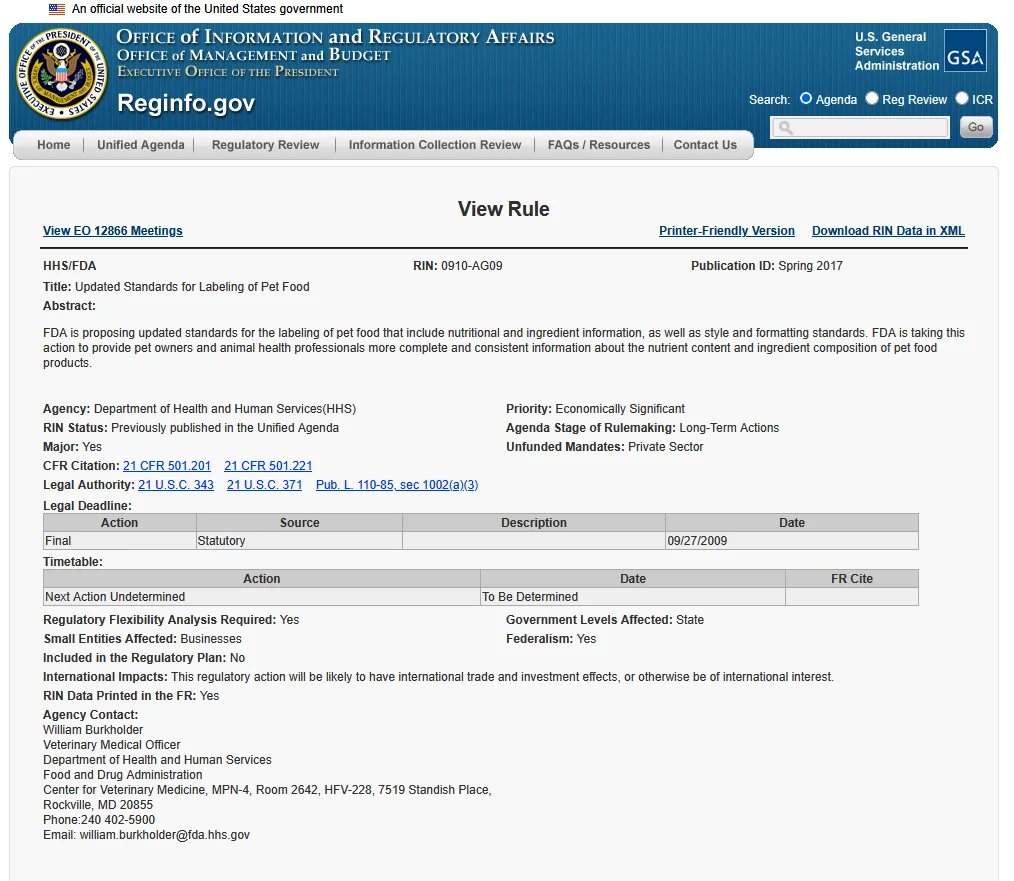
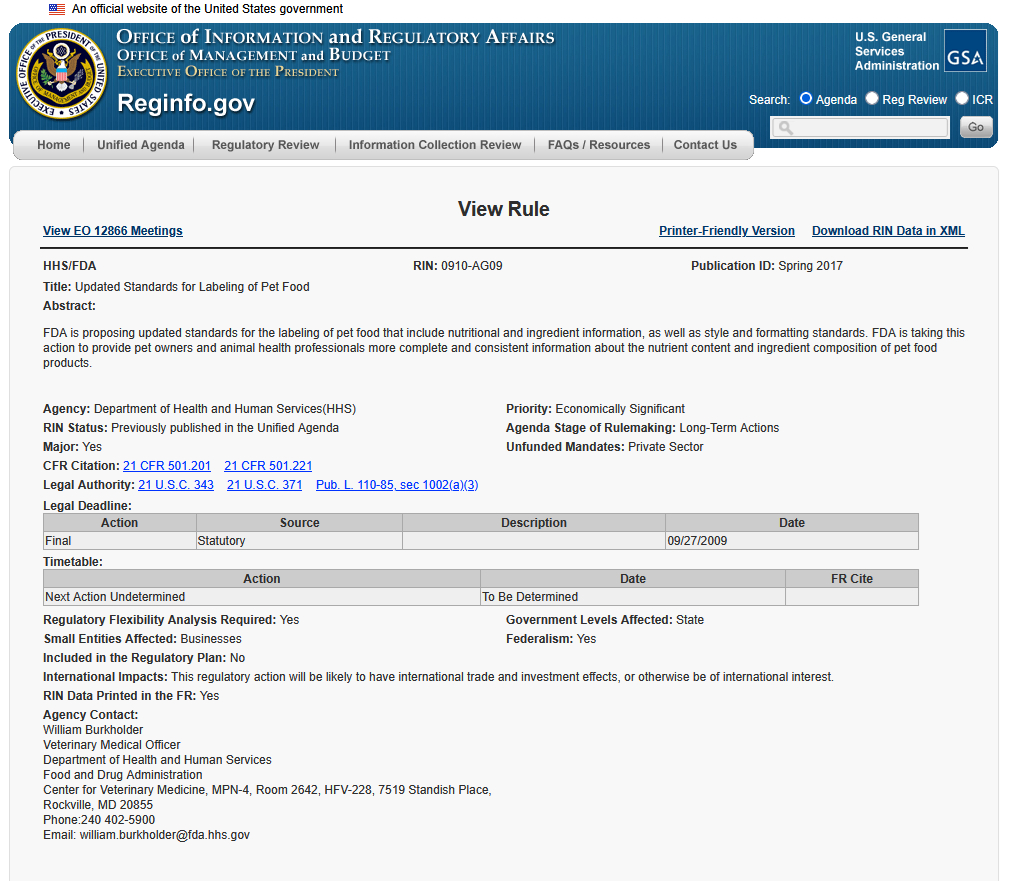
The third mandate—updated labeling—remains unfulfilled. The last significant public update on this rule was recorded in 2017 by the Office of Information and Regulatory Affairs (OIRA). At that time, the status was listed as "Next Action Undetermined." Since then, the federal government has effectively ceased public progress on the 2007 mandate for nutritional transparency.
Supporting Data: The Illusion of Progress
To understand why pet food labels remain largely unchanged since 2007, one must examine the role of AAFCO. While the FDA has remained stagnant, AAFCO—a private, non-governmental organization comprised of state and federal feed officials—has been developing its own "Pet Food Labeling Modernization" (PFLM) project.
However, consumer advocates point to three critical issues with the AAFCO PFLM that distinguish it from the federal mandate:
- Voluntary vs. Mandatory: AAFCO standards are not federal law. They are "model bills" that individual states must choose to adopt. This creates a patchwork of regulations rather than a unified national safety standard.
- The 2030 Timeline: While Congress demanded updates by 2009, the AAFCO updates are not expected to be fully implemented until 2030—twenty-one years past the original federal deadline.
- State-Level Resistance: Industry rumors and reports from state legislative sessions suggest that several states are already hesitant or outright refusing to implement the AAFCO updates, citing the costs of re-labeling for manufacturers.
The data suggests that the FDA is effectively deferring its federal responsibility to a third-party organization that lacks the enforcement power of a federal agency and operates on a timeline that spans decades rather than years.
Official Responses: A Wall of Silence
In an effort to clarify the agency’s position, advocates for pet food safety recently reached out to the FDA’s Center for Veterinary Medicine (CVM). On June 17, 2026, a formal inquiry was submitted regarding the status of 21 USC 2102 (a)(2), specifically asking for details on the "updated standards for the labeling of pet food" that the agency was legally required to complete by 2009.
As of this report, the FDA CVM has provided no response. This silence is consistent with the agency’s behavior over the last several years, where inquiries regarding the 2007 mandates are often met with references to the FSMA or the ongoing work of AAFCO, rather than an admission of failure to meet the specific requirements of the 2007 Act.

Susan Thixton, a prominent pet food consumer advocate and founder of TruthaboutPetFood.com, suggests that the lack of response is telling. "We know the answer," Thixton stated. "We just wanted the FDA to admit it. For seventeen years, they have ignored a direct order from Congress, and in doing so, they have left pet owners in the dark about what they are actually putting into their animals’ bowls."
Implications: The High Cost of Regulatory Inertia
The failure to implement the 2007 laws has profound implications for public health, consumer rights, and the integrity of the US regulatory system.
1. Erosion of Public Trust
When an agency fails to meet a statutory deadline by nearly two decades, it undermines the authority of Congress and the trust of the electorate. Pet owners, who contribute billions of dollars to the US economy annually, are left to wonder why their interests are consistently sidelined in favor of industry convenience.
2. The Persistence of "Mystery Ingredients"
Without federal ingredient standards, the definitions of what constitutes "meat by-products" or "animal meal" remain opaque and vary significantly between manufacturers. The 2018 deletion of the requirement for ingredient standards means that the legal "floor" for pet food quality remains dangerously low.
3. Safety Risks
The 2007 recall was exacerbated by a lack of transparency in the supply chain. While processing standards (FSMA) have improved facility inspections, the lack of modernized labeling means that if another contamination event occurs, tracing the specific nutritional or ingredient components of a product remains a Herculean task for the average consumer.
4. Regulatory Capture
The FOIA documents revealing collaboration between the FDA and industry trade groups to delete safety requirements suggest a phenomenon known as "regulatory capture." This occurs when a regulatory agency, created to act in the public interest, instead advances the commercial or political concerns of the industry it is charged with overseeing.
Call to Action: The Path Forward
As the seventeenth anniversary of the missed 2009 deadline approaches, consumer advocacy groups are calling for a renewed push for legislative oversight. The Association for Truth in Pet Food is encouraging pet owners to contact their congressional representatives to demand accountability.
The proposed strategy involves a direct appeal to the House and Senate committees that oversee the FDA. Advocates are requesting that citizens send formal letters asking why the requirements of 21 USC 2102 have been ignored and demanding that the FDA promptly establish the labeling updates mandated by law.
"The law was written to protect our pets," Thixton concluded. "It wasn’t a suggestion; it was a requirement. It is time for Congress to follow up on the work they started in 2007 and ensure that the FDA finally does its job."
For now, the "Next Action" for pet food labeling remains "Undetermined" in the eyes of the federal government, leaving the safety and transparency of the American pet food supply in a state of perpetual delay.