The regulatory framework governing the multi-billion-dollar pet food industry is currently at a critical crossroads. The Association of American Feed Control Officials (AAFCO), a private organization that wields immense influence by drafting the model laws adopted by state and federal regulators, recently concluded its biannual meeting in San Diego, California. While the organization is not a government agency, its role as the architect of pet food regulations makes its deliberations a matter of significant public interest.
The recent proceedings, however, have sparked intense scrutiny from consumer advocates and industry watchdogs. From debates over ingredient definitions that could lower the bar for quality, to the continued stalling of congressionally mandated label updates, the San Diego summit highlighted a growing disconnect between regulatory priorities and the welfare of pets.
The Anatomy of AAFCO: A Regulatory Paradox
To understand the current state of pet food, one must first understand AAFCO. Despite its authoritative-sounding name, AAFCO is a private entity. Its membership consists primarily of state and federal regulatory officials—most notably from the FDA—who work alongside industry representatives to craft the standards that appear in state statutes.
The organization meets twice a year, in January and August, to deliberate on changes to ingredient definitions, labeling requirements, and safety protocols. While these meetings are open to the public, the influence of industry stakeholders often overshadows consumer input, leading to a regulatory environment where the definitions of "food" are frequently treated as legal puzzles rather than nutritional benchmarks.
Ingredient Definitions: The "Meat and Bone" Controversy
One of the most revealing moments of the San Diego meeting occurred within the Ingredient Definitions Committee. The discussion centered on a seemingly minor technical change to the definition of "Meat and Bone Meal" (MBM).
The current definition stipulates: “Meat and Bone Meal is the rendered product from mammal tissues, including bones, exclusive of any added blood, hair, hoof, horn, hide trimmings, manure, stomach and rumen contents… The total ash content for the product should contain a minimum of 28% ash.”
The Push for Deregulation
During the session, committee members engaged in a contentious debate regarding the removal of the 28% minimum ash requirement. The implications are profound: industry participants noted that "Meat Meal" and "Meat and Bone Meal" are nearly identical in composition, with the ash content being the primary legal differentiator. By removing the ash floor, suppliers could effectively relabel lower-grade "Meat Meal" as "Meat and Bone Meal," blurring the lines between ingredient tiers.
Why Quality Matters
This debate is not merely academic. Historically, Meat and Bone Meal has been categorized as the lowest quality of rendered ingredients. The definition allows for the processing of whole carcasses, including animals that may be dead, diseased, or decomposing prior to rendering. While the definition prohibits the addition of items like hair, manure, or hoof, the inclusion of these materials—if present naturally on the carcass—is permitted.
The FDA has previously acknowledged the risks associated with these ingredients. In their own investigations into the presence of pentobarbital—a drug used for euthanasia—in dog food, the FDA identified rendered products like Meat and Bone Meal, Beef and Bone Meal, and Animal Digest as potential vectors. The fact that the committee openly discussed adjusting these definitions without addressing the underlying quality of the raw material sourcing suggests that the regulatory focus remains on the "letter of the law" rather than the safety of the final bowl of food.
The Labeling Saga: Two Decades of Delay
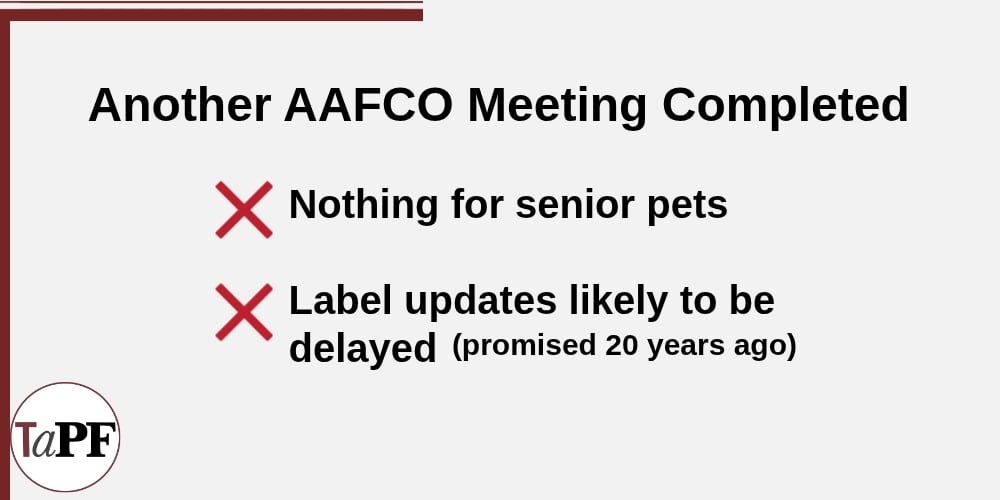
Perhaps the most egregious example of regulatory inertia is the "Pet Food Label Modernization" effort. Following the 2007 pet food safety crisis, Congress mandated that the FDA update pet food labeling requirements to ensure better transparency. The deadline for these updates was September 2009.
Nearly 16 years later, the mission remains incomplete. AAFCO eventually took up the task, finalizing updates in July 2023. However, implementation has been pushed back to 2030.
The Fiber Disclosure Standoff
During the Current Issues and Outreach Committee session, the conversation turned to the requirement to disclose dietary fiber percentages. Industry representatives raised concerns that lab testing for dietary fiber is inconsistent, particularly in high-moisture products like canned, raw, or fresh food.
Critics of the current regulatory pace view this as a strategic delay. By suddenly raising "technical challenges" regarding testing methods—challenges that arguably should have been resolved years ago—the industry is successfully lobbying for further postponements of labeling standards. This ensures that the transparency promised to consumers in 2007 will remain deferred, potentially well beyond the 2030 target.
The Illusion of Choice: Marketing vs. Nutrition
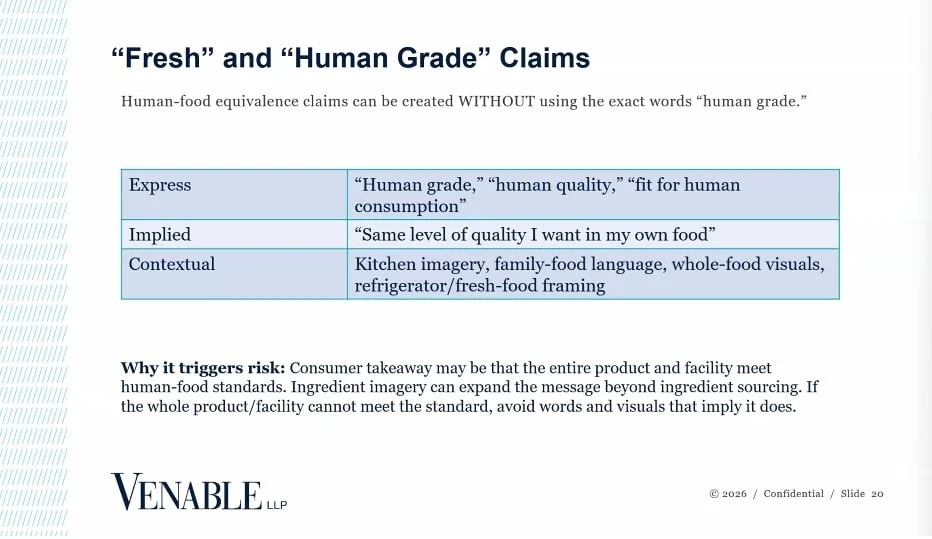
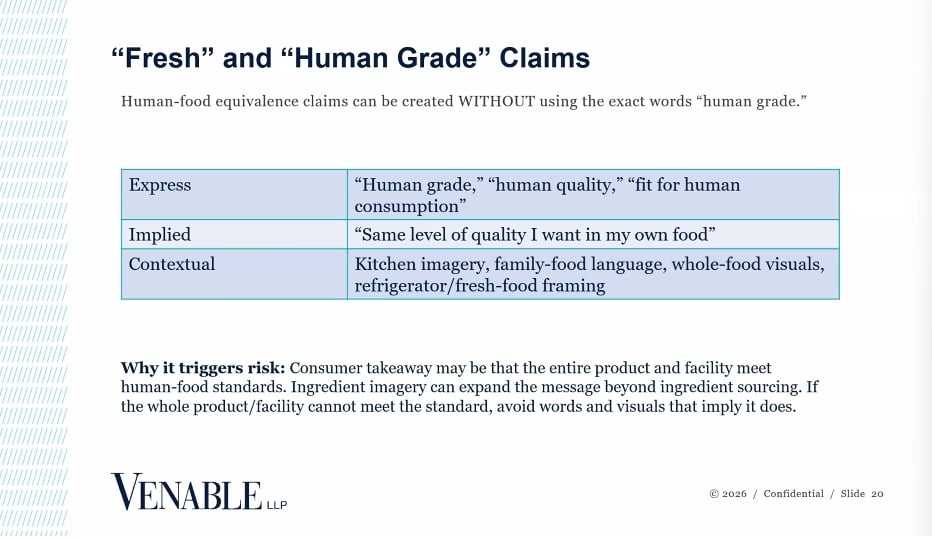
The Pet Food Committee sessions also shed light on the pervasive issue of misleading marketing. Legal expert Todd Harrison of the firm Venable addressed the assembly, providing a blunt warning regarding "ingredient imagery."
Manufacturers frequently use high-quality imagery—such as pristine cuts of steak or fresh poultry—on packaging to imply the use of high-quality ingredients, even when the product consists primarily of processed meal or by-products. Mr. Harrison suggested that the industry is heading toward a "day of reckoning" in the form of class-action lawsuits. When the imagery on the label does not align with the reality of the ingredient list, manufacturers face significant legal exposure.

The "Senior" Nutrition Gap
Another major failure identified during the meeting involves nutritional profiles for senior pets. The FDA representative admitted that veterinarians are increasingly advising owners of senior pets to reduce their food intake to account for lower activity levels. However, because there is no specific nutritional profile for "senior" pets, these dogs often end up receiving a caloric deficit that is not matched by an increase in nutrient density, leading to potential deficiencies.
Despite acknowledging this as a systemic issue, neither the FDA nor AAFCO moved to implement a mandatory senior nutritional profile. Instead, the current status quo remains: companies are allowed to market products as "senior" even if they are nutritionally identical to standard adult formulas, effectively allowing the industry to profit from misleading health claims while leaving aging pets at risk.
Implications for the Consumer
The overarching message from the San Diego summit is clear: the regulatory process is slow, heavily influenced by industry, and often detached from the lived reality of pet owners.
Key Takeaways for Pet Owners:
- Label Skepticism: Until the 2030 label updates are actually implemented, consumers should treat "ingredient imagery" on packaging with extreme caution. It is rarely an accurate reflection of the product’s quality.
- Ingredient Vigilance: The push to lower standards for "Meat and Bone Meal" suggests that regulators are more concerned with supply chain flexibility than with raising the quality floor of pet food ingredients.
- Senior Pet Caution: Marketing terms like "Senior" are currently unregulated. Owners should consult with veterinary nutritionists rather than relying on product labels to ensure their aging pets are meeting their specific nutritional needs.
Looking Ahead: The Road to Orlando
As AAFCO prepares for its next meeting in Orlando, Florida, the pressure on the organization is mounting. The failure to address the senior nutrition gap, the constant delays in labeling, and the questionable efforts to weaken ingredient definitions have created a rift between the regulators and the public they serve.
For the pet food consumer, the wait for substantive reform continues. Whether the 2030 deadline for label updates holds, or whether further "technical hurdles" will be used to kick the can down the road, remains to be seen. In the meantime, the advocacy for "truth in pet food" remains more vital than ever, as the industry continues to prioritize ease of manufacture over the nutritional health of the animals that rely on these products for their daily survival.
Susan Thixton is a pet food consumer advocate and the founder of the Association for Truth in Pet Food. She continues to monitor AAFCO proceedings to ensure that pet owners remain informed about the policies that dictate the quality and safety of their pets’ food.