In the niche world of reptile breeding, the "Lemon Frost" leopard gecko (Eublepharis macularius) was initially hailed as a visual masterpiece. Characterized by its striking, bright white, and yellow coloration, the morph became a highly sought-after commodity among collectors shortly after its introduction. However, beneath the aesthetic appeal of these reptiles lies a biological tragedy. Researchers have discovered that the very trait that gives the Lemon Frost its vibrant appearance is inextricably linked to an aggressive, high-frequency cancer known as iridophoroma.
For evolutionary geneticists and oncologists, this unfortunate biological quirk has unexpectedly opened a new frontier. By studying these geckos, scientists are gaining unprecedented insights into pigment cell cancers in non-mammalian vertebrates, potentially uncovering universal mechanisms of tumorigenesis that have long remained elusive in traditional rodent models.
The Chronology of a Genetic Mystery
The story of the Lemon Frost morph began in 2015, when prominent reptile breeder Steve Sykes acquired a pair of the geckos from a fellow breeder. The potential for the morph was immense, and Sykes immediately began an intensive breeding program. Within a year, however, the excitement turned to alarm.
As the offspring matured, Sykes noticed the emergence of small, raised white nodules on their skin. Having spent years working with reptiles, he recognized these as tumors. Faced with the ethical dilemma of continuing a lineage prone to health complications, Sykes sought answers. He wanted to know if it was possible to decouple the aesthetic "Lemon Frost" trait from the tumor-forming gene, or if the two were genetically tethered.
His pursuit of answers led him to the laboratory of Leonid Kruglyak, an evolutionary geneticist at the University of California, Los Angeles (UCLA). Recognizing the unique opportunity to study a spontaneous cancer model, the research team began an exhaustive genomic investigation into the Lemon Frost lineage. This collaboration bridged the gap between amateur hobbyist breeding and rigorous academic oncology, setting the stage for a groundbreaking study published in the Springer Nature journal, BMC Biology.
Genomic Insights: Decoding the "Start Here" Sign
To understand why these geckos were prone to tumors, the research team performed whole-genome sequencing on both tumor tissue and healthy tissue from the same individuals. The results were startling.
The primary discovery centered on a missense mutation in the TATA-box binding protein (TBP). To understand the significance of this, one must view the genome as a vast, complex cookbook. Every gene is a recipe, but before a cell can "cook" a protein, it must identify the precise starting point of that gene. The "TATA box" serves as the biological "Start Here" sign, a sequence of DNA that acts as a signal for the cell’s machinery. The TATA-box binding protein is the molecule that attaches to this sign, signaling the commencement of gene expression.
When this protein is mutated in the Lemon Frost gecko, the cellular "instruction manual" becomes garbled. The cell loses its ability to correctly initiate the transcription of vital genes, leading to the cellular chaos that characterizes the early stages of cancer.
The IARS1 and RNF213 Gene Fusion
Beyond the TBP mutation, researchers identified a recurring gene fusion between IARS1 and RNF213. In a healthy organism, these genes are responsible for critical housekeeping functions: ensuring proteins are synthesized correctly and regulating how blood vessels respond to injury or physiological stress.
In the Lemon Frost morph, these two distinct genes were fused together, creating a hybrid genetic instruction that disrupts normal vascular development. This fusion is believed to be a key driver in the geckos’ inability to regulate cell growth, particularly within the dermis where the iridophores (the pigment cells responsible for the gecko’s white coloration) reside.
The Trio of Mutations: MAP3K13, TENM4, and OR2AT4
The study further pinpointed three specific mutated genes—MAP3K13, TENM4, and OR2AT4—that act as accelerators for tumor progression. These mutations lead to a dysregulation in actin filament organization. Actin filaments are the "scaffolding" of a cell; when they are disrupted, the cell loses its structure and its ability to communicate with neighbors.
The researchers noted that this structural collapse is a hallmark of metastatic potential. The breakdown of the cytoskeleton—the cell’s internal framework—leads to transcriptional misregulation and chromatin remodeling defects, effectively pushing the cells toward a cancerous state.
Clinical Characteristics of Iridophoroma
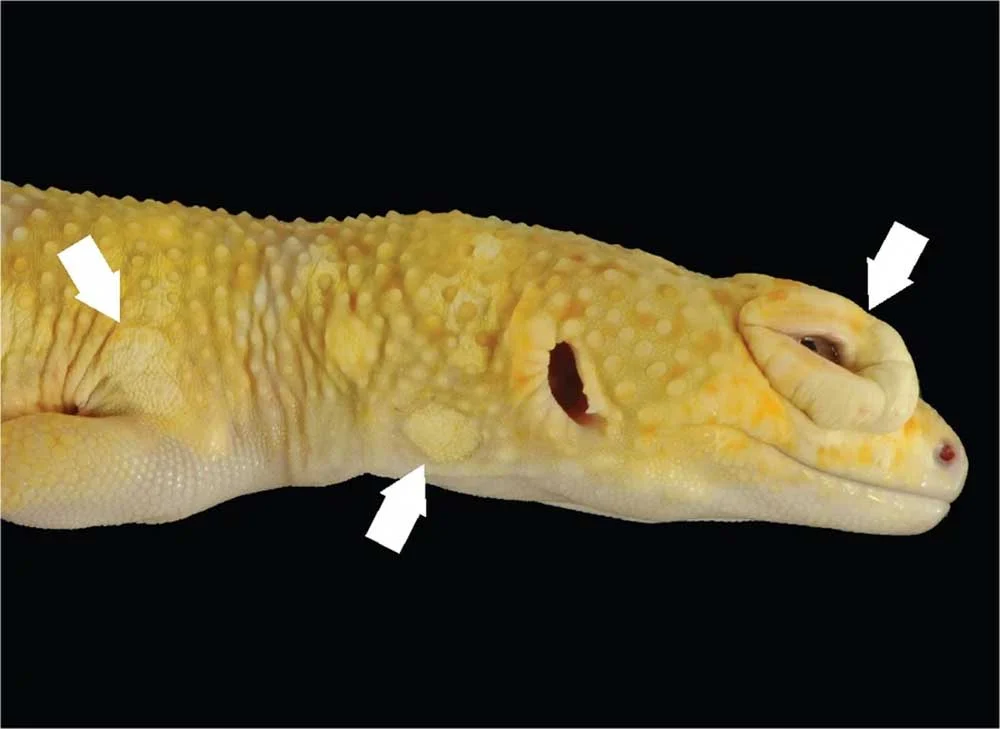
The statistics surrounding the Lemon Frost morph are sobering. More than 80 percent of the geckos studied developed iridophoromas—a rare form of pigment cell neoplasm.
In these geckos, the iridophores, which normally provide the white, reflective coloration, begin to proliferate uncontrollably within the dermis. These neoplasms manifest as dense, white, raised nodules. While these lesions are initially confined to the skin and can be surgically excised, the nature of the malignancy is insidious. The cancer is highly prone to metastasis. Once the cells break free from the dermis, they frequently colonize internal organs, with the liver being the most common site of secondary spread.
For breeders and owners, this creates a grim prognosis. The "beauty" of the animal is, quite literally, the site of its undoing. The research confirms that there is currently no way to "breed out" the cancer from the Lemon Frost morph without losing the physical traits that define it, as the mutations are deeply embedded in the genetic architecture that produces the white pigmentation.
Implications for Cancer Research
The publication of the paper, titled "Dissecting cancer in a non-mammalian model: genomic insights from lemon frost geckos," marks a significant milestone in comparative oncology. For decades, cancer research has been dominated by mouse models. While these have provided invaluable data, they do not always capture the full spectrum of cancer biology, particularly in the realm of pigment cell tumors.
Establishing a New Model
The Lemon Frost gecko offers a unique, non-mammalian model that allows researchers to observe tumor development in a vertebrate with a different evolutionary history than mammals. Because these geckos develop cancers at such a high frequency (over 80 percent), they provide a "cleaner" data set than many other models, where researchers often have to artificially induce tumors.
Future Therapeutic Avenues
By characterizing the genomic changes associated with iridophoroma, the UCLA team has provided a blueprint for future studies. The pathways identified—specifically those involving actin filament disruption and the IARS1-RNF213 fusion—are not necessarily unique to geckos. Many of these biological pathways are conserved across vertebrate species.
If researchers can find ways to stabilize the cytoskeleton or inhibit the specific protein fusions in these geckos, those findings could theoretically be translated into human oncology research. The study effectively turns the Lemon Frost gecko into a "sentinel" species, providing a living laboratory to test the efficacy of targeted therapies that could one day treat similar cancers in humans.
A Call for Ethical Breeding
The plight of the Lemon Frost leopard gecko has sparked a broader conversation within the pet trade regarding the ethics of selective breeding. When aesthetics are prioritized over health, the genetic cost is often borne by the animal.
Steve Sykes’ decision to share his breeding data with academic researchers is being heralded as a model for how the pet industry should handle genetic health crises. Rather than concealing the issues or continuing to breed affected animals in secret, the partnership between a commercial breeder and a university laboratory has resulted in a significant contribution to global medical knowledge.
The researchers conclude that while the Lemon Frost gecko is a tragic example of the consequences of genetic manipulation, it serves as an indispensable tool for science. "This study offers the first characterization of genomic changes associated with iridophoroma in a reptilian species," the authors noted in their conclusion. "It establishes the Lemon Frost gecko as a promising, if unconventional, model for future cancer research."
As the scientific community continues to digest the findings, one thing is clear: the path to understanding the most complex disease in human history may well run through the specialized scales of a small, white-spotted gecko from California. The Lemon Frost, once a symbol of breeding success, has become a symbol of scientific resilience, reminding us that even in the most unfortunate of genetic circumstances, there is a path to discovery.