In a significant contribution to Southeast Asian herpetology, researchers have formally described a new species of venomous pit viper from the genus Trimeresurus, discovered within the lush, biodiverse landscapes of China’s Yunnan Province. The newly identified species, Trimeresurus hongheensis—commonly referred to as the Honghe green pit viper—represents a remarkable addition to the Crotalinae subfamily, highlighting the hidden ecological complexity of the Honghe River region.
The discovery, detailed in a study titled "Integrative taxonomy identifies a new species of Trimeresurus Lacépède, 1804 (Reptilia: Serpentes: Viperidae) from Yunnan Province, China," was recently published in the journal Zoological Research Diversity and Conservation. This finding not only expands our understanding of the genus Trimeresurus but also underscores the necessity of rigorous taxonomic review in regions where cryptic species may have previously been misidentified.
Main Facts: Meet the Honghe Green Pit Viper
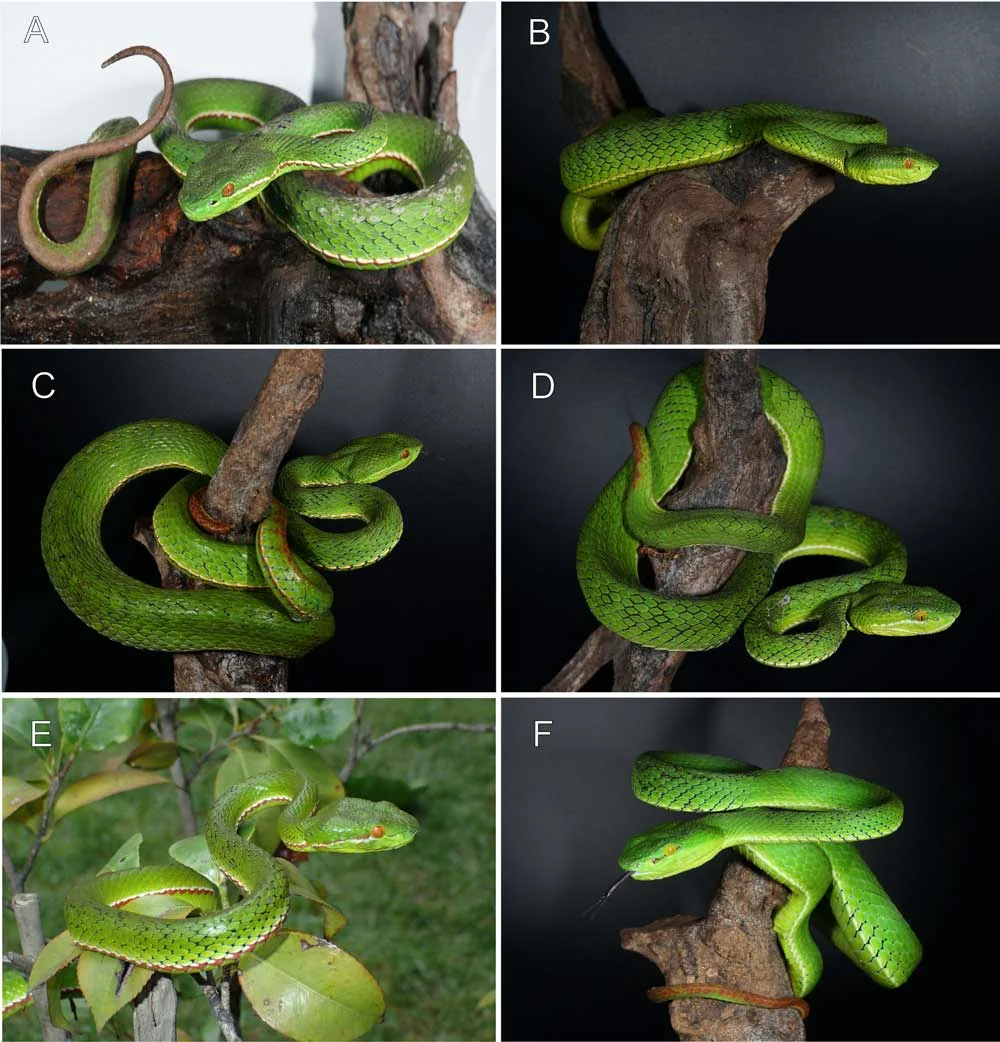
The Honghe green pit viper, known in Chinese as "Hónghé Zhú Yè Qīng" (红河竹叶青), is a specialized arboreal snake perfectly adapted for life within the forest canopy. Its physical morphology provides clear evidence of its evolutionary trajectory; the snake possesses a slender, elongated body paired with a prehensile tail, an anatomical feature that allows it to navigate dense vegetation and perch securely among branches while hunting.
Morphology and Sexual Dimorphism
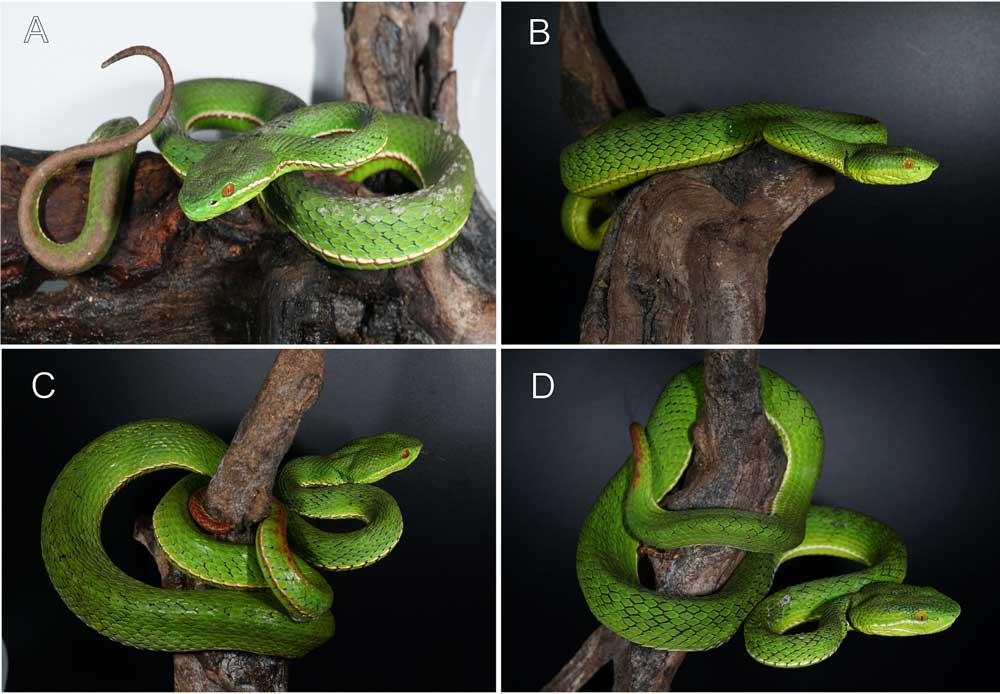
The species displays striking visual characteristics that distinguish it from its close relatives. Its dorsal surface and head are a deep, vibrant green, while its ventral side (belly) presents a contrasting yellow or light green hue. Perhaps the most distinct feature is the coloration of the tail: approximately 80 percent of the tail is a rusty red, which transitions into a darker, more intense red at the terminal tip.
Sexual dimorphism is notably pronounced in this species, manifesting in both color patterns and ocular characteristics:
- Coloration: Males feature a distinctive white post-ocular stripe that is bordered by red or white coloration. Females, by contrast, lack this white stripe entirely.
- Stripe Patterning: In individuals where the stripe is present, it begins at the heat-sensing pits and extends down the body, running in parallel with a secondary red stripe.
- Iris Color: Male specimens exhibit a brick red or sepia-toned iris, whereas females possess a more vibrant yellow or rusty red iris.
Regarding size, the species demonstrates moderate sexual dimorphism in length as well. Males reach a snout-to-vent length (SVL) of approximately 658mm, while females are larger, measuring up to 722mm.
Chronology of the Discovery and Research
The identification of Trimeresurus hongheensis was the culmination of extensive field surveys and rigorous laboratory analysis conducted by a team of dedicated herpetologists.
Field Collection and Initial Observations
The research process began with the collection of specimens across several key locations in Yunnan Province, including Honghe, Jinping, Pingbian, and Yuanjiang counties, as well as the urban vicinity of Mengzi City. During these expeditions, researchers observed the snakes primarily in forest vegetation, often perched well above the ground—consistent with their arboreal nature.
Comparative Taxonomy
The researchers utilized an integrative taxonomic approach to confirm that the specimens represented a distinct species rather than a variant of known pit vipers. By comparing the specimens against the "Trimeresurus albolabris complex"—a group notorious for taxonomic confusion due to the morphological similarity of its members—the team established clear geographic and genetic boundaries.
The research team determined that the Honghe River Basin and the Ailao Mountain range act as significant biogeographic barriers. These features effectively isolate T. hongheensis from its closest relative, T. yunnanensis, which is primarily distributed west of the Honghe River. This geographic separation has likely driven the speciation process over thousands of years, resulting in the distinct evolutionary path observed in the Honghe population.
Supporting Data: The Trimeresurus Genus
The genus Trimeresurus, commonly known as Asian pit vipers, is a widespread and diverse group within the subfamily Crotalinae. Globally, there are more than 150 species identified within this complex, many of which are medically significant due to their potent hemotoxic venom.
Relationship to Known Species
The study identifies five primary relatives to which T. hongheensis is most closely linked:
- Trimeresurus albolabris
- Trimeresurus gumprechti
- Trimeresurus stejnegeri
- Trimeresurus medoensis
- Trimeresurus yunnanensis
The differentiation of these species is often subtle, requiring the use of molecular phylogenetics and detailed scale counting (pholidosis) to confirm distinct lineages. By successfully mapping the T. hongheensis lineage, the researchers have provided a clearer framework for future herpetological surveys in Southern China.
Official Responses and Scientific Significance
The scientific community has welcomed the publication of the study, noting that the Trimeresurus albolabris complex has historically been a "black box" of taxonomy. For years, many green pit vipers in the region were simply lumped under one or two broad classifications.
"The formal description of Trimeresurus hongheensis is a vital step in biodiversity documentation," said one lead researcher involved in the project. "By recognizing these unique populations, we can better implement conservation strategies that protect specific habitats, rather than assuming all green pit vipers share the same environmental requirements."
The study is now available in full for peer review and public access on the Zoological Research Diversity and Conservation portal. This transparency is vital, as it allows researchers across Asia to verify the identification keys provided, potentially leading to the discovery of more populations or even further cryptic species within the Honghe River Basin.
Implications: Conservation and Future Research
The discovery of T. hongheensis carries profound implications for conservation biology in Yunnan Province.
Habitat Protection
The Honghe River Basin is an area of high biodiversity but is also subject to human encroachment, agricultural expansion, and climate-induced habitat shifts. As an arboreal species, the Honghe green pit viper is highly sensitive to the health of the forest canopy. The loss of old-growth trees or the fragmentation of forest corridors could pose a direct threat to the survival of this newly identified snake.
The Need for Continued Monitoring
Taxonomists emphasize that the discovery of a new species is rarely the end of the story. Future research must now focus on:
- Population Surveys: Determining the current population density and geographic range limits of the snake.
- Venom Composition: Given the medical importance of the Trimeresurus genus, studying the venom of T. hongheensis may have implications for pharmacology and the development of antivenoms specific to the region.
- Ecological Niche Modeling: Understanding the specific humidity, temperature, and prey requirements of this viper to assess its resilience against the warming climate of Southern China.
A Beacon for Regional Biodiversity
The discovery also serves as a reminder of the "hidden" wealth of biodiversity in the Asian highlands. As researchers continue to apply modern genomic and morphological techniques to the fauna of Yunnan, it is increasingly likely that other species, long overlooked or mistaken for common varieties, will be brought to light.
The Honghe green pit viper is more than just a new entry in a field guide; it is a sentinel of the health of the Honghe River’s ecosystems. Protecting this species means protecting the intricate canopy architecture of the Yunnan forests, ensuring that this unique pit viper continues to thrive in its natural environment for generations to come.
For those interested in the technical specifics, the full taxonomic breakdown, including holotype and paratype details (such as specimen GXNU251201 from Mingjiu, Mengzi), can be referenced in the official research paper. As science continues to peel back the layers of the Trimeresurus complex, the Honghe green pit viper stands as a testament to the persistent mystery and majesty of the natural world.