Main Facts: A Historic Wild Encounter in Florida
In the wild, few predatory interactions are as high-stakes as a face-off between a mammalian carnivore and a heavily armed, venomous reptile. Researchers working in the pine flatwoods and pastures of Florida have successfully documented a rare, near-two-hour battle between a wild bobcat (Lynx rufus) and a massive adult Eastern diamondback rattlesnake (Crotalus adamanteus).
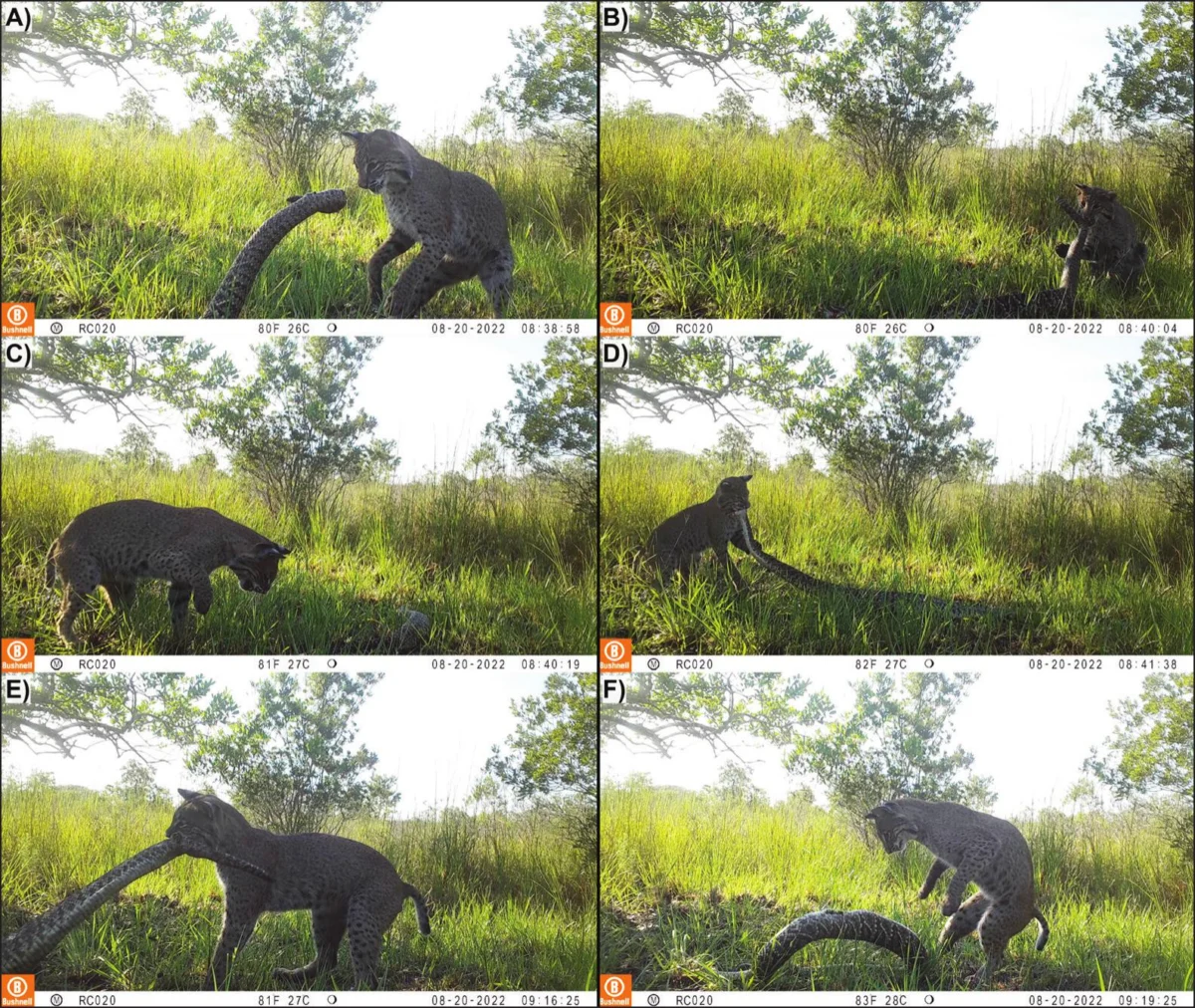
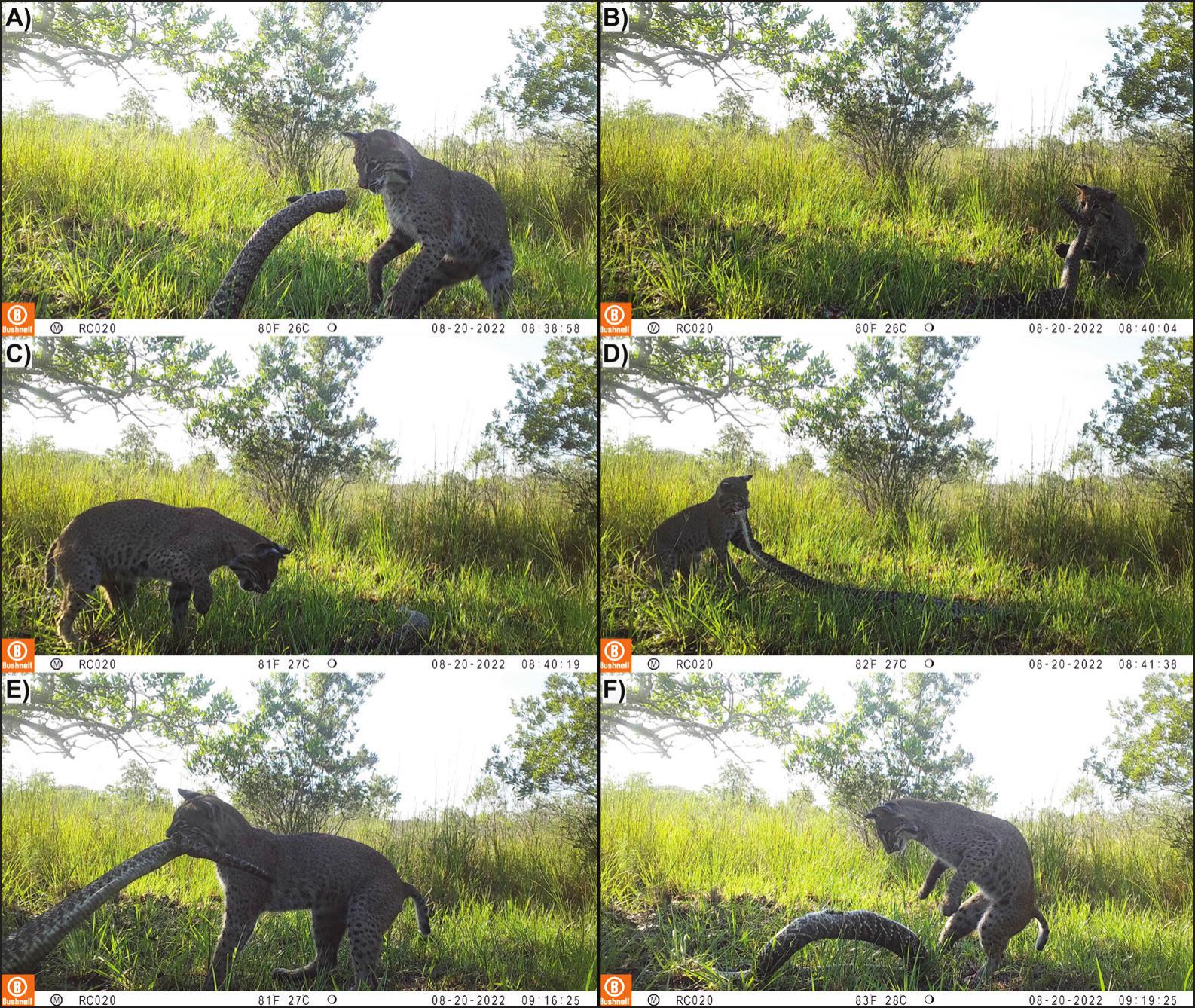
The encounter, captured by a strategically placed remote field camera, provides what scientists are calling the first definitive, primary photographic evidence of a bobcat actively hunting and attacking a living adult Eastern diamondback rattlesnake. While anecdotal accounts or indirect evidence of mammal-reptile conflicts occasionally surface, this sequence of 38 high-resolution photographs offers an unprecedented, second-by-second chronicle of a wild cat taking down one of North America’s most formidable venomous snakes.
The documentation occurred on August 20, 2022, at the University of Florida Range Cattle Research and Education Center, located in Ona, Hardee County, Florida. A research team comprising Mohamed Khalil Meliane, Peyton E. Niebanck, Nicole Rita, Samantha Nunn, and E. Hance Ellington managed the remote equipment. The resulting paper, titled "Photographic Evidence of a Bobcat (Lynx rufus) Attack on an Eastern Diamondback Rattlesnake (Crotalus adamanteus)," has been published in the open-access journal Southeastern Naturalist.
Historically, documented evidence of bobcats preying upon venomous snakes has been remarkably scarce. Prior to this discovery, the primary piece of supporting literature came from a 2001 incident in Georgia. In that instance, researchers found the remains of an Eastern diamondback rattlesnake inside the stomach contents of a harvested bobcat. However, because stomach content analysis only reveals what was ingested, scientists could not definitively confirm whether the cat had actively hunted and killed the venomous reptile or simply scavenged the carcass of a snake that had died of natural causes.
The Florida camera-trap photographs definitively close this knowledge gap, proving that bobcats are active, calculated predators capable of subduing venomous ambush hunters in direct combat.
Chronology of the Battle: A Step-by-Step Breakdown
The remote Bushnell Core camera captured the entire dynamic over a nearly two-hour window, allowing researchers to piece together a precise timeline of the predator-prey interaction. Positioned precisely 50 centimeters off the ground and programmed to record burst shots of three frames upon a motion trigger—with a rapid 0.6-second recovery interval—the camera missed virtually nothing of the dramatic struggle.
Phase 1: The Initial Approach and Caution
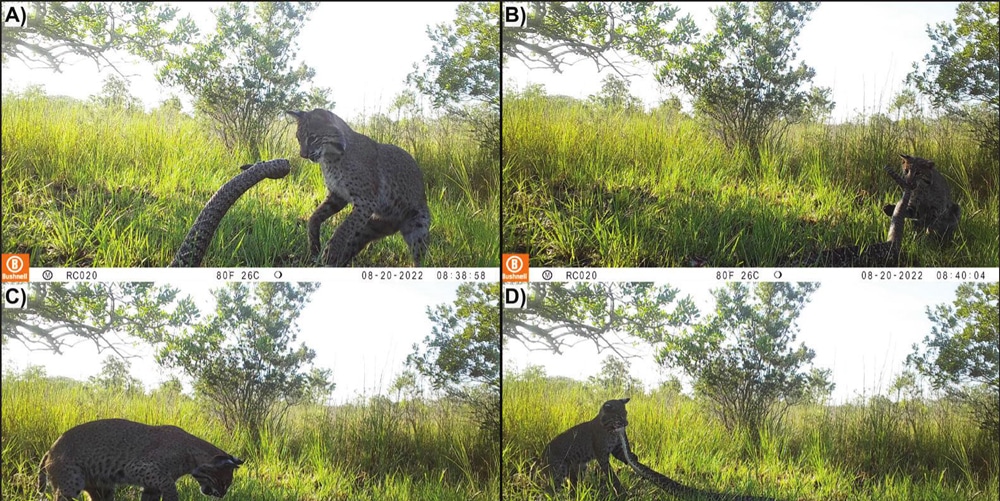
The series begins with the bobcat cautiously sizing up its dangerous prey. Knowing the lethal potential of a rattlesnake’s hemotoxic venom, the wild cat initially maintained a defensive distance, carefully avoiding the snake’s vibrating, contracting tail.
Phase 2: The First Strike
As the interaction progressed, the bobcat shifted from defensive observation to offensive aggression. The camera captured the feline lunging and clamping its jaws directly onto the rattlesnake’s contracting tail for approximately five seconds.
Phase 3: The Claws Come Out
Following the tail-bite, the bobcat escalated the assault, rapidly clawing at the snake’s midbody for roughly 20 seconds. This prolonged scratching appears to have worn down the snake’s defensive posture and inflicted deep lacerations.
Phase 4: A Brief Lull
In a surprising display of tactical patience, the bobcat backed away and rested near the wounded snake for 29 seconds, seemingly catching its breath and avoiding potential counter-strikes while the venomous reptile suffered from blood loss and shock.
Phase 5: The Head-On Coup de Grâce
Re-engaging the prey with calculated precision, the bobcat seized the snake by the head. This crucial phase lasted for an extensive 114 seconds. By immobilizing the head, the bobcat neutralized the rattlesnake’s primary weapon—its venom-injecting fangs.
Phase 6: Final Defenses and Aftermath
Following the prolonged head-bite, the bobcat briefly bit the tail again for six seconds. Subsequent photographs showed the massive rattlesnake overturned on its back, exhibiting severe wounds to its head, midbody, and tail. Even in this compromised, overturned state, the snake made desperate, albeit unsuccessful, attempts to strike back at its feline tormentor before ultimately succumbing to its injuries.
Supporting Data and Technical Setup of the Observation
The deployment of the camera trap that recorded this event was not an accident of nature photography, but part of a broader, methodical ecological study. The University of Florida Range Cattle Research and Education Center serves as a living laboratory where researchers monitor wildlife corridors, cattle-land interactions, and local biodiversity.
The technical specifications of the camera trap played a vital role in securing usable data:
- Camera Model: Bushnell Core trail camera.
- Mounting Height: 50 centimeters (approx. 19.7 inches) above ground level.
- Trigger Settings: Burst mode capturing three consecutive images per trigger event.
- Recovery Interval: 0.6 seconds between trigger sequences to minimize blind spots in fast-moving wildlife scenarios.
This meticulous setup ensured that the camera did not just snap a single, ambiguous photo, but instead compiled a continuous visual dataset. The resulting images allowed researchers to analyze behavioral loops, duration of contact, and tactical shifts between offense and retreat.
Biologists emphasize that capturing such behavior on camera is exceedingly rare due to the secretive, solitary nature of bobcats and the sporadic nature of wildlife movements. The success of this camera trap underscores the immense value of automated, passive monitoring systems in modern wildlife research, allowing scientists to witness rare natural events without human interference altering animal behavior.
Expanding Horizons: Bobcats as Apex Generalist Predators of Reptiles
While the documentation of a bobcat killing an Eastern diamondback rattlesnake is groundbreaking, it arrives alongside a growing body of evidence suggesting that Lynx rufus plays a much larger role as a predator of large and dangerous reptiles than previously understood.
In recent years, researchers have documented bobcats expanding their dietary horizons to include invasive species and formidable native reptiles that many would assume are far too dangerous or large for a medium-sized cat to handle.
The Everglades Python Connection
In 2022, researchers in the Florida Everglades documented a series of camera-trap photos depicting bobcats actively consuming the eggs of the invasive Burmese python (Python bivittatus). This discovery marked the first known instance of a native North American mammal utilizing Burmese python nests as a food source, suggesting that local wildlife is slowly finding ways to adapt to and interact with the invasive constrictor population.
Furthermore, a separate incident in 2021 provided strong evidence that bobcats are capable of killing adult Burmese pythons. Researchers discovered the carcass of a large adult female python bearing distinct claw scratches. Additionally, surrounding signs at a nearby cache site matched behavioral patterns consistently associated with bobcat hunting and food-storing tactics.
Implications for Ecosystem Dynamics
These collective observations—ranging from the dispatching of a venomous native rattlesnake to the predation on invasive python eggs and adults—highlight the extreme adaptability and behavioral plasticity of the bobcat. Ecologists point out that bobcats are quintessential generalist predators. When traditional mammalian prey like rabbits, rodents, or small deer are scarce, or simply as an opportunistic meal, bobcats demonstrate the tactical intelligence and physical prowess required to take on high-risk, high-reward prey.
The ability to successfully hunt large vipers like the Eastern diamondback rattlesnake requires a sophisticated blend of reflexes, patience, and spatial awareness. Because rattlesnakes possess potent hemotoxic venom capable of causing severe tissue damage, organ failure, or death, any miscalculation by the bobcat could result in a fatal bite. The fact that the Florida bobcat executed this hunt successfully—and seemingly walked away unharmed—speaks volumes about the evolutionary fitness and predatory capabilities of this resilient wild cat.
Broader Implications for Conservation and Future Research
The publication of this study in Southeastern Naturalist does more than just document a dramatic wildlife encounter; it reshapes how wildlife biologists view predator-prey dynamics in the American Southeast.
As human development continues to fragment natural habitats, forcing native species into closer proximity with one another and with agricultural lands, understanding the full scope of an animal’s diet and behavioral repertoire becomes essential. Conservationists note that apex and mesopredators like bobcats help regulate ecosystem health. By keeping venomous snake populations in check—and potentially exerting top-down pressure on invasive species like Burmese pythons—bobcats perform critical ecological services that ripple throughout their native habitats.
Researchers hope that this documented interaction will encourage further deployment of high-speed camera traps across Florida and the broader southeastern United States. By casting a wider digital net, scientists aim to uncover more hidden behaviors of elusive carnivores, shedding light on the complex, hidden interactions that shape the natural world.
For those interested in examining the raw data, methodological notes, and the complete sequence of photographs, the full-length open-access research paper, "Photographic Evidence of a Bobcat (Lynx rufus) Attack on an Eastern Diamondback Rattlesnake (Crotalus adamanteus)," is available online via the BioOne Digital Library.