By Investigative Desk
August 20, 2026
In a significant escalation of the ongoing battle for pet food transparency, a formal complaint was filed on August 18, 2026, with the Government Accountability Office (GAO) targeting the FDA’s Center for Veterinary Medicine (CVM). The filing, spearheaded by consumer advocate Susan Thixton of TruthaboutPetFood.com and the Association for Truth in Pet Food, alleges systemic mismanagement, the misallocation of federal funding, and a pattern of "enforcement discretion" that critics argue has transformed the pet food industry into a secretive waste disposal system for the rendered remains of diseased or non-slaughtered animals.
This complaint marks a pivotal moment in the relationship between pet owners and federal regulators, shifting the discourse from mere dissatisfaction to a formal request for a congressional investigation into the CVM’s operational integrity.
The Core Allegations: A Pattern of Regulatory Failure
The six-page filing presented to the GAO serves as a scathing indictment of the CVM’s regulatory posture. At the heart of the complaint is the assertion that the agency is engaged in "programmatic mismanagement," selectively enforcing federal laws while ignoring others to the detriment of pet health and consumer rights.
Selective Enforcement and "Enforcement Discretion"
The central contention of the complaint is that the CVM has effectively abandoned its duty to provide uniform oversight. By applying "enforcement discretion," the agency has publicly admitted that it does not consider the inclusion of diseased animals—or animals that died by means other than slaughter—in pet food to be a significant safety concern.
Critics argue that this policy directly contradicts the spirit, if not the letter, of federal food safety mandates. By allowing these ingredients to be labeled under the generic, innocuous term "chicken" or "meat," the FDA is accused of facilitating consumer deception on a national scale. The complaint highlights that manufacturers are permitted to use marketing imagery of human-grade roasted poultry on packaging for products that may contain condemned, non-slaughtered animal tissues.
Chronology of Institutional Negligence
To illustrate the breadth of the CVM’s perceived inaction, the GAO complaint details specific historical examples of how the agency handles massive influxes of adverse event reports.
The Purina Case Study
The complaint highlights a harrowing six-month period during which the FDA received 1,705 adverse event reports specifically linked to Purina Pet Foods. Within that data set, 206 reports involved the potential deaths of pets. Despite the severity of these figures, the CVM did not issue a formal Warning Letter.
Instead, a public alert was delayed for seven months. Even then, the agency disclosed that it had only investigated approximately 8% of the reports it received. When an inspection was finally performed at a Purina manufacturing plant, the FDA opted for a "Preventive Controls Surveillance" inspection rather than a "for-cause" inspection—the latter being the standard procedure for investigating allegations of tainted product. During this surveillance, the agency reportedly discussed only 24 consumer complaints, nearly 40% of which were unrelated, legacy complaints dating back to 2007.
Supporting Data: The Anatomy of a Hidden Industry
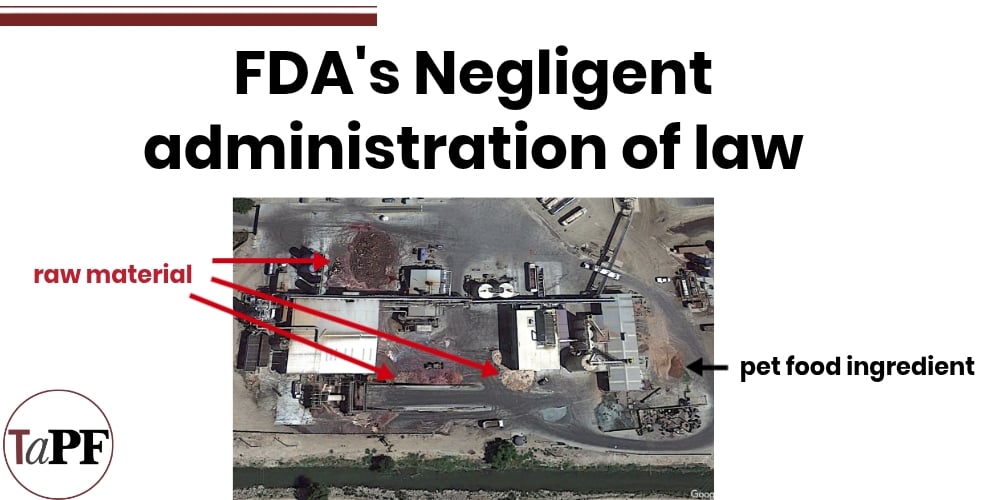
The complaint submitted to the GAO is not merely anecdotal; it includes graphic documentation intended to show the reality of the "rendering" industry. Rendering is the process of converting animal byproducts into fats, proteins, and meals. While this is an industrial necessity, the complaint argues that the FDA’s lack of oversight allows for the processing of "4D" animals—those that are Dead, Dying, Diseased, or Disabled—into pet food without any disclosure to the end consumer.
Lack of Scientific Justification
A primary point of contention is the lack of empirical, scientific evidence provided by the CVM to justify the inclusion of these ingredients. The agency has stated in response to Citizen Petition (FDA-2016-P-3578) that it sees no safety concern in the use of diseased animals. However, the advocates filing the GAO complaint argue that the CVM has failed to produce the safety studies required to support such a broad, industry-friendly conclusion. This leaves a massive void where scientific rigor should reside, filled instead by what advocates describe as "regulatory convenience."
Official Responses and the Stance of the CVM
Historically, the FDA’s position has been that they regulate pet food based on risk-based assessments and available resources. The agency maintains that its "enforcement discretion" allows it to prioritize threats that pose the highest risk to public health.

However, the GAO complaint challenges this defense by pointing out that the CVM is funded by Congress specifically to uphold food safety laws. If the agency chooses to bypass these laws, it is not merely prioritizing tasks; it is, according to the filing, misallocating congressional funding. By shielding manufacturers from the requirement to disclose the true nature of their ingredients, the CVM is accused of enabling a "secret waste disposal system" that prioritizes the profitability of the rendering and pet food industries over the safety of American pets.
Implications: The Quest for Congressional Oversight
The filing of this complaint is intended to trigger a formal investigation by the Government Accountability Office. Because the CVM operates under the oversight of the House Committee on Energy and Commerce and the Senate Committee on Health, Education, Labor and Pensions, the advocates are now calling on the public to mobilize.
The Role of the Voter
With federal elections approaching in November, the advocates are framing this issue as a litmus test for accountability. The goal is to flood the offices of the aforementioned committees with requests for a GAO report. By demanding that their representatives act on the evidence provided, pet owners are attempting to force a conversation that has been relegated to the periphery of Washington politics for too long.
What Consumers Can Do
The call to action is clear:
- Direct Communication: Citizens are encouraged to email their representatives on the House Energy and Commerce Committee and the Senate HELP Committee.
- Standardized Messaging: The advocates have provided a template email that emphasizes the "secret waste disposal" nature of the current regulatory environment.
- Evidence-Based Pressure: By urging Congress to view the photographic evidence of rendering facilities, advocates hope to create an emotional and logical imperative for lawmakers to demand transparency.
Conclusion: A Demand for Uniformity
The fundamental demand of the Association for Truth in Pet Food is for the FDA to provide proof that it is uniformly enforcing all applicable federal food safety laws. If the agency cannot provide this evidence, it must be held accountable for the systemic failures that have left millions of pet owners in the dark.
As the GAO considers the complaint, the pet food industry stands at a crossroads. The current system relies on the assumption that "pet food" is a distinct category that warrants less stringent oversight than human food, despite the fact that these products are the sole source of nutrition for millions of household companions.

The battle being waged is not just about the quality of kibble or canned food; it is about the integrity of a government agency tasked with protecting the most vulnerable members of our families. For Susan Thixton and her allies, the objective is simple: no pet food should contain undisclosed diseased material, and no consumer should be deceived by labels that mask the reality of what lies inside the bag.
Whether this complaint will lead to the sweeping reforms requested remains to be seen, but it has undoubtedly placed the FDA’s CVM under a microscope that it cannot easily escape. As the November elections loom, the power of the ballot box is being invoked to ensure that pet safety is no longer treated as a matter of "discretion," but as a matter of law.
For more information on the full complaint and to find instructions on how to contact your congressional representatives, visit TruthaboutPetFood.com.