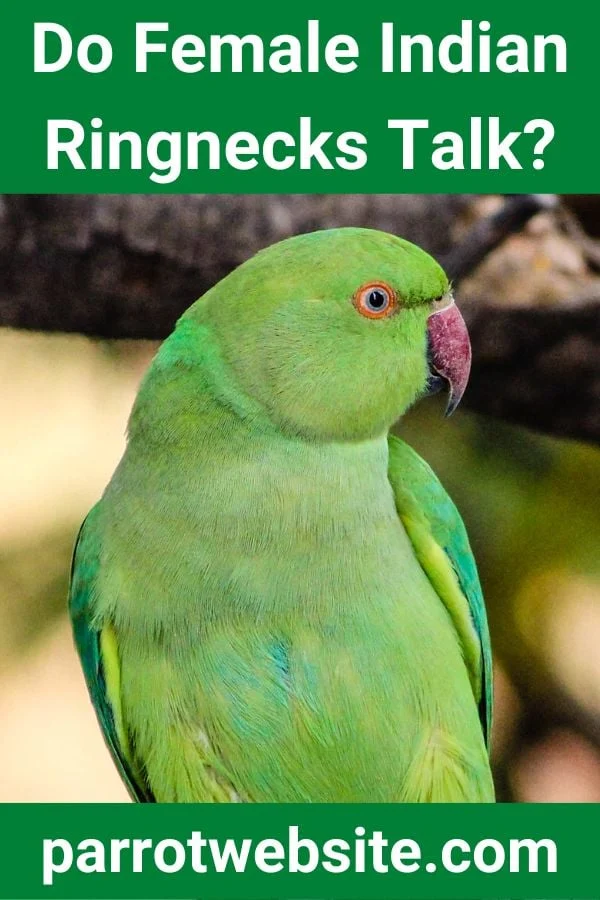
For many prospective bird owners, the decision to welcome a parrot into the home is often predicated on one specific, highly anticipated milestone: the moment the bird utters its first word. Among the most popular species for household companionship is the Indian Ringneck, a bird celebrated for its vibrant, emerald-hued plumage and its charmingly inquisitive personality. However, a persistent question echoes through avian enthusiast circles: while males are renowned for their loquacious nature, can female Indian Ringnecks truly hold a conversation?
The short answer is an emphatic yes. Female Indian Ringnecks are highly intelligent, capable creatures that possess the same neurological capacity for mimicry as their male counterparts. While the perception persists that males are the superior orators, the reality is far more nuanced.
Main Facts: The Vocal Capability of the Species
Indian Ringnecks (Psittacula krameri) are widely recognized as some of the most proficient mimics in the parrot family. They do not merely mimic; they often capture the cadence, tone, and inflection of human speech with startling accuracy.
When discussing female Indian Ringnecks, it is crucial to establish that their ability to vocalize is inherent to the species. Biology does not dictate that a female is "mute" or incapable of speech. Every female Indian Ringneck possesses the vocal apparatus and the cognitive capacity required to learn a wide vocabulary of words and phrases.
However, "ability" should not be confused with "inclination." While most female Indian Ringnecks will begin to vocalize and mimic human speech as they mature—often with minimal prompting—individual personality plays a significant role. Just as human children have varying proclivities for language, so too do these parrots. Some females may become chatterboxes, delighting their owners with a repertoire of phrases, while others may be more reserved, preferring to communicate through chirps, whistles, and non-verbal body language.
Chronology: From Hatchling to Eloquent Companion
The development of a parrot’s speech is a journey that requires patience, consistency, and a structured environment. Understanding the timeline of their vocal development is essential for any owner looking to foster their bird’s conversational skills.
The Developmental Window
Female Indian Ringnecks are generally quick learners. Most individuals begin their journey into mimicry around the eight-month mark. It is common for owners to notice small, garbled, or "mumbling" sounds before actual words emerge. If a bird has not begun to attempt mimicry by the one-year mark, it does not necessarily indicate a failure, but it may suggest a need for more focused environmental interaction.
The Consolidation Phase
Once the bird begins to mimic, the period between one and two years of age is the most critical. This is the "consolidation phase," where the parrot solidifies its vocabulary. Owners who provide consistent, high-quality interaction during this period often see the most significant progress.
Maturity and Fluency
By the time an Indian Ringneck reaches three years of age, their conversational abilities are typically fully developed. This does not mean they stop learning—on the contrary, parrots remain curious throughout their lives—but the primary foundation of their speech is established. They are capable of learning complex phrases and can continue to add to their "mental library" well into their adulthood.
Supporting Data: Why Males and Females Differ
The discourse regarding male versus female superiority in speech often boils down to evolutionary biology. In the wild, the behaviors of these birds are dictated by the pressures of survival and reproduction.
The Role of Territory and Attraction
In the wild, male Indian Ringnecks are responsible for establishing and defending territory. Their vocal prowess is a vital tool in this endeavor. A male’s ability to produce a diverse range of songs and mimic sounds is an indicator of his health, vitality, and intelligence—all traits that are highly attractive to potential mates. Because the male is the one actively "advertising" himself to females, he is under constant evolutionary pressure to be the most proficient communicator in his vicinity.
Conversely, female Indian Ringnecks do not carry the burden of attracting a mate through elaborate vocal displays. Their role in the reproductive cycle is more selective. Because they are not hard-wired to use complex vocalizations to secure a partner, they are often perceived as less "motivated" to talk.
The Capacity Gap
It is a common misconception that males have a biological "speech center" that females lack. Scientific consensus holds that both sexes have the same physiological hardware for speech. The difference is purely behavioral. The male’s internal drive to impress drives his vocal output; the female, lacking this specific evolutionary incentive, may choose to use her voice for more practical purposes—such as alerting her flock to danger or expressing comfort—rather than for performance.
Training Strategies: Cultivating a Chatty Companion
While a bird’s natural inclination plays a role, human intervention significantly influences the outcome. Training a female Indian Ringneck to talk is less about "instruction" and more about "immersion."
Positive Reinforcement
The most effective training tool is positive reinforcement. Utilizing a clicker—a device that marks the exact moment of a desired behavior—can be highly beneficial. When the parrot produces a sound that approximates a word, immediately click and provide a high-value treat. This creates a clear association: speaking = reward.
Consistent Exposure
Parrots are, by nature, mimicry machines. They will replicate the noises they hear most frequently. If you want your bird to speak, you must provide the auditory input. This involves speaking clearly, slowly, and enthusiastically to your bird every single day.
Avoiding Complacency
Many owners make the mistake of tapering off their efforts once the bird begins to speak. This is the exact moment when you should increase your engagement. Use your parrot’s budding vocabulary to engage in "conversations." If you ask a question and the bird responds with a sound, acknowledge it. This reinforces the social aspect of speech, which is the primary reason parrots mimic in the first place.
Implications for Prospective Owners
If you are considering adopting an Indian Ringneck, it is important to manage your expectations regarding their personality.
The "Individual" Variable
Regardless of gender, every Indian Ringneck is an individual. You might find a female that is more talkative than a male, or a male that prefers silence. The gender of the bird is a general indicator of tendencies, not a guarantee of behavior. If your goal is strictly to own a "talking machine," you may find yourself frustrated by the unpredictability of the species.
The Importance of Health
If your female Indian Ringneck is completely silent—not just refusing to talk, but failing to make any vocalizations or social noises—it is imperative to consult an avian veterinarian. Silence can sometimes be a sign of illness, stress, or psychological distress. A healthy, happy Indian Ringneck will almost always be vocal, whether or not those vocalizations manifest as human speech.
The Bond as the Foundation
Ultimately, the primary motivation for a parrot to learn human language is to deepen its bond with its human "flock." Parrots are highly social, sentient beings that view their owners as their social group. Mimicking your voice is their way of saying, "I am one of you." When you approach training with the intent of building a relationship rather than "teaching a trick," you will find that the speech—if it comes—is a much more meaningful reward.
Conclusion
The debate over whether female Indian Ringneck parrots can talk is settled by the evidence of both biology and experience: they absolutely can. While males may hold a slight statistical edge due to their evolutionary need to attract mates through vocal displays, female Indian Ringnecks are more than capable of developing impressive vocabularies.
For the prospective owner, the lesson is clear: if you choose a female Indian Ringneck, do not view her as a "second-tier" talker. View her as a companion with the latent potential for brilliant communication, waiting for the right environment, the right reinforcement, and the right bond to flourish. By focusing on consistent, positive, and social interaction, you are not just training a bird; you are welcoming an intelligent, vocal member into your home who may surprise you with just how much she has to say.