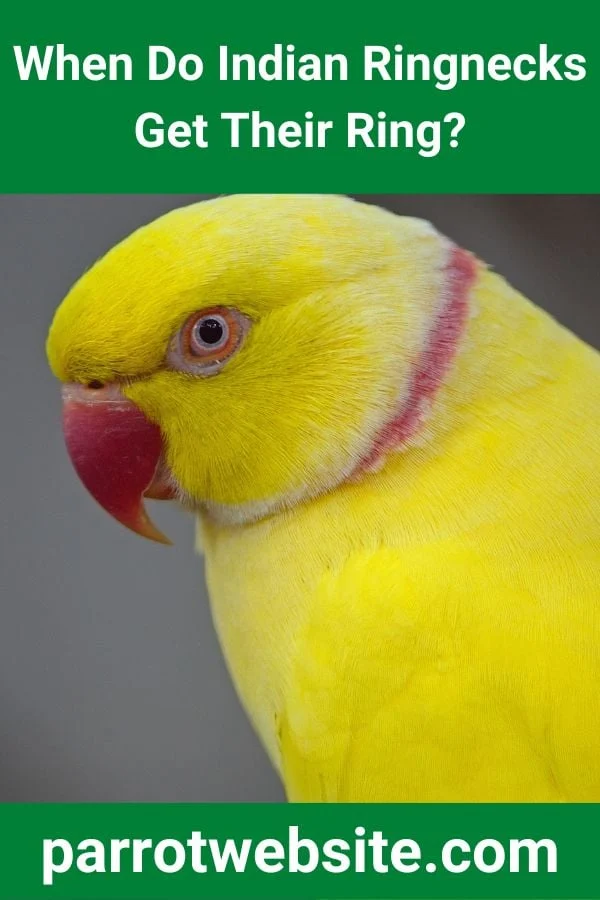
Nomenclature in the animal kingdom is often a paradoxical affair—at once entirely intuitive and frustratingly opaque. With many avian species, common names provide little insight into their biology, leaving owners to consult ornithological texts to decipher the origins of a moniker. However, the Indian ringneck parrot (Psittacula krameri) is a refreshing exception. As the name suggests, these birds are defined by the striking, iridescent bands that adorn the necks of the males. Yet, for many new enthusiasts and bird owners, a singular question persists: at what point in a bird’s life does this signature feature manifest?
Understanding the maturation process of the Indian ringneck is more than just a matter of curiosity; it is a vital component of responsible avian husbandry. The appearance of the ring is a biological milestone, signaling the transition from juvenile to adult, and serves as a primary marker for sexual maturity.
Main Facts: Decoding the Ringneck’s Signature
At its core, the ring of the Indian ringneck is a form of sexual dimorphism—a physiological distinction between the sexes. While both male and female parrots are vibrant, intelligent, and long-lived companions, the male possesses a distinct ornamental display that the female lacks.
The "ring" is not a single, uniform stripe. Rather, it is a complex, multi-layered development that typically includes a black throat band accompanied by pink and blue hues. This feature serves as an evolutionary beacon, intended to signal health, genetic fitness, and readiness to reproduce. In the wild, these displays are the primary mechanism by which males compete for the attention of females. Consequently, the development of these feathers is deeply tied to the bird’s endocrine system and the onset of puberty.
Chronology of Development: A Timeline of Change
The journey from a plain-feathered fledgling to a fully adorned adult is a gradual, multi-year process. While individual variations are common, the following timeline serves as the standard developmental trajectory for male Indian ringnecks.
The Juvenile Phase (0–18 Months)
For the first year and a half of life, both male and female ringnecks appear nearly identical to the casual observer. At approximately 12 weeks of age, the bird will have molted into its juvenile plumage. During this period, owners often struggle to distinguish gender. There are no definitive physical markers to rely on; the parrot is simply a smaller, quieter version of its adult self.
The Emergence of the Black Ring (18 Months)
The first sign of sexual maturity typically appears around the 18-month mark. Males will begin to show the initial, faint darkening of feathers around the throat. This is the precursor to the black ring. It is important to note that this is a "benchmarking" period; some precocious males may show these signs slightly earlier, while others may lag behind.
The Full Display (2–3 Years)
Between the second and third year, the transformation accelerates. The black ring becomes more pronounced and clearly defined. Simultaneously, the signature pink and blue accents begin to emerge. By the time a male ringneck reaches its third birthday, the ring is usually fully formed.
The Outlier Cases (Up to 4 Years)
Nature rarely adheres strictly to a calendar. Some healthy male ringnecks may not exhibit their full, vibrant "jewelry" until they are four years old. If a bird has reached this age and still shows no signs of the ring, it is generally safe to assume the bird is either female or, in rare cases, possesses a genetic anomaly that inhibits the expression of these secondary sexual characteristics.
Supporting Data: Why the Disparity?
The variation in ring development is rarely a sign of poor health; rather, it is a reflection of the complex interplay between genetics, environment, and social cues.
Sexual Dimorphism and Natural Selection
The ring is a classic example of "honest signaling" in evolutionary biology. Because the development of such an elaborate display requires significant energy and nutritional resources, it acts as an indicator of the male’s overall vigor. Females, who are responsible for selecting a mate, use these rings to gauge which males are the most capable of providing for a brood.
The Role of Hormones
Because these rings are linked to sexual maturity, their emergence is triggered by hormonal surges. In captivity, external factors—such as photoperiod (the amount of light exposure) and diet—can influence the speed at which these hormones reach the necessary levels. A bird kept in a stable environment with high-quality nutrition may hit these milestones with more consistency than a bird in an inconsistent environment.
Do Females Ever Have Rings?
A common point of confusion for owners is the presence of a "ring" on a female. It is essential to clarify that while females do not grow the bold, colorful rings of the males, they often exhibit a very faint, white, or shadow-like band around the neck. This should not be confused with the mature male’s display.
Official Perspectives: Veterinary and Avian Expert Insights
Veterinarians and avian behaviorists consistently emphasize that the ring should be treated as a developmental indicator rather than a strict medical diagnostic tool.
According to avian specialists, the most reliable way to determine the sex of a juvenile bird is not to wait for the ring, but to opt for DNA sexing. By collecting a small feather sample or a drop of blood, labs can provide a definitive answer within days. This is highly recommended for owners who want to understand their bird’s behavior, as the onset of sexual maturity—marked by the ring—often correlates with an increase in territorial behavior, vocalizations, and the need for more complex mental stimulation.
Regarding the "maturity" of the bird, experts note a distinction between anatomical maturity and social maturity. A bird may be physically capable of breeding at 18 months, but its social skills and capacity to raise a clutch successfully often do not peak until the bird is at least three or four years old.
Implications for Owners: What to Expect
The transition to adulthood in Indian ringnecks brings significant changes that owners should be prepared for.
Behavioral Shifts
As the ring develops, the parrot’s personality may shift. The hormonal influx that brings about the colorful plumage can also lead to "bluffing," a phase where the bird may become more assertive, territorial, or even aggressive. Owners should interpret this not as a behavioral failure, but as a biological reality of the bird entering its prime.
Long-Term Identification
Once the ring is fully developed, the parrot’s visual appearance becomes static. Unlike humans, whose aging process is visible through skin and hair changes, a ringneck will look remarkably similar at age four as it does at age forty. This makes the early years of documentation—keeping records of hatch dates and early molts—crucial for those who wish to track the health of their companion over its long lifespan.
The Importance of Patience
The primary takeaway for owners is the necessity of patience. It is easy to become anxious when a two-year-old male has yet to show its full colors. However, rushing this process or attempting to force maturity through environmental manipulation is both unnecessary and potentially stressful for the animal. Providing a consistent, high-welfare environment allows the bird to reach its natural biological milestones at its own pace.
Conclusion
The Indian ringneck parrot is a masterclass in the beauty of nature’s design. The gradual appearance of their neck rings is not merely a cosmetic change; it is a profound biological evolution that marks the transition into maturity. By understanding the timeline—from the initial black markings at 18 months to the fully realized display by age three or four—owners can better anticipate the needs and behaviors of their companions.
While the "ring" remains a fascinating, visible marker of the male’s development, it is only one aspect of the rich, multi-decade journey of living with an Indian ringneck. Whether your bird is a juvenile waiting for its colors or a mature adult showing off its vibrant bands, the experience of witnessing these changes remains one of the most rewarding aspects of avian companionship. Keep your records, provide a balanced diet, and enjoy the show—because in the world of the ringneck, the development of these colors is truly a spectacle worth waiting for.