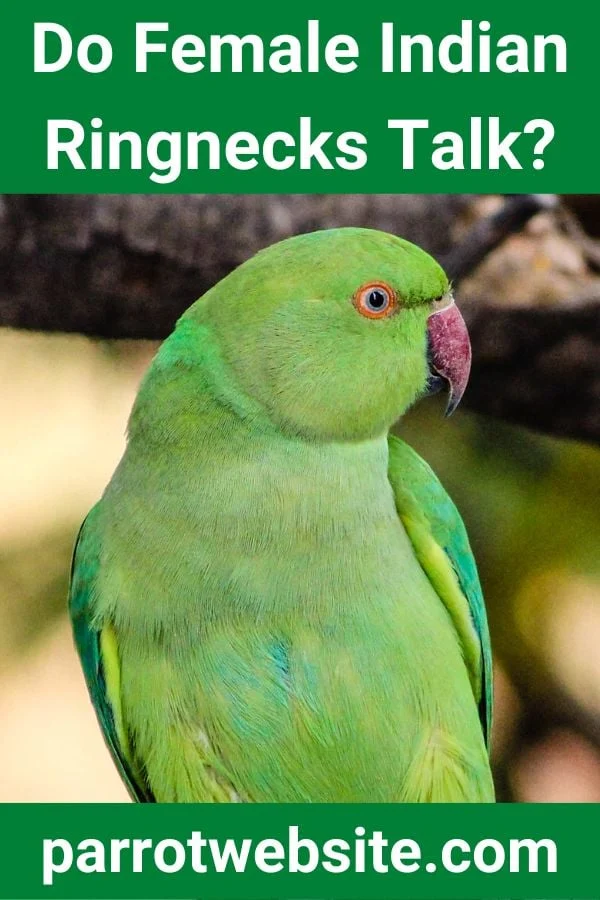
For many prospective bird owners, the decision to welcome an Indian Ringneck parrot (Psittacula krameri) into the home often hinges on a singular, highly anticipated milestone: speech. There is an enduring fascination with the avian ability to mimic human language, and the Indian Ringneck is frequently cited as one of the premier "talkers" in the parrot kingdom. However, a common misconception persists regarding the gender-based aptitude of these birds. Specifically, the question arises: can female Indian Ringnecks talk?
The short answer is an unequivocal yes. Female Indian Ringnecks possess the biological machinery and the neurological capacity to mimic human speech with remarkable clarity. While they are often overshadowed by their male counterparts in popular lore, the reality is that female Ringnecks are intelligent, inquisitive, and highly capable conversationalists. This report explores the nuances of their vocal behavior, the evolutionary drivers behind their speech, and how owners can foster these skills.
Main Facts: The Vocal Nature of the Species
The Indian Ringneck parrot is celebrated not only for its vibrant, emerald-hued plumage and elegant silhouette but also for its spirited personality. Unlike some species that remain relatively quiet, the Indian Ringneck is inherently vocal.
Biological Capacity
From a physiological perspective, there is no sexual dimorphism in the vocal organs of the Indian Ringneck. Both males and females possess a syrinx—the vocal organ of birds—capable of producing a vast array of complex sounds, ranging from sharp, rhythmic whistles to the precise articulation of human phonemes. Because both genders share this anatomical hardware, the female’s ability to speak is equal to the male’s in potential.
The Myth of Male Superiority
While it is frequently claimed that males are "better" talkers, this is a matter of behavioral inclination rather than raw ability. In the avian world, the pressure to demonstrate intelligence, health, and fitness often falls on the male, who must attract a mate through elaborate displays of song and mimicry. Consequently, males are often more "chatty" because they are biologically hardwired to broadcast their presence. Females, conversely, are more selective. While they can learn, they are often less inclined to use their voice as a constant advertisement of their presence, leading to the erroneous belief that they are "lesser" talkers.
Chronology: The Development of Speech
Understanding when and how a female Indian Ringneck begins to speak is vital for any owner hoping to encourage vocalization. The process is not instantaneous; it is a gradual evolution that mirrors the maturation of the bird.
The Early Stages (0–8 Months)
During the first several months of life, a young Ringneck is in an observational phase. They are "listening" to their environment, absorbing the sounds of household appliances, ambient noises, and the cadence of human speech. While they may produce soft "sub-song" or babbling during this time, they are rarely mimicking recognizable words.
The Onset of Mimicry (8–12 Months)
Most Indian Ringneck females begin to experiment with human words between the eight-month and one-year mark. This is a critical period of development. Owners often report that the bird will suddenly produce a word they have heard repeated dozens of times, often with startling clarity.
The Consolidation Phase (1–3 Years)
Between the first and third year of life, the bird’s vocabulary will solidify. This is the "golden window" for language acquisition. If an owner remains consistent with training during this period, the parrot can develop an extensive lexicon of complex phrases. After the age of three, while the bird can continue to learn, their ability to integrate new patterns often stabilizes, and they focus on perfecting the phrases they already know.
Supporting Data: Why Gender Differences Persist
To understand why females might seem less inclined to talk than males, we must look at the evolutionary psychology of the species.
Territoriality and Mate Attraction
In the wild, male Indian Ringnecks are responsible for establishing and defending territory. Their vocalizations are a tool for territorial marking and, crucially, a way to signal their vitality to potential mates. A male with a large, varied repertoire is perceived as a more desirable partner, as it indicates a healthy brain and a long developmental history.
Females, by contrast, are tasked with the critical role of choosing a mate and securing a nesting site. Their survival—and the survival of their offspring—depends on discretion and the ability to remain inconspicuous to predators. Therefore, there is no evolutionary advantage for the female to be a "loudmouth." While this instinct is tempered in a domestic environment, it remains a foundational difference in their personality.
The Role of Environmental Enrichment
Data suggests that both genders respond positively to "social integration." A parrot that is treated as a member of the flock—included in family dinners, conversations, and daily activities—is significantly more likely to talk. Because females are highly intelligent and social, they do not necessarily lack the desire to talk; they simply require the right social stimuli to feel that speech is a necessary part of their interaction with their human flock.
Expert Perspectives: Training and Engagement
Training a parrot is rarely a matter of "instruction" in the human sense; it is a matter of positive reinforcement and environmental conditioning.
Professional Training Methods
Avian behaviorists emphasize the following strategies for encouraging speech in female Indian Ringnecks:
- Positive Reinforcement: The use of a clicker is highly effective. By clicking the moment the bird makes a sound resembling a word and immediately providing a high-value treat (such as a sunflower seed or a piece of fruit), the owner creates a strong neurological association between speech and reward.
- Contextual Association: Parrots learn best when words are tied to events. Saying "Hello" when entering the room or "Goodnight" when covering the cage helps the bird understand the functional purpose of the sound.
- Clarity and Repetition: Parrots are mimicry specialists. If an owner speaks clearly, slowly, and with consistent inflection, the bird is far more likely to capture the nuances of the word.
The "Silent" Female
What if, despite all efforts, a female Ringneck remains silent? Experts suggest that this is statistically rare. However, if a bird is entirely mute—making no chirps, whistles, or vocalizations of any kind—it is a significant red flag. A silent parrot may be suffering from respiratory issues, nutritional deficiencies, or psychological stress. A veterinary examination is the only way to rule out underlying health complications.
Implications: A Balanced View of Ownership
The decision to choose a male or female Indian Ringneck should not be based solely on the probability of them becoming a "talking machine." The implications of this choice extend to the overall dynamic of the household.
The Benefit of the Female Personality
Many owners report that while males might be more prone to repetitive talking, females often exhibit a more nuanced and "situational" use of language. A female that feels secure and bonded to her owner may use words not just as mimicry, but as a form of social greeting or request. They are often described as being more observant and less prone to the "show-off" behaviors that characterize males.
Realistic Expectations
Prospective owners should view the ability to talk as a bonus rather than a guarantee. Every Indian Ringneck is an individual. Just as humans have varying degrees of aptitude for language, so do parrots. There are "chatty" females that can outperform many males, and there are "quiet" males that prefer the company of silence.
Long-term Commitment
Finally, it is essential to remember that parrots are long-lived companions, often reaching 20 to 30 years of age. Whether or not your Indian Ringneck eventually learns to recite a dictionary of words, the core of the relationship should be built on mutual trust and companionship. The joy of owning a parrot comes from the unique bond formed, not just the ability to engage in a verbal exchange.
Conclusion
The Indian Ringneck parrot is a spectacular species, and the female of the breed is a hidden gem of the avian world. While the male is often perceived as the more gifted linguist due to his evolutionary drive to perform, the female is just as capable and, in many cases, just as conversational.
By understanding that their vocalizations are a reflection of their social bond and environment, owners can cultivate a rich, interactive relationship with their birds. Whether she learns to greet you every morning or prefers to communicate through a series of complex whistles and chirps, a female Indian Ringneck remains one of the most rewarding and intelligent avian companions one could hope to share a home with. The key to unlocking her voice is simple: patience, consistent positive reinforcement, and a deep, enduring respect for her individual personality.